

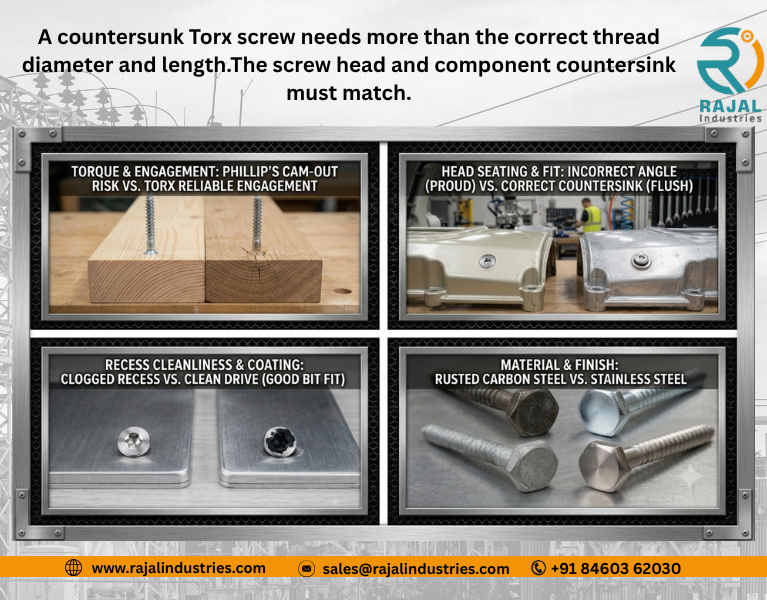
Finding the right Countersunk Torx Screw Manufacturer is important when an assembly needs a flush screw head, controlled dimensions and reliable drive engagement.
Countersunk Torx screws combine two useful design features:
Countersunk Head + Internal Torx Drive
The countersunk head is designed to sit flush or nearly flush with the mating surface when installed into a correctly designed countersink.
The Torx-style internal drive provides multiple points of tool engagement and is widely used where controlled and repeatable assembly is important.
These screws can be used in suitable:
- Automotive assemblies
- Electronics
- Electrical equipment
- Industrial machinery
- Appliances
- Enclosures
- Panels
- Equipment housings
- OEM assemblies
For industrial buyers, however, specifying only:
“Countersunk Torx Screw”
is usually not enough.
The complete requirement should define:
Thread → Diameter → Length → Head Geometry → Drive → Material → Mechanical Requirement → Finish → Quantity
Rajal Industries can evaluate bulk and drawing-based countersunk Torx screw requirements for industrial and OEM applications, subject to manufacturing feasibility and customer specifications.
What Is a Countersunk Torx Screw?
A countersunk Torx screw is a threaded fastener combining:
Countersunk Head
The head has an angled underside designed to fit into a matching countersunk recess.
Internal Torx Drive
The head contains a six-lobed internal drive profile for engagement with a matching driver.
Threaded Body
Depending on the screw type and specification, the thread is designed to engage with:
- Tapped hole
- Nut
- Threaded insert
- Other approved mating thread
The exact product geometry depends on the applicable standard or customer drawing.
Quick Answer: What Is a Countersunk Torx Screw Used For?
A countersunk Torx screw is used where an assembly requires a low-profile or flush finished surface together with a positive internal drive.
Common applications can include:
Automotive Components → Electronics → Electrical Equipment → Industrial Machinery → Appliances → Panels → Enclosures → OEM Assemblies
The actual screw should be selected according to the mating component, thread, load, material and assembly requirements.
Why Use a Countersunk Head?
A countersunk head can sit within a matching countersunk recess.
This is useful where:
- A projecting screw head is undesirable
- Surface clearance is limited
- Components move across the surface
- Appearance matters
- A flush assembly is required
- Product packaging space is limited
The countersink in the mating component must match the specified screw-head geometry.
Why Use a Torx Drive?
Torx drives are used in many industrial assemblies because the drive geometry can provide good tool engagement when the screw and driver are correctly matched.
Potential benefits include:
- Positive driver engagement
- Suitable torque transfer
- Reduced tendency for driver slip compared with some traditional drive forms
- Suitability for powered assembly
- Repeatable installation
- Compact internal drive geometry
Actual assembly performance depends on:
Drive Quality + Correct Bit + Tool Alignment + Installation Settings + Screw Material
The drive should therefore be treated as an engineered feature, not simply a visual head detail.
Countersunk Torx Screw vs Phillips Countersunk Screw
| Feature | Countersunk Torx Screw | Phillips Countersunk Screw |
| Head Style | Countersunk | Countersunk |
| Drive | Six-lobe internal | Cross recess |
| Tool Engagement | Torx-type bit | Phillips bit |
| Powered Assembly | Commonly suitable | Commonly used |
| Drive Selection | Application dependent | Application dependent |
| Flush Installation | Yes, with correct countersink | Yes, with correct countersink |
Neither drive is automatically better for every application.
The OEM should select the drive according to its assembly process and product requirements.
Countersunk Torx Screw vs Socket Countersunk Screw
Both products can provide a countersunk head but use different drive geometries.
| Feature | Torx Countersunk | Hex Socket Countersunk |
| Drive | Six-lobe | Internal hex |
| Driver | Torx-type | Hex key/bit |
| Head | Countersunk | Countersunk |
| Flush Installation | Possible | Possible |
| Assembly Tooling | Torx tooling | Hex tooling |
| Selection | OEM requirement | OEM requirement |
A customer drawing should clearly identify the required drive.
Countersunk Torx Screw vs Standard Torx Screw
The difference is mainly the head geometry.
A standard Torx-driven screw may use:
- Pan head
- Button head
- Cylindrical head
- Flange head
- Other head forms
A countersunk Torx screw specifically uses a countersunk head.
Therefore:
Torx = Drive Type
Countersunk = Head Type
These terms describe different parts of the screw.
Why Countersunk Torx Screws Are Used by OEMs
OEM assembly lines often need fasteners that provide:
- Repeatable dimensions
- Correct drive fit
- Consistent head geometry
- Controlled threads
- Reliable finish
- Assembly compatibility
- Batch consistency
This makes precision screws important even when the individual fastener is small.
A minor dimensional problem can cause:
- Bit engagement problems
- Screw sitting above the surface
- Threading difficulty
- Assembly stoppage
- Cosmetic rejection
- Rework
For high-volume production, consistency can matter as much as unit price.
Countersunk Torx Screws for Automotive OEMs
Automotive and auto-component manufacturers can use countersunk Torx screws in suitable assemblies such as:
- Interior components
- Brackets
- Housings
- Covers
- Trim-related assemblies
- Electronic modules
- Equipment components
- Secondary mechanical assemblies
The exact fastener requirement depends on the component design.
Automotive buyers may require controls for:
- Material
- Mechanical properties
- Dimensions
- Drive geometry
- Surface finish
- Corrosion performance
- Traceability
- Documentation
These should be defined in the RFQ and drawing.
Countersunk Torx Screws for Automotive Interior Components
Interior assemblies can benefit from a flush or low-profile head where the design requires a smooth finished surface.
Potential applications may include:
- Trim components
- Brackets
- Mounting hardware
- Covers
- Interior equipment
- Access components
Appearance can be important in visible areas.
Therefore, buyers may need tighter control over:
- Head surface
- Countersunk geometry
- Plating appearance
- Drive condition
- Burrs
- Handling marks
Countersunk Torx Screws for Automotive Electronic Components
Modern vehicles contain many electronic modules and supporting components.
Suitable screw applications may include:
- Electronic housings
- Control-unit enclosures
- Mounting brackets
- Covers
- Equipment housings
Fastener requirements may include:
Small Size + Controlled Head + Accurate Drive + Consistent Thread + Defined Finish
For automated or semi-automated assembly, dimensional consistency becomes particularly important.
Countersunk Torx Screws for EV Components
Electric vehicles create demand for many types of precision fasteners.
Depending on the approved assembly design, countersunk Torx screws may be considered for suitable:
- Electronic housings
- Control systems
- Brackets
- Covers
- Auxiliary components
- Interior assemblies
However, not every EV component should use the same fastener.
Battery, structural and safety-critical assemblies may have specific engineering and qualification requirements.
The OEM drawing should always control the final specification.
Countersunk Torx Screws for Electronics
Electronics manufacturers can require small precision screws for:
- Housings
- Covers
- Chassis
- Equipment enclosures
- Mounting plates
- Internal brackets
- Control equipment
Important characteristics may include:
- Small diameter
- Accurate thread
- Consistent countersunk head
- Accurate Torx recess
- Clean surface
- Controlled plating
- Cosmetic appearance
Why Small Precision Screws Need Tight Control
Smaller screws provide less room for dimensional variation.
Problems can include:
- Driver does not enter
- Driver fits loosely
- Recess strips
- Screw head sits proud
- Thread does not start properly
- Screw jams in tapped hole
- Head damages during installation
Therefore, OEM screws should be evaluated as functional components rather than simple commodity hardware.
Countersunk Torx Screws for Electrical Equipment
Suitable electrical applications can include:
- Electrical panels
- Switchgear components
- Control equipment
- Enclosures
- Covers
- Mounting assemblies
- Instrumentation
The exact fastener depends on the product design.
Where electrical requirements are involved, material and surface finish should also match the OEM specification.
Countersunk Torx Screws for Industrial Machinery
Industrial machinery can use countersunk Torx screws where the design requires a flush surface.
Potential applications include:
- Machine covers
- Guards
- Plates
- Equipment housings
- Access panels
- Brackets
- Instrumentation
- Mechanical subassemblies
A flush head can be useful where a protruding bolt or screw head could interfere with:
- Moving components
- Sliding parts
- Covers
- Guards
- Operator access
Countersunk Torx Screws for Industrial Automation
Automation equipment may use precision screws in:
- Sensor brackets
- Machine covers
- Control units
- Robotic equipment
- Fixtures
- Instrumentation
- Electronic enclosures
For repetitive assembly, buyers should consider:
- Drive consistency
- Tool compatibility
- Thread quality
- Installation torque
- Surface finish
- Screw feeding, where applicable
If screws are used with automated feeders, the assembly process should be discussed with the manufacturer.
Countersunk Torx Screws for Appliances
Home and commercial appliance manufacturers can use countersunk Torx screws in suitable:
- Housings
- Covers
- Frames
- Panels
- Internal brackets
- Equipment assemblies
High-volume appliance production may require:
- Stable dimensions
- Reliable drive geometry
- Consistent finish
- Bulk production
- Controlled packaging
Fastener quality should remain consistent from batch to batch.
Countersunk Torx Screws for Electronics Enclosures
An enclosure may require the screw head to remain flush with the outer surface.
A typical connection can be:
Countersunk Torx Head → Enclosure Panel → Tapped Component / Insert / Nut
Important checks include:
- Panel thickness
- Countersink geometry
- Head diameter
- Head angle
- Screw length
- Thread engagement
- Driver access
The countersink and screw head should be designed as a matching pair.
Countersunk Torx Screws for Sheet Metal Assemblies
Countersunk Torx screws may be used in suitable sheet-metal assemblies, but the actual screw type matters.
Depending on the design, the screw may engage:
- A nut
- A threaded insert
- A tapped component
- Another specified mating feature
Do not assume that every countersunk Torx screw is a self-tapping screw.
The thread type should be clearly specified.
Countersunk Torx Screws for Equipment Panels
Panels can require flush fasteners where:
- Space is limited
- Appearance matters
- A smooth external surface is needed
- Equipment must slide near the panel
- Protruding heads are undesirable
Applications may include:
- Industrial cabinets
- Machinery panels
- Electrical enclosures
- Equipment covers
- Access panels
Countersunk Torx Screws for Consumer Products
Some consumer and professional products use Torx-driven fasteners because the manufacturer wants a defined assembly tool and compact drive system.
Potential uses can include:
- Equipment housings
- Devices
- Tools
- Appliances
- Electronic products
For visible components, surface appearance may become an additional acceptance requirement.
Countersunk Torx Screws for OEM Production
For an OEM, the screw specification should ideally define:
- Thread standard
- Nominal diameter
- Pitch
- Length
- Head diameter
- Head height
- Countersunk angle
- Torx drive size
- Recess geometry
- Material
- Mechanical properties
- Surface finish
- Coating requirement
- Inspection
- Packaging
This reduces ambiguity between the buyer and Torx screw supplier.
Standard vs Custom Countersunk Torx Screws
Standard Screws
A standard screw can be suitable where an established specification matches the assembly.
Benefits can include:
- Easier sourcing
- Established dimensions
- Lower development requirement
- Easier supplier comparison
Custom Screws
Custom OEM screws may be required when the assembly needs:
- Special head diameter
- Modified head height
- Special Torx recess
- Non-standard length
- Special thread
- Custom point
- Special material
- Special finish
- Customer marking
- Application-specific geometry
Custom requirements should always be controlled by an approved drawing.
Drawing-Based Countersunk Torx Screws
For OEM projects, drawings are especially useful when head and drive geometry are critical.
The drawing can define:
Thread + Head + Countersink + Torx Recess + Material + Finish + Tolerances
This gives the manufacturer a clear basis for:
- Tooling
- Production
- Inspection
- Sample approval
- Mass production
Countersunk Head Geometry
The countersunk head is not simply a flat head.
Important dimensions can include:
- Head diameter
- Head height
- Head angle
- Transition geometry
- Recess position
If the head geometry does not match the mating countersink, the installed screw may:
- Sit above the surface
- Sit too deeply
- Contact incorrectly
- Create poor appearance
- Concentrate load incorrectly
For precision OEM applications, head geometry should be inspected against the drawing or applicable standard.
Why Countersunk Angle Matters
The mating component and screw head should use compatible countersunk geometry.
Do not assume every countersunk screw has the same angle.
The applicable product standard or customer drawing should define the required head angle.
This is particularly important when replacing an existing imported screw.
A screw with the same:
Diameter + Pitch + Length
can still fail the assembly if the countersunk head geometry is different.
Torx Drive Size Selection
The Torx recess must match the intended driver.
The required drive size depends on the screw design and applicable specification.
Buyers should not define the product simply as:
“M4 Torx Screw”
Instead specify the actual:
- Thread size
- Head design
- Drive designation
- Material
- Finish
For custom parts, include recess dimensions or the applicable drive standard in the drawing.
Why Torx Recess Quality Matters
Poor recess geometry can cause:
- Loose driver fit
- Driver not entering fully
- Slipping
- Recess damage
- Inconsistent installation
- Assembly-line rejection
For high-volume OEM applications, the drive should be checked functionally with the approved bit.
This is one reason why selecting a capable Countersunk Torx Screw Manufacturer matters for precision applications.
Thread Selection
Countersunk Torx describes the:
Head + Drive
It does not completely define the thread.
Depending on the product, thread requirements can include:
- Metric machine thread
- Fine thread
- Coarse thread
- Application-specific thread
- Self-tapping geometry
- Other OEM-defined forms
Never assume the thread from the head style.
Metric Countersunk Torx Screws
Metric machine-thread versions can be used in suitable industrial and OEM assemblies.
The requirement should identify:
Nominal Diameter × Pitch × Length
For example, simply writing an M4 screw without specifying the required pitch can create ambiguity where more than one pitch is possible.
The approved drawing or standard should control the final dimensions.
Selecting Screw Length
Length should match:
- Component thickness
- Countersunk seating
- Washer or intermediate component, if applicable
- Thread engagement
- Available internal clearance
Too short can create insufficient engagement.
Too long can cause:
- Bottoming
- Interference
- Contact with internal components
- Assembly damage
For electronics and compact equipment, even a small length error can create problems.
Carbon Steel Countersunk Torx Screws
Carbon steel may be used for many industrial OEM screws where suitable mechanical properties and surface protection are specified.
Possible finishes can include:
- Zinc plating
- Black finish
- Other customer-specified coatings
The exact material and finish should follow the customer requirement.
Avoid defining the product only as “MS Torx screw” when controlled mechanical properties are required.
Stainless Steel Countersunk Torx Screws
Stainless steel can be considered where corrosion resistance, appearance or application requirements call for it.
Common commercial requirements may include:
- SS304 / A2-type
- SS316 / A4-type
The exact grade should be defined rather than simply stating:
“Stainless steel.”
Material selection should consider both environment and mechanical requirements.
Countersunk Torx Screw Surface Finishes
Depending on the material and OEM specification, finishes can include:
- Zinc-plated
- Black finish
- Passivated stainless steel
- Other engineered coatings
The coating can influence:
- Corrosion resistance
- Appearance
- Friction
- Assembly behaviour
- Dimensions
For controlled torque applications, coating and lubrication conditions can also affect assembly behaviour.
Why Finish Consistency Matters for OEM Screws
High-volume OEM customers may require consistent appearance and assembly performance across multiple batches.
Problems can include:
- Colour variation
- Uneven coating
- Excess coating in recess
- Thread coating buildup
- Surface damage
- Corrosion spots
Therefore, finish inspection should cover both functional and visual requirements where specified.
Precision Requirements for Countersunk Torx Screws
The word precision screws should mean controlled characteristics, not simply small size.
Important characteristics can include:
| Feature | Why It Matters |
| Thread Diameter | Mating-thread fit |
| Pitch | Assembly compatibility |
| Length | Engagement / clearance |
| Head Diameter | Countersink fit |
| Head Height | Flush seating |
| Head Angle | Mating geometry |
| Torx Recess | Driver engagement |
| Material | Mechanical requirement |
| Finish | Corrosion / appearance |
| Straightness | Assembly |
| Burr Control | Fit and handling |
The actual tolerances should come from the applicable standard or approved drawing.
Countersunk Torx Screw Quality Problems OEMs Should Avoid
Common problems can include:
- Incorrect head angle
- Oversized head
- Undersized head
- Incorrect recess
- Shallow Torx drive
- Damaged drive
- Thread damage
- Burrs
- Incorrect length
- Plating buildup
- Poor surface appearance
- Batch-to-batch dimensional variation
These problems can affect assembly even when the screw appears visually acceptable.
Bulk Production Requirements
For bulk OEM supply, buyers should consider more than sample quality.
Ask whether the manufacturer can maintain:
- Dimensional consistency
- Tooling condition
- Drive geometry
- Thread quality
- Material control
- Coating consistency
- Lot identification
- Production capacity
- Inspection frequency
A good sample is useful, but mass-production control is equally important.
Sample Approval for OEM Projects
For a new custom requirement, a practical process is:
Drawing Review → Technical Feasibility → Tooling if Required → Samples → Dimensional Inspection → Functional Assembly Trial → Customer Approval → Bulk Production
For automotive, electronics and other controlled OEM projects, additional approval documentation may be required according to the customer’s quality system.
What Should Buyers Check on Samples?
Before approving a custom countersunk Torx screw, check:
☐ Thread size
☐ Pitch
☐ Length
☐ Head diameter
☐ Head height
☐ Head angle
☐ Torx drive
☐ Driver fit
☐ Material
☐ Surface finish
☐ Burrs
☐ Thread fit
☐ Flush seating
☐ Assembly performance
The most useful test is often to install the sample into the actual production assembly.
Functional Assembly Trial
A dimensional inspection can show whether the screw matches the drawing.
A functional trial can show whether it works in the assembly.
Use the actual or representative:
Component + Countersink + Mating Thread + Torx Bit + Assembly Tool
Check:
- Driver engagement
- Thread starting
- Seating
- Flushness
- Tool access
- Installation behaviour
- Final appearance
This is especially useful before releasing a large OEM order.
What Information Should You Send to a Countersunk Torx Screw Manufacturer?
For faster technical review and accurate quotation, provide:
- Drawing
- Applicable standard
- Thread diameter
- Pitch
- Length
- Head dimensions
- Head angle
- Torx drive requirement
- Material
- Mechanical properties
- Surface finish
- Coating requirement
- Required testing
- Sample quantity
- Bulk quantity
- Annual requirement
- Packaging
- Delivery schedule
For replacement or localization projects, an existing approved sample can also be useful together with the drawing.
Countersunk Torx Screw RFQ Example
We require countersunk Torx screws for an OEM assembly. Please review the attached drawing and confirm whether you can manufacture the specified thread, countersunk head geometry and Torx recess. Please quote for the required material, finish and quantity and confirm sample lead time, testing capability and bulk production capacity.
This gives the supplier much more useful information than:
“Please quote M4 Torx screws.”
Why Rajal Industries for Countersunk Torx Screws?
Rajal Industries can evaluate bulk and drawing-based countersunk Torx screw requirements for suitable:
- Automotive Components
- Electronics
- Electrical Equipment
- Industrial Machinery
- Appliances
- Equipment Enclosures
- Control Systems
- Panels
- OEM Assemblies
- Engineering Applications
Subject to technical feasibility and customer specifications, requirements can be evaluated for:
- Countersunk Torx Screws
- Precision Screws
- OEM Screws
- Metric Threads
- Standard Sizes
- Custom Dimensions
- Custom Head Geometry
- Customer-Specified Torx Drives
- Carbon Steel
- Stainless Steel
- Zinc-Plated Finishes
- Passivated Stainless Steel
- Customer-Specified Coatings
- Drawing-Based Manufacturing
- Dimensional Inspection
- Material Verification
- Mechanical Testing as Specified
- Surface-Finish Inspection
- Batch Traceability
- Bulk Packaging
- Scheduled OEM Supply
Final manufacturing capability should be confirmed against the customer’s approved drawing, dimensions, tolerances, material, mechanical properties, finish, testing requirements and order quantity.
Bulk Buyer Quick Answer
What should I check before buying countersunk Torx screws?
Before placing a bulk order, confirm:
Thread + Diameter + Pitch + Length + Countersunk Head Geometry + Torx Drive + Material + Mechanical Properties + Finish + Quantity
For OEM applications, also check driver fit and flush seating using actual assembly samples.
A capable Countersunk Torx Screw Manufacturer should review the customer’s drawing before confirming custom or precision requirements.
Selecting Countersunk Torx Screws by Application
Different industries can require different controls.
| Application | Important Requirements |
| Automotive | Consistency, drive fit, coating, traceability |
| Automotive Electronics | Small dimensions, clean recess, thread accuracy |
| Electronics | Precision, appearance, assembly fit |
| Electrical Equipment | Material, finish, thread compatibility |
| Industrial Machinery | Strength, seating, reliable installation |
| Appliances | High-volume consistency, finish |
| Enclosures | Flush seating, head geometry |
| Automation Equipment | Drive consistency, repeatable assembly |
| OEM Production | Drawing compliance, batch consistency |
The customer drawing should remain the main reference for production and inspection.
Countersunk Torx Screws for Automotive Production
Automotive fasteners can be produced in very high quantities.
This means a problem affecting only a small percentage of screws can still create a large number of rejected assemblies.
Automotive buyers should pay attention to:
- Thread dimensions
- Screw length
- Head geometry
- Torx recess
- Mechanical properties
- Coating
- Surface appearance
- Lot consistency
- Traceability
- Packaging
Requirements can vary significantly between vehicle components.
The OEM or Tier supplier specification should therefore control the final product.
Automotive OEM Screw Approval
A new OEM screw may need more than a dimensional sample approval.
Depending on the customer’s quality requirements, approval may involve:
Drawing Review → Sample → Dimensional Report → Material Verification → Mechanical Testing → Coating Verification → Assembly Trial → Customer Approval
Some automotive customers may also require their own supplier approval or production-part approval process.
The exact documentation should be agreed before production.
Countersunk Torx Screws for Electronics
Electronics applications often use relatively small screws.
At small sizes, minor dimensional variation can become important.
Buyers should check:
Torx Recess
The correct driver should enter properly and engage consistently.
Head Geometry
The countersunk head should seat correctly in the component.
Thread
The screw should start and engage without damaging the mating thread.
Length
Excessive length can interfere with internal components.
Finish
Visible screws may also have cosmetic requirements.
Why Countersunk Head Fit Matters
A countersunk screw and the mating countersink should work together.
Three basic conditions can occur:
Correct Seating
The head seats as intended within the countersink.
Head Sits Proud
The screw head remains above the intended surface.
Possible causes include:
- Incorrect head diameter
- Incorrect head angle
- Incorrect countersink
- Incomplete tightening
- Burr or interference
Head Sits Too Deep
The head goes below the intended surface.
Possible causes include:
- Oversized countersink
- Incorrect screw-head geometry
- Component variation
For precision assemblies, flushness may need a defined acceptance requirement.
Countersunk Angle Must Match the Assembly
Do not assume all countersunk screws use the same head angle.
The required angle should come from:
- Applicable product standard
- OEM drawing
- Existing approved component specification
This matters especially when localizing an imported screw.
A supplier may manufacture the correct:
Diameter + Pitch + Length
but the screw can still fail the assembly because the head geometry is different.
Torx Drive Quality for OEM Production
The Torx recess is one of the most important functional characteristics of the screw.
A good recess should provide reliable engagement with the specified driver.
Problems can occur if the recess is:
- Too shallow
- Too deep
- Poorly formed
- Off-center
- Damaged
- Filled with coating
- Incorrectly sized
For high-volume production, the drive should be checked both dimensionally and functionally where required.
Torx Bit Fit Test
A simple functional check can be made using the approved driver bit.
The bit should:
- Enter correctly
- Engage properly
- Remain reasonably stable during installation
- Transfer the required installation torque without abnormal slipping
A bit-fit test can help detect problems that may not be obvious during visual inspection.
However, the customer’s specified gauges or inspection methods should take priority where defined.
Why Drive Consistency Matters in Automated Assembly
A manual operator may sometimes compensate for small fastener variations.
Automated equipment usually has less tolerance for inconsistent screws.
Problems can include:
- Driver engagement failure
- Screw dropping
- Misalignment
- Installation stoppage
- Recess damage
- Incomplete tightening
- Cycle-time loss
For automation applications, the Torx Screw Supplier should know that the screw will be used in automated or semi-automated production.
Countersunk Torx Screws for Robotic Assembly
Where screws are installed automatically, buyers may need to evaluate:
- Screw orientation
- Head consistency
- Recess consistency
- Driver engagement
- Thread starting
- Screw feeding
- Installation settings
- Final seating
Packaging can also matter if screws are supplied to automated feeding equipment.
The complete assembly process should be considered during sample trials.
Thread Accuracy for Precision Screws
The thread must correctly engage the mating component.
Potential thread problems include:
- Incorrect pitch
- Oversized thread
- Undersized thread
- Damaged thread
- Burrs
- Poor thread form
- Coating buildup
For precision screws, thread inspection should follow the applicable drawing or standard.
Thread Fit Should Be Checked With the Actual Assembly
A screw can pass a basic visual inspection but still create assembly problems.
Where practical, test the screw with:
- Actual tapped component
- Production nut
- Threaded insert
- Representative mating part
This helps identify functional fit problems before bulk production.
Countersunk Torx Screws With Threaded Inserts
Electronics, plastic assemblies and equipment housings may use threaded inserts.
A typical connection can be:
Countersunk Torx Screw → Component → Threaded Insert
Important checks include:
- Thread diameter
- Pitch
- Screw length
- Insert thread
- Available depth
- Head seating
- Installation requirement
A screw that is too long may bottom out before the head seats correctly.
Countersunk Torx Screws for Plastic Assemblies
The phrase “Torx screw for plastic” can describe several different fastener designs.
A countersunk Torx machine screw may be used with:
- Threaded insert
- Nut
- Other designed mating thread
Other applications may require a screw specifically designed to form or cut threads in plastic.
These products should not be treated as interchangeable.
The thread design must match the application.
Countersunk Torx Screws for Thin Sheet Assemblies
Thin sheet can create challenges for countersunk heads because the available material thickness may be limited.
The designer should consider:
- Sheet thickness
- Countersink depth
- Head dimensions
- Mating thread
- Structural requirement
Do not assume that every sheet can accept a full countersink without affecting the component.
The component drawing should define the required geometry.
Countersunk Torx Screw Material Selection
Material should be selected according to:
Mechanical Requirement + Environment + Manufacturing Requirement + Customer Specification
Possible materials can include suitable:
- Carbon steels
- Stainless steels
- Other customer-specified materials
Avoid specifying only:
“Steel”
for a controlled OEM requirement.
Carbon Steel for OEM Screws
Carbon steel can provide a practical option for many industrial applications.
The customer should define required:
- Material specification
- Mechanical properties
- Heat treatment, where applicable
- Surface coating
- Corrosion requirement
A manufacturer should not assume a mechanical grade from the product name alone.
Stainless Steel for Precision Screws
Stainless steel may be selected for:
- Corrosion resistance
- Appearance
- Environmental requirements
- Product-specific needs
Common commercial requirements may include:
- SS304 / A2-type
- SS316 / A4-type
The exact grade and required mechanical condition should be specified.
Surface Finish Selection
Possible finishes depend on the material and customer specification.
Examples can include:
- Zinc plating
- Black finishes
- Passivation for suitable stainless steel
- Customer-specific coatings
The coating can affect more than appearance.
It can influence:
- Corrosion performance
- Friction
- Thread fit
- Drive recess
- Assembly behaviour
For controlled installation processes, coating consistency can therefore matter.
Coating Inside the Torx Recess
Excessive coating inside a small Torx recess can interfere with driver engagement.
Possible problems include:
- Bit does not enter fully
- Tight bit fit
- Poor torque transfer
- Recess damage
This is especially important for smaller precision screws.
The finishing process should therefore be controlled so the functional drive remains usable.
Coating on Threads
Excessive coating buildup on threads can affect:
- Thread fit
- Installation torque
- Mating component
- Assembly consistency
Thread dimensions and coating should be considered together.
For high-volume OEM applications, functional thread checks after coating can be valuable.
Torque Requirements for Countersunk Torx Screws
There is no universal installation torque based only on screw diameter.
Torque can depend on:
- Screw material
- Mechanical properties
- Thread
- Mating material
- Coating
- Lubrication
- Joint design
- Assembly requirement
The OEM should define the installation process where torque control is important.
Do not copy a generic torque value into a production line without engineering review.
Why Torque-Tension Behaviour Matters
Installation torque is not the same as clamp load.
Friction can consume a significant part of the applied torque.
Changes in:
- Coating
- Lubrication
- Surface condition
- Mating thread
can change assembly behaviour.
For critical applications, the customer should define the required installation and validation method.
Common Countersunk Torx Screw Failures
1. Torx Bit Does Not Fit
Possible causes:
- Incorrect drive size
- Poor recess geometry
- Coating buildup
- Damaged recess
- Incorrect bit
First Check
Approved Bit + Recess + Coating
2. Torx Recess Strips During Installation
Possible causes include:
- Incorrect driver
- Poor driver engagement
- Misalignment
- Excessive installation torque
- Incorrect recess geometry
- Material issue
Do not automatically assume the drive design itself is unsuitable.
3. Screw Head Does Not Sit Flush
Possible causes:
- Incorrect head angle
- Incorrect head diameter
- Wrong countersink
- Burrs
- Component variation
- Incomplete seating
First Check
Screw Head Drawing + Component Countersink
4. Screw Sits Too Deep
Possible causes:
- Oversized countersink
- Incorrect head geometry
- Component variation
- Incorrect screw specification
This can create cosmetic or functional problems.
5. Screw Does Not Enter the Thread
Possible causes include:
- Wrong pitch
- Damaged thread
- Coating buildup
- Cross-threading
- Mating-thread issue
Check both the screw and mating component.
6. Screw Breaks During Assembly
Possible causes can include:
- Excessive torque
- Incorrect material
- Heat-treatment issue
- Mating-thread problem
- Misalignment
- Manufacturing defect
A proper failure analysis should separate installation problems from fastener defects.
7. Head Breakage
Countersunk head geometry creates a different head-to-shank transition than some other screw styles.
If a failure occurs, review:
- Material
- Manufacturing process
- Head geometry
- Installation torque
- Joint design
- Failure location
Do not increase hardness or strength without understanding the original cause.
8. Early Corrosion
Possible causes:
- Incorrect material
- Wrong coating
- Coating damage
- Insufficient corrosion protection
- Aggressive environment
- Storage conditions
Corrosion requirements should be specified before production.
9. Cosmetic Rejection
Visible screws may be rejected for:
- Scratches
- Plating variation
- Head marks
- Burrs
- Surface defects
- Colour variation
If appearance matters, cosmetic acceptance criteria should be agreed before bulk production.
10. Assembly-Line Jamming
Possible fastener-related causes can include:
- Dimensional variation
- Damaged threads
- Inconsistent heads
- Recess problems
- Packaging contamination
- Feeding issues
For automated production, evaluate the fastener together with the actual feeding and installation system.
Troubleshooting Table
| Problem | Possible Cause | First Check |
| Bit Won’t Fit | Recess / coating | Drive inspection |
| Recess Stripping | Tool / torque / geometry | Bit + installation |
| Head Sits Proud | Head / countersink mismatch | Assembly geometry |
| Head Too Deep | Countersink variation | Component + screw |
| Thread Jamming | Pitch / coating / damage | Thread fit |
| Screw Breakage | Torque / material | Assembly + fastener |
| Corrosion | Finish / environment | Specification |
| Cosmetic Rejection | Surface condition | Visual criteria |
| Line Stoppage | Variation / feeding | Production trial |
Common OEM Purchasing Mistakes
Mistake 1: Ordering Only by M Size
“M4 Torx screw” does not fully define the product.
Mistake 2: Ignoring Head Angle
The screw may not seat correctly.
Mistake 3: Not Specifying Torx Drive
Drive geometry should be defined.
Mistake 4: Ignoring Screw Length Definition
Always follow the applicable standard or drawing for how length is specified and measured.
Mistake 5: Saying Only “SS”
Specify the stainless grade.
Mistake 6: Saying Only “Zinc”
Specify the required coating system where controlled performance matters.
Mistake 7: Not Testing the Production Bit
Driver compatibility should be checked.
Mistake 8: Approving Only by Visual Inspection
A screw can look correct but fail during assembly.
Mistake 9: Skipping Sample Assembly
Fit and seating should be checked before bulk approval.
Mistake 10: Comparing Suppliers Only by Price
First confirm that all suppliers are quoting the same technical requirement.
Localization of Imported Countersunk Torx Screws
Many OEMs may want to localize an existing imported fastener.
A good localization process is:
Existing Drawing + Approved Sample → Technical Review → Material Confirmation → Dimensional Study → Tooling → Prototype → Inspection → Functional Trial → Approval → Production
Do not rely only on reverse engineering an old physical sample where an approved drawing is available.
Samples can experience:
- Wear
- Coating variation
- Damage
- Manufacturing variation
The approved specification should remain the primary reference.
Custom Countersunk Torx Screw Development
Custom development may be required for:
- Modified head diameter
- Reduced head height
- Special countersunk geometry
- Special Torx recess
- Non-standard thread
- Special length
- Custom point
- Special material
- Special coating
- Customer marking
Custom OEM screws should be controlled through a drawing revision system.
Custom Tooling
Special screw geometry may require dedicated:
- Heading tooling
- Recess tooling
- Threading tooling
- Inspection gauges
Before placing a custom order, confirm:
- Tooling cost
- Tooling ownership
- Tool life
- Replacement responsibility
- Sample lead time
- Production lead time
These points can become important for long-term OEM programs.
Sample Approval Process for Custom Screws
A practical process is:
1. Drawing Review
Manufacturer checks technical feasibility.
2. Tooling
Required tooling is developed or arranged.
3. Sample Production
Initial pieces are manufactured.
4. Dimensional Inspection
Critical dimensions are checked.
5. Material & Finish Verification
Specified material and surface requirements are reviewed.
6. Functional Assembly
Customer checks the screw in the actual assembly.
7. Approval
Approved sample and drawing become production references.
8. Bulk Production
Mass production starts against approved requirements.
Quality Control for Countersunk Torx Screws
A typical control flow can include:
Raw Material → Heading → Torx Recess Forming → Threading → Heat Treatment if Required → Surface Finish → Inspection → Testing → Packing
The exact manufacturing sequence can vary depending on:
- Material
- Screw design
- Manufacturing method
- Customer specification
Critical Dimensions to Inspect
For countersunk Torx precision screws, inspection may include:
| Characteristic | Why It Matters |
| Thread Diameter | Mating fit |
| Pitch | Thread compatibility |
| Overall Length | Engagement |
| Head Diameter | Countersink fit |
| Head Height | Flushness |
| Head Angle | Seating |
| Torx Recess | Driver engagement |
| Recess Depth | Bit fit |
| Concentricity | Assembly |
| Thread Condition | Installation |
| Surface Finish | Corrosion / appearance |
The customer drawing should identify critical characteristics where required.
Functional Inspection
Dimensional measurement should be supported by functional checks where useful.
These may include:
- Torx bit fit
- Thread gauge
- Mating-component trial
- Head seating
- Assembly test
For OEM applications, functional inspection can be particularly useful because the final requirement is successful assembly.
100% Inspection vs Sampling Inspection
Not every characteristic needs 100% inspection.
The inspection plan should depend on:
- Criticality
- Customer specification
- Production process
- Historical capability
- Risk
Some characteristics may use statistical sampling, while certain critical or customer-defined features may require more extensive inspection.
The inspection plan should be agreed rather than assumed.
Batch Traceability
OEM buyers may require finished screws to be traceable to:
- Raw material
- Production batch
- Heat treatment, where applicable
- Surface treatment
- Inspection
- Testing
Traceability requirements should be defined before production and reflected in packaging or documentation where required.
Packaging for Precision OEM Screws
Packaging should protect the product from:
- Moisture
- Mixing
- Surface damage
- Thread damage
- Contamination
- Loss of traceability
For automated assembly, buyers may also have specific packaging or feeding requirements.
Possible requirements can include:
- Defined quantity per box
- Lot labels
- Barcode labels
- Batch numbers
- Customer part numbers
- Special internal packing
How to Evaluate a Countersunk Torx Screw Manufacturer
A serious OEM buyer should evaluate more than the quoted price.
Check:
- Is the company actually manufacturing the screw?
- Can it produce the required Torx recess accurately?
- Can it control countersunk head geometry?
- Can it manufacture the required thread?
- Can it maintain tolerances?
- Can it process the required material?
- Can it provide the required finish?
- Can it inspect the drive?
- Can it inspect threads?
- Can it provide material reports?
- Can it support mechanical testing?
- Can it provide coating reports?
- Can it support traceability?
- Can it develop custom tooling?
- Can it provide samples?
- Can it support the required monthly volume?
- Can it maintain batch consistency?
- Can it meet the delivery schedule?
This is more useful than simply searching for the cheapest Torx Screw Supplier.
Supplier Comparison Table
| Requirement | Supplier A | Supplier B | Supplier C |
| Manufacturer | |||
| Torx Capability | |||
| Countersunk Head Control | |||
| Custom Drawing | |||
| Material Options | |||
| Coating Options | |||
| Thread Inspection | |||
| Drive Inspection | |||
| Functional Testing | |||
| Traceability | |||
| Samples | |||
| Tooling Support | |||
| MOQ | |||
| Monthly Capacity | |||
| Lead Time | |||
| Price |
Compare price after technical equivalence is confirmed.
Questions to Ask a Torx Screw Supplier
- Do you manufacture countersunk Torx screws in-house?
- Which screw sizes can you manufacture?
- Which Torx drive sizes can you produce?
- Can you manufacture according to our drawing?
- Can you control custom head dimensions?
- Can you manufacture custom head angles?
- Which materials can you offer?
- Which mechanical grades can you support?
- Which surface finishes are available?
- Can you manufacture stainless steel screws?
- How do you inspect the Torx recess?
- Can you perform functional bit-fit inspection?
- How are threads inspected?
- Can you provide dimensional reports?
- Can you provide material certificates?
- Which mechanical tests are available?
- Can you provide coating-thickness reports?
- Is batch traceability available?
- Can you develop dedicated tooling?
- Can you provide samples before mass production?
- What is your MOQ?
- What is your monthly capacity?
- What is the sample lead time?
- What is the production lead time?
- Can you support scheduled OEM deliveries?
OEM RFQ Checklist
Before requesting a quotation, send:
☐ Product drawing
☐ Customer part number
☐ Applicable standard
☐ Thread diameter
☐ Thread pitch
☐ Screw length
☐ Head diameter
☐ Head height
☐ Countersunk angle
☐ Torx drive requirement
☐ Material
☐ Mechanical properties
☐ Heat-treatment requirement
☐ Surface finish
☐ Coating requirement
☐ Corrosion requirement
☐ Dimensional tolerances
☐ Testing requirements
☐ Documentation requirements
☐ Sample quantity
☐ Bulk quantity
☐ Annual quantity
☐ Packaging requirement
☐ Delivery schedule
Example RFQ for Countersunk Torx Screws
We require countersunk Torx screws for an industrial OEM application. Please review the attached drawing and confirm manufacturing feasibility. Quote for the specified material, finish and quantities, and confirm Torx recess capability, dimensional inspection, sample lead time, MOQ, monthly capacity and bulk production lead time.
If the product is being localized, also mention:
An existing approved sample is available for reference, but production must follow the approved drawing.
Frequently Asked Questions
What is a countersunk Torx screw?
A countersunk Torx screw combines a countersunk head with an internal six-lobe Torx-style drive. It is commonly used where the assembly requires a flush or low-profile surface and positive driver engagement.
Where are countersunk Torx screws used?
They can be used in suitable automotive, electronics, electrical, appliance, machinery, enclosure and industrial OEM assemblies.
Why use Torx instead of Phillips?
Torx drive geometry can provide positive tool engagement and suitable torque transfer when the screw and driver are correctly matched. The best drive still depends on the OEM assembly requirement.
Why is a countersunk head used?
A countersunk head allows the screw to sit flush or nearly flush with the mating surface when installed into a correctly designed countersink.
Are all countersunk screw angles the same?
No. The applicable standard or customer drawing should define the required countersunk geometry.
Can countersunk Torx screws be customized?
Yes, subject to manufacturing feasibility. Custom requirements may include head geometry, thread, length, drive, material, finish and marking.
Can countersunk Torx screws be made in stainless steel?
Yes, suitable designs may be manufactured in specified stainless steel grades such as SS304 or SS316, subject to technical requirements and manufacturing feasibility.
Can countersunk Torx screws be zinc plated?
Carbon steel screws can be supplied with suitable zinc-plated finishes where required by the customer specification.
Are countersunk Torx screws suitable for automated assembly?
They can be suitable for automated or semi-automated assembly. Drive consistency, thread quality, dimensional control and feeding requirements should be verified with the production system.
How should a Torx recess be inspected?
Inspection can include dimensional or gauge-based checks according to the applicable specification, along with functional fit using the approved driver where required.
Why does my Torx bit not fit the screw?
Possible causes include the wrong bit size, incorrect recess geometry, coating buildup, damage or manufacturing variation.
Why does a countersunk screw sit above the surface?
Possible causes include a mismatch in head angle, head diameter or component countersink, as well as burrs or incomplete seating.
What information should I send to a countersunk Torx screw manufacturer?
Send the drawing, thread size, pitch, length, head geometry, Torx drive, material, mechanical requirement, finish, tolerances, testing requirements and quantity.
Can an imported countersunk Torx screw be localized in India?
Potentially yes. The best approach is to provide the approved drawing and reference sample for manufacturing feasibility, tooling, sample development and validation.
Should I approve samples before mass production?
For new or custom OEM requirements, sample inspection and functional assembly approval are strongly recommended before bulk production.
AEO Quick Answers
What is a countersunk Torx screw used for?
A countersunk Torx screw is used where an assembly needs a flush or low-profile screw head with a Torx-style internal drive. Applications can include automotive components, electronics, industrial machinery, appliances, panels and OEM equipment.
How do I select a countersunk Torx screw?
Select the screw according to thread diameter, pitch, length, countersunk head geometry, Torx drive, material, mechanical requirements, finish and mating component. For OEM production, verify the screw using the actual assembly before bulk approval.
What should I send to a countersunk Torx screw manufacturer?
Send an approved drawing showing thread, length, head dimensions, countersunk angle, Torx drive, material, finish and tolerances. Also provide quantity, testing, documentation and packaging requirements.
Why is Torx used in OEM assembly?
Torx drive geometry can provide positive tool engagement and is suitable for many manual, powered and automated assembly processes when the screw, driver and installation settings are correctly matched.
Can countersunk Torx screws be custom manufactured?
Yes. Custom countersunk Torx screws can be evaluated for special dimensions, head geometry, drive, thread, material and finish. Custom production should be based on an approved technical drawing.
Why Rajal Industries for Countersunk Torx Screws?
As a Countersunk Torx Screw Manufacturer, Rajal Industries can evaluate bulk and drawing-based requirements for suitable:
- Automotive Components
- Electronics
- Electrical Equipment
- Industrial Machinery
- Appliances
- Equipment Enclosures
- Automation Equipment
- Panels
- OEM Assemblies
- Engineering Applications
Subject to technical feasibility and customer approval, requirements can be evaluated for:
- Countersunk Torx Screws
- Precision Screws
- OEM Screws
- Metric Threads
- Custom Thread Requirements
- Standard Sizes
- Custom Sizes
- Modified Head Dimensions
- Customer-Specified Torx Drives
- Carbon Steel
- Stainless Steel
- Zinc-Plated Finishes
- Passivated Stainless Steel
- Customer-Specified Coatings
- Drawing-Based Manufacturing
- Dimensional Inspection
- Material Verification
- Mechanical Testing as Specified
- Surface-Finish Inspection
- Functional Fit Checks
- Batch Traceability
- Bulk Packaging
- Scheduled OEM Supply
Final manufacturing capability should always be confirmed against the customer’s approved drawing, dimensions, tolerances, material, mechanical properties, surface finish, testing requirements and order quantity.
Key Takeaways
- A countersunk Torx screw combines a countersunk head with an internal Torx-style drive.
- Head geometry is critical for correct flush seating.
- The countersunk angle must match the mating component.
- Torx recess quality affects driver engagement.
- Thread size alone does not define the complete screw.
- Small precision screws require careful dimensional control.
- Coating buildup can affect both threads and the Torx recess.
- Automotive and electronics OEMs may require traceability and additional documentation.
- Automated assembly requires consistent drive, head and thread geometry.
- A dimensional inspection should be supported by functional assembly checks where appropriate.
- Custom screws should be controlled through approved drawings.
- Imported fasteners can potentially be localized after technical review and validation.
- Samples should be approved before high-volume custom production.
- Supplier comparison should begin with technical compliance, not price alone.
Conclusion
Choosing the right Countersunk Torx Screw Manufacturer is especially important for automotive, electronics and industrial OEM applications where a small dimensional variation can affect the complete assembly.
The most important characteristics are:
Thread → Length → Countersunk Head → Head Angle → Torx Recess → Material → Mechanical Properties → Finish → Functional Fit
For OEM buyers, price per screw is only one part of the purchasing decision.
Consistent head geometry, reliable driver engagement, correct threads, controlled surface finish and repeatable mass production can have a much greater effect on assembly efficiency.
A practical sourcing process is:
Drawing → Manufacturer Review → Tooling if Required → Samples → Inspection → Functional Trial → Approval → Mass Production
Rajal Industries can evaluate standard and custom countersunk Torx screw requirements based on customer drawings, technical specifications and bulk quantities.