

Finding the right coach screw manufacturer is important when fasteners are being purchased for timber structures, industrial construction, utility projects or other high-volume applications.
Coach screws are heavy-duty threaded fasteners commonly designed for fastening into timber and wood-based structural members. They typically combine:
- Hexagonal head
- Partially or fully threaded shank depending on design
- Coarse thread
- Pointed end
They are also commonly referred to as lag screws or, depending on market terminology, lag bolts.
For industrial and project buyers, selecting a coach screw should go beyond diameter and length.
The RFQ may need to define:
Size + Thread Geometry + Head + Material + Mechanical Requirement + Surface Finish + Application + Quantity
Rajal Industries can evaluate bulk and drawing-based coach screw requirements for suitable industrial, construction and OEM applications, subject to technical feasibility and customer specifications.
Quick Answer: What Is a Coach Screw?
A coach screw is a heavy-duty threaded fastener commonly used to secure components to timber or wood.
Unlike a conventional machine bolt that normally works with a nut or tapped thread, a coach screw forms or engages directly with the wood substrate.
Typical applications can include:
- Timber Construction
- Wooden Frames
- Structural Wood Connections
- Utility Structures
- Outdoor Timber Structures
- Industrial Wood Assemblies
- Equipment Mounting to Timber
- Selected Solar and Infrastructure Applications
The correct screw size and installation method depend on the timber, load, joint geometry and project specification.
What Does a Coach Screw Look Like?
A typical coach screw may contain:
Hexagonal Head
Allows installation using a wrench, socket or suitable powered tool.
Unthreaded or Partially Threaded Shank
Depending on the design and standard, part of the shank may remain unthreaded.
Coarse Thread
Designed for engagement with timber or similar suitable materials.
Pointed End
Helps the fastener enter the material during installation.
The exact geometry should follow the applicable standard or customer drawing.
Coach Screw vs Lag Screw: Are They the Same?
The terms coach screw and lag screw are often used for similar heavy-duty wood fasteners.
Terminology can vary between countries and buyers.
For sourcing, do not rely only on the product name.
A buyer should specify:
- Diameter
- Length
- Head dimensions
- Thread length
- Thread geometry
- Material
- Finish
- Applicable standard or drawing
This prevents confusion when requesting quotations from a lag screw supplier or coach screw manufacturer.
Coach Screw vs Lag Bolt
“Coach screw,” “lag screw” and “lag bolt” may sometimes be used interchangeably in commercial searches.
However, a buyer should avoid assuming that every supplier means exactly the same geometry.
For bulk procurement, use a technical drawing or recognized standard.
The drawing should control the manufactured product, not the marketing name.
Why Buyers Search for Coach Screw Manufacturers in India
Project and OEM buyers usually need more than an online catalogue.
They may require:
- Bulk quantities
- Drawing-based sizes
- Different lengths
- Controlled raw material
- Mechanical properties
- Surface coatings
- Corrosion protection
- Dimensional inspection
- Batch traceability
- Project packaging
- Scheduled deliveries
This is why searches such as:
- Coach Screw Manufacturer
- Coach Screw Manufacturer in India
- Lag Screw Supplier
- Coach Screw Supplier
- Timber Screw Manufacturer
- Heavy Duty Wood Screw Manufacturer
often carry stronger commercial intent than a general search such as “what is a coach screw?“
Coach Screw Manufacturer vs Trader
For bulk industrial sourcing, buyers should identify whether the company is:
Manufacturer → Distributor → Stockist → Trader
A manufacturer may be more suitable where the requirement involves:
- Custom dimensions
- Large quantities
- Special materials
- Specific coatings
- Drawing-based manufacturing
- Inspection requirements
- Repeat monthly supply
A stockist or distributor can still be useful where standard products are required quickly in smaller quantities.
The right source depends on the procurement requirement.
What Should You Check in a Coach Screw Manufacturer?
Before sending a bulk order, evaluate:
- Manufacturing capability
- Available diameter range
- Available length range
- Heading capability
- Thread-forming capability
- Material options
- Mechanical-property control
- Surface-finishing capability
- Dimensional inspection
- Testing capability
- Production capacity
- Batch traceability
- Packaging
- Delivery planning
For custom products, the manufacturer should review the drawing before confirming feasibility.
Coach Screw Manufacturing Process
A typical manufacturing route can involve:
Raw Material → Cutting / Forming → Head Formation → Point Formation → Thread Formation → Heat Treatment if Required → Surface Finishing → Inspection → Packing
The exact sequence depends on:
- Size
- Material
- Product geometry
- Required mechanical properties
- Manufacturing process
- Surface finish
For bulk OEM or project supply, process controls should be aligned with the approved specification.
Raw Material Selection
The correct raw material depends on the required:
- Strength
- Formability
- Toughness
- Environment
- Surface finish
- Project specification
Possible material categories may include:
- Carbon Steel
- Alloy Steel for specified requirements
- Stainless Steel
- Customer-Specified Material
The exact grade should be stated in the purchase specification.
Carbon Steel Coach Screws
Carbon steel is commonly considered for general-purpose timber screws and industrial wood fastening.
Depending on the application, carbon steel coach screws can be supplied with protective surface finishes.
Potential applications include:
- Timber Frames
- Wooden Supports
- Industrial Wood Structures
- Construction
- Equipment Mounting
- Utility Work
Material and mechanical requirements should be selected from the actual joint requirement.
Stainless Steel Coach Screws
Stainless steel may be considered where corrosion resistance is important.
Potential applications include:
- Outdoor Timber Structures
- Humid Environments
- Coastal Projects
- Certain Solar Installations
- External Equipment
- Corrosion-Sensitive Assemblies
The stainless steel grade should be specified.
Do not request only “SS coach screw” where material grade matters.
Coach Screw Surface Finishes
Depending on material and application, possible finishes can include:
- Zinc Plating
- Hot-Dip Galvanizing
- Mechanical or project-specific coatings
- Stainless Steel Passivation where specified
- Customer-Specified Finishes
The finish should match the exposure conditions.
For outdoor projects, corrosion protection is especially important.
Zinc-Plated Coach Screws
Zinc plating may be suitable for certain indoor or moderately protected environments, depending on the required corrosion performance.
Buyers should define more than simply:
“Zinc plated”
Where necessary, specify:
- Coating type
- Coating thickness
- Passivation
- Required corrosion performance
This makes supplier quotations easier to compare.
Hot-Dip Galvanized Coach Screws
Hot-dip galvanizing may be considered for suitable outdoor or infrastructure applications where stronger corrosion protection is required.
Potential uses can include:
- Outdoor Timber Construction
- Utility Projects
- Structural Wood Assemblies
- External Equipment
- Infrastructure
However, coating thickness can influence dimensions and thread fit.
The product design and applicable specification should account for the coating.
Coach Screw Sizes
Coach screws are available in many diameters and lengths.
The exact range depends on:
- Standard
- Manufacturer
- Application
- Material
- Production method
A buyer may need to specify dimensions such as:
| Parameter | What to Specify |
| Nominal Diameter | Required screw diameter |
| Overall Length | Required fastening length |
| Thread Length | Full or partial |
| Head Width | Across flats |
| Head Height | Head geometry |
| Shank Diameter | As specified |
| Point | Required geometry |
| Thread | Standard / drawing |
For custom or high-volume requirements, a drawing is recommended.
How to Select Coach Screw Diameter
The diameter should be selected according to:
- Required load
- Timber type
- Timber thickness
- Edge distance
- Joint geometry
- Number of fasteners
- Installation conditions
- Engineering design
Do not select the diameter only from the weight of the component being mounted.
Structural timber connections should follow the applicable engineering design and project requirements.
How to Select Coach Screw Length
Length depends on:
- Thickness of the attached component
- Washer thickness, if used
- Required penetration into timber
- Timber dimensions
- Joint geometry
- Structural design
A screw that is too short may provide insufficient engagement.
A screw that is unnecessarily long may increase:
- Installation effort
- Risk of interference
- Material cost
The correct length should be calculated from the complete joint.
Partially Threaded Coach Screws
Some coach screw designs have an unthreaded shank below the head.
Depending on the joint design, this may help the connected component seat against the timber when tightened.
Important dimensions include:
- Overall length
- Thread length
- Shank length
- Shank diameter
The required geometry should follow the applicable standard or drawing.
Fully Threaded Coach Screws
Certain designs may use a longer or fully threaded section.
Whether this is appropriate depends on:
- Joint design
- Material being fastened
- Required engagement
- Product specification
Do not substitute fully threaded and partially threaded versions without engineering approval.
Coach Screw Head Types
The traditional coach screw commonly uses a hexagonal head.
A hex head allows installation with:
- Spanner
- Wrench
- Socket
- Powered Driver with Suitable Socket
For bulk industrial projects, important head dimensions can include:
- Width across flats
- Head height
- Bearing surface
- Head-to-shank transition
These dimensions should remain consistent across production batches.
Why Hex Head Coach Screws Are Common
Heavy-duty wood fastening can require more installation torque than small general-purpose wood screws.
A hex head provides strong external tool engagement.
This can make it suitable for:
- Construction
- Timber Structures
- Utility Work
- Industrial Assembly
- Outdoor Projects
Installation torque should still be controlled according to the joint.
Coach Screws with Washers
A washer may be used under the coach screw head where the joint requires:
- Larger bearing area
- Load distribution
- Surface protection
- Project-specific joint geometry
The washer should be selected according to:
- Screw diameter
- Head
- Timber
- Connected component
- Load
- Specification
The washer should not be treated as an automatic requirement for every coach screw application.
Coach Screws for Timber Construction
Timber construction is one of the main applications for heavy duty wood screws.
Potential uses can include:
- Timber Frames
- Wooden Beams
- Wooden Supports
- Brackets
- Structural Hardware
- Timber-to-Metal Connections
- Timber-to-Timber Connections
For structural work, screw selection should be based on engineering requirements rather than general hardware practice.
Coach Screws for Timber-to-Metal Connections
A common arrangement can involve:
Metal Bracket → Washer / Screw Head → Coach Screw → Timber
Potential applications include:
- Brackets
- Plates
- Supports
- Mounting Hardware
- Structural Connectors
Important factors include:
- Hole diameter in the metal component
- Screw diameter
- Screw length
- Timber penetration
- Washer
- Edge distance
- Installation method
The connection should be engineered for the required load.
Coach Screws for Timber-to-Timber Connections
Coach screws may also be considered for suitable timber-to-timber joints.
Important factors include:
- Timber species
- Moisture condition
- Grain direction
- Screw diameter
- Penetration
- Edge distance
- Spacing
- Number of screws
Structural applications should follow the applicable design standard and project engineer’s requirements.
Coach Screws for Solar Projects
Coach screws may be used in selected solar applications where equipment or mounting hardware is fixed to a suitable timber substrate.
Potential examples can include:
- Solar Mounting on Timber Structures
- Wooden Support Structures
- Certain Rooftop Mounting Conditions
- Auxiliary Solar Equipment
However, coach screws should not be presented as a universal solar mounting fastener.
Many solar structures use:
- Structural Bolts
- Hex Bolts
- U-Bolts
- Anchor Fasteners
- Threaded Rods
- Self-Drilling Screws
- Specialized Solar Mounting Fasteners
The fastener must match the mounting system and approved engineering design.
What Solar EPC Buyers Should Specify
For a coach screw requirement, solar buyers should provide:
- Application
- Mounting detail
- Substrate
- Diameter
- Length
- Material
- Surface finish
- Washer requirement
- Drawing
- Required testing
- Project quantity
- Delivery schedule
For outdoor solar projects, corrosion exposure should receive special attention.
Coach Screws for Utility Projects
Potential coach screw applications may exist in suitable:
- Timber Poles
- Wooden Supports
- Utility Structures
- Equipment Mounting
- Electrical Infrastructure
- Outdoor Timber Assemblies
The exact fastener depends on the utility specification.
For utility buyers, important requirements can include:
- Material
- Dimensions
- Coating
- Mechanical performance
- Corrosion resistance
- Inspection
- Batch traceability
Coach Screws for Wooden Utility Poles
Where approved by the utility design, coach screws may be used to attach suitable:
- Brackets
- Hardware
- Supports
- Equipment
- Accessories
to timber poles.
However, pole-line fastening requirements can vary significantly between utilities.
The buyer’s specification should control the fastener.
Coach Screws for Industrial Wood Structures
Industrial applications can include:
- Wooden Equipment Bases
- Packaging Structures
- Industrial Timber Frames
- Heavy Wooden Assemblies
- Mounting Hardware
- Wooden Support Systems
For repetitive industrial use, buyers may require:
- Consistent dimensions
- Reliable thread geometry
- Controlled coating
- Bulk packaging
- Repeat delivery schedules
Coach Screws for Outdoor Structures
Outdoor timber structures can expose fasteners to:
- Rain
- Humidity
- Temperature changes
- Chemicals
- Coastal atmosphere
Possible applications include:
- Outdoor Timber Frames
- Equipment Platforms
- Wooden Supports
- Utility Structures
- Industrial Outdoor Assemblies
Material and coating selection should reflect the actual exposure environment.
Coach Screws vs Ordinary Wood Screws
| Feature | Coach Screw | General Wood Screw |
| Typical Construction | Heavy-duty | Light to medium duty |
| Head | Commonly hex | Many head types |
| Diameter | Generally larger | Broad range |
| Tool | Wrench / socket | Driver / screwdriver |
| Typical Application | Heavy timber joints | General wood fastening |
| Installation Torque | Typically higher | Usually lower |
| Bulk Project Use | Common in suitable applications | Application dependent |
This is a general comparison. Modern structural wood screws can differ significantly from ordinary wood screws, so buyers should compare actual specifications rather than product names alone.
Coach Screw vs Structural Wood Screw
Modern structural wood screws can offer different:
- Head designs
- Drive systems
- Thread geometries
- Point designs
- Installation characteristics
A traditional coach screw should therefore not automatically be substituted for a proprietary structural wood screw.
If a project specifies a particular approved fastener, any substitution should receive engineering approval.
Coach Screw vs Machine Bolt
| Feature | Coach Screw | Machine Bolt |
| Typical Engagement | Timber | Nut / tapped thread |
| Thread | Wood-engaging coarse thread | Machine thread |
| Point | Usually pointed | Commonly flat/chamfered end |
| Nut Required | Normally no | Often yes |
| Main Application | Timber fastening | Mechanical joints |
Choose according to the substrate and joint design.
Coach Screw vs Self-Drilling Screw
A self-drilling screw is generally designed to drill and form its fastening path in suitable metal without a separate drilling operation.
A coach screw is primarily associated with timber fastening.
They are not direct substitutes.
For example:
Steel PEB Sheet → Self-Drilling Screw
may be appropriate for a specified joint.
Heavy Timber Member → Coach Screw
may be appropriate for a different joint.
Always follow the project specification.
Pilot Holes for Coach Screws
Depending on:
- Screw diameter
- Timber species
- Timber density
- Edge distance
- Fastener geometry
- Manufacturer instructions
a pilot hole may be required or recommended.
A correctly sized pilot hole can help:
- Reduce splitting risk
- Improve installation
- Control screw alignment
- Reduce excessive installation torque
The required pilot-hole diameter should come from the applicable engineering guidance or fastener specification.
Why Pilot Hole Size Matters
A pilot hole that is too small can increase:
- Installation torque
- Risk of timber splitting
- Fastener stress
A pilot hole that is too large can reduce effective thread engagement.
For structural work, avoid using one generic pilot-hole rule for every timber and screw size.
Installation Tools for Coach Screws
Depending on size and project conditions, coach screws can be installed using:
- Hand Wrench
- Ratchet
- Socket Wrench
- Powered Impact Tool
- Torque-Controlled Tool
Tool selection should consider:
- Screw size
- Timber density
- Required torque
- Project quality requirements
Overtightening should be avoided.
Common Coach Screw Installation Problems
Potential problems include:
- Timber splitting
- Screw head damage
- Screw bending
- Screw breakage
- Insufficient engagement
- Excessive installation torque
- Incorrect pilot hole
- Corrosion
- Loose joint
Many of these issues come from the complete joint or installation method rather than the fastener alone.
Why Material Traceability Matters
For industrial and project orders, buyers may require confirmation of:
- Raw material grade
- Batch / heat reference
- Mechanical properties
- Coating
- Production lot
Traceability becomes more important where fasteners are used in controlled infrastructure or OEM projects.
Quality Checks for Coach Screws
Depending on the specification, inspection may include:
- Diameter
- Length
- Thread dimensions
- Thread length
- Head dimensions
- Point geometry
- Material
- Hardness
- Mechanical properties
- Surface finish
- Coating thickness
- Corrosion performance
- Visual inspection
Testing should follow the applicable standard, drawing and customer requirements.
Coach Screw Buyer Specification Checklist
Before requesting a quotation, define:
☐ Application
☐ Standard / Drawing
☐ Diameter
☐ Overall Length
☐ Thread Length
☐ Head Dimensions
☐ Thread Geometry
☐ Point Geometry
☐ Material Grade
☐ Mechanical Requirements
☐ Heat Treatment, if required
☐ Surface Finish
☐ Coating Thickness, if specified
☐ Corrosion Requirement
☐ Washer Requirement
☐ Required Tests
☐ Inspection Documentation
☐ Sample Quantity
☐ First Order Quantity
☐ Monthly Requirement
☐ Annual Requirement
☐ Packaging
☐ Delivery Schedule
Example of a Strong Coach Screw RFQ
Instead of:
Need coach screws. Send your best price.
Use:
Requirement: Coach screws for outdoor timber construction. Please quote against the attached drawing and confirm material grade, dimensions, thread length, head dimensions, surface finish, coating capability and available testing. Also confirm MOQ, monthly production capacity and lead time. Estimated annual requirement: 500,000 pcs.
For project work, also include the required standard and project-specific inspection requirements.
Why Rajal Industries for Coach Screw Requirements?
Rajal Industries can evaluate bulk and drawing-based coach screw requirements for suitable OEM, timber, construction, utility and industrial applications.
Subject to technical feasibility and customer approval, requirements can be evaluated for:
- Coach Screws
- Lag Screws
- Timber Screws
- Heavy Duty Wood Screws
- Hex Head Wood Screws
- Custom Sizes
- Different Lengths
- Carbon Steel
- Stainless Steel
- Zinc-Plated Finishes
- Hot-Dip Galvanized Finishes
- Customer-Specified Coatings
- Drawing-Based Manufacturing
- Dimensional Inspection
- Material Verification
- Mechanical Testing as Specified
- Coating Inspection
- Batch Traceability
- Bulk Packaging
- Scheduled Project Supply
Potential customer sectors include:
- Timber Construction
- Industrial Construction
- Solar EPCs
- Utility Contractors
- Electrical Infrastructure
- Outdoor Structure Manufacturers
- Industrial OEMs
- Wooden Equipment Manufacturers
- Project Contractors
- Fastener Distributors
Final manufacturing capability should always be confirmed against the customer’s drawing, material, dimensions, coating, testing requirements and expected quantity.
Bulk Buyer Quick Answer
What information should I send to a coach screw manufacturer?
For a bulk RFQ, send:
Diameter + Length + Thread Length + Head + Material + Finish + Standard/Drawing + Quantity
For project requirements, also include:
- Application
- Timber or substrate
- Mechanical requirements
- Corrosion requirement
- Washer requirement
- Testing
- Documentation
- Monthly or project quantity
- Delivery schedule
This allows a coach screw manufacturer to review both manufacturing feasibility and commercial requirements.
Coach Screw Standards, Selection, Installation & Bulk Buying Guide
For a bulk buyer, choosing the correct coach screw manufacturer is only part of the sourcing process.
The screw itself must match the:
Application → Timber → Joint → Load → Diameter → Length → Thread → Material → Coating → Installation Method
This becomes especially important for timber construction, outdoor infrastructure, solar mounting on timber substrates, utility projects and other long-service applications.
A technically correct coach screw should be selected from the actual joint requirement, not simply by copying a size used on another project.
Coach Screw Standards Buyers Should Know
Coach screws are manufactured to different standards and specifications depending on market and customer requirements.
Common references buyers may encounter include:
- DIN 571
- ISO 1479
- Customer-specific drawings
- Project-specific specifications
However, buyers should confirm the exact applicable edition, dimensions and requirements before placing an order.
A standard number alone may not define every commercial requirement such as:
- Material grade
- Surface coating
- Corrosion resistance
- Packaging
- Testing
- Documentation
These should be stated separately in the RFQ or purchase specification.
DIN 571 Coach Screws
DIN 571 is a commonly referenced dimensional standard for hexagon head wood screws, often commercially called coach screws or lag screws.
A DIN 571 requirement should still clearly identify:
- Nominal diameter
- Length
- Material
- Surface finish
- Quantity
- Additional testing, if required
For example:
DIN 571 + Diameter × Length + Material + Finish
provides a much clearer purchasing specification than simply writing “coach screw.”
What Dimensions Matter on a Coach Screw?
Important dimensions can include:
| Parameter | Why It Matters |
| Nominal Diameter | Determines basic fastener size |
| Overall Length | Controls penetration and joint geometry |
| Thread Length | Determines threaded engagement |
| Shank Diameter | Affects fit and joint behaviour |
| Head Width | Determines wrench/socket fit |
| Head Height | Affects clearance |
| Thread Geometry | Controls timber engagement |
| Point Geometry | Influences installation |
| Under-Head Geometry | Affects seating |
For custom production, buyers should send an approved drawing.
How to Select the Correct Coach Screw
A practical selection sequence is:
Step 1: Identify the Substrate
Determine whether the screw will enter:
- Softwood
- Hardwood
- Engineered timber
- Another approved wood-based substrate
Different substrates can behave differently during installation.
Step 2: Define the Joint
Determine whether the connection is:
- Timber to timber
- Metal to timber
- Bracket to timber
- Equipment to timber
- Mounting system to timber
Step 3: Determine the Required Load
Consider applicable:
- Tensile load
- Shear load
- Combined loading
- Service conditions
Step 4: Select Diameter and Length
The fastener should provide suitable engagement without creating unnecessary interference or timber damage.
Step 5: Select Material and Coating
Match these to:
- Strength requirement
- Indoor/outdoor environment
- Moisture
- Corrosion exposure
- Project life
Step 6: Validate Installation
Check:
- Pilot hole
- Tool
- Installation torque
- Edge distance
- Spacing
- Timber condition
For structural applications, final selection should follow the engineer-approved design.
Coach Screw Diameter Selection
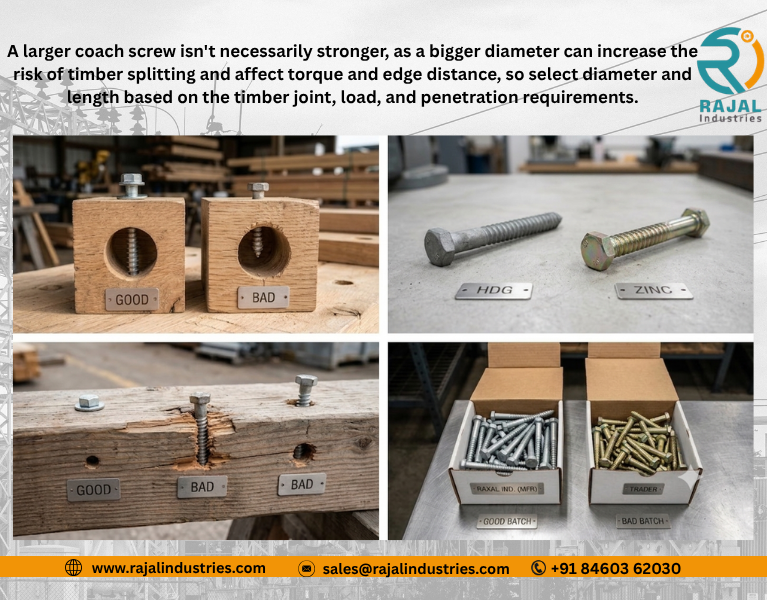
A larger diameter does not automatically mean a better joint.
Increasing diameter can affect:
- Timber splitting risk
- Pilot-hole requirement
- Installation torque
- Edge distance
- Hole size in attached hardware
- Material cost
The correct diameter should therefore come from the joint design.
Coach Screw Length Selection
Coach screw length should consider:
Attached Component Thickness + Washer + Required Timber Penetration
The required penetration depends on the joint and engineering design.
Avoid generic rules such as:
“The screw should always penetrate two-thirds of the timber.”
Such rules can be misleading because the correct engagement depends on the specific connection.
Thread Length Selection
Coach screws may have partially threaded designs.
Thread length can affect:
- Engagement
- Clamping
- Installation
- Joint behaviour
For a drawing-based requirement, define thread length rather than assuming that every manufacturer uses identical geometry.
Coach Screw Thread Design
A coach screw generally uses a relatively coarse wood-engaging thread.
Thread geometry can influence:
- Installation torque
- Timber engagement
- Pull-out behaviour
- Manufacturing requirements
Do not substitute a machine thread for a wood-screw thread simply because the nominal diameter appears similar.
Coach Screw Head Dimensions
The hexagonal head allows the fastener to be installed using a wrench or socket.
Important dimensions include:
- Width across flats
- Head height
- Bearing surface
Why does this matter for bulk buyers?
An incorrect across-flats dimension can create:
- Tool fit problems
- Slipping
- Assembly delays
For repetitive industrial installation, dimensional consistency is important.
Should You Use a Washer with a Coach Screw?
A washer may be useful where the joint requires additional bearing area under the head.
Potential reasons include:
- Load distribution
- Surface protection
- Preventing excessive local indentation
- Meeting a project specification
But a washer should not automatically be added to every application.
The joint design should determine whether it is required.
Selecting Washers for Coach Screws
Where a washer is specified, define:
- Washer ID
- Washer OD
- Thickness
- Material
- Finish
- Applicable standard
For outdoor applications, the washer and screw should also have suitable corrosion compatibility.
Pilot Hole Selection for Coach Screws
Pilot holes are an important part of many coach screw installations.
The correct pilot hole can depend on:
- Screw diameter
- Thread geometry
- Timber species
- Timber density
- Moisture condition
- Edge distance
- Installation method
A suitable pilot hole can help reduce:
- Timber splitting
- Excessive driving torque
- Screw damage
- Installation difficulty
However, the correct pilot-hole size should come from the applicable fastener guidance, timber design requirements or engineering specification.
What Happens if the Pilot Hole Is Too Small?
A pilot hole that is too small can increase installation resistance.
Possible consequences include:
- High installation torque
- Timber splitting
- Head damage
- Screw breakage
- Tool wear
- Incomplete installation
This is particularly important with dense hardwood.
What Happens if the Pilot Hole Is Too Large?
An excessively large pilot hole may reduce effective thread engagement.
This can affect the intended connection performance.
Therefore:
Smaller is not always stronger. Larger is not always easier.
The correct pilot hole must suit the fastener and timber.
Should Coach Screws Be Hammered into Timber?
No.
A coach screw is intended to be installed by rotational driving into the prepared timber connection.
Hammering the fastener into position can damage:
- Timber
- Thread
- Coating
- Fastener geometry
Installation should follow the applicable project or manufacturer guidance.
Can You Install Coach Screws with an Impact Wrench?
A suitable powered tool may be used in some applications, but uncontrolled impact installation can create problems.
Possible risks include:
- Overtightening
- Head damage
- Screw failure
- Timber damage
- Excessive embedment
Where installation quality is important, use a controlled process appropriate to the joint.
Coach Screw Installation Sequence
A typical installation process may involve:
Mark Position → Drill Required Pilot Hole → Position Component → Add Washer if Specified → Insert Coach Screw → Drive with Suitable Tool → Tighten to Approved Condition → Inspect
The exact sequence should follow the project specification.
Common Coach Screw Applications
Heavy duty wood screws can be considered for suitable applications such as:
- Timber Construction
- Wooden Frames
- Timber-to-Metal Connections
- Timber-to-Timber Connections
- Industrial Wooden Structures
- Outdoor Structures
- Utility Timber Structures
- Equipment Mounting
- Brackets
- Wooden Supports
- Selected Solar Mounting Applications
The suitability of the fastener should always be checked for the actual joint.
Coach Screws for Timber Construction
For timber construction, buyers should consider:
- Timber type
- Joint design
- Load
- Diameter
- Length
- Penetration
- Edge distance
- Fastener spacing
- Pilot hole
- Corrosion exposure
Structural applications should be designed or approved by a qualified engineer according to the applicable project requirements.
Coach Screws for Heavy Timber Structures
Heavy timber applications may involve:
- Beams
- Posts
- Frames
- Supports
- Brackets
- Plates
The fastener may experience:
- Shear
- Withdrawal
- Combined loading
This is why simply selecting a “large coach screw” is not enough.
The complete connection should be designed.
Coach Screws for Metal-to-Timber Connections
One common application is fastening a metal component to timber.
For example:
Hex Head → Washer → Metal Bracket → Timber
Important checks include:
- Bracket-hole diameter
- Washer dimensions
- Screw diameter
- Timber penetration
- Edge distance
- Installation
- Corrosion compatibility
This type of joint can appear in construction, utility and industrial applications.
Coach Screws for Solar Projects
Coach screws can be relevant to solar projects when the mounting system is attached to an approved timber substrate.
Possible applications include:
- Timber Roof Structures
- Wooden Support Members
- Certain Rooftop Solar Mounting Systems
- Auxiliary Equipment Attached to Timber
But the fastener should not be described as a universal solar fastener.
Steel solar structures commonly use completely different fasteners.
What Solar EPC Buyers Should Check
For suitable timber-based solar applications, procurement teams should confirm:
- Mounting-system specification
- Roof or timber substrate
- Screw diameter
- Screw length
- Material
- Coating
- Washer
- Corrosion requirement
- Installation method
- Required documentation
Outdoor solar projects can have long service lives, making corrosion protection especially important.
Coach Screws for Utility Projects
A lag screw supplier may receive requirements from utility and infrastructure buyers for fastening to suitable timber structures.
Potential applications can include:
- Timber Poles
- Wooden Supports
- Equipment Mounting
- Brackets
- Utility Hardware
- Electrical Infrastructure
Utility specifications can be strict.
The RFQ may define:
- Standard
- Dimensions
- Material
- Finish
- Coating
- Mechanical properties
- Inspection
- Packaging
- Traceability
The supplier should quote against the exact utility specification.
Coach Screws for Wooden Utility Poles
Where permitted by the project design, coach screws may secure suitable hardware to wooden poles.
Examples may include:
- Brackets
- Supports
- Mounting Hardware
- Accessories
However, utility applications can vary by authority and project.
Never substitute a standard commercial coach screw where an approved utility fastener is specified.
Corrosion Protection for Outdoor Coach Screws
Outdoor timber connections may be exposed to:
- Rain
- Humidity
- Condensation
- Salt
- Chemicals
- Treated timber
- Temperature changes
The fastener material and coating should be selected for the actual environment.
Zinc-Plated vs Hot-Dip Galvanized Coach Screws
| Factor | Zinc Plated | Hot-Dip Galvanized |
| Coating Thickness | Generally thinner | Generally thicker |
| Indoor Use | Common in suitable conditions | Possible |
| Outdoor Use | Depends on specification | Often considered for suitable outdoor applications |
| Thread Impact | Lower coating buildup | Greater dimensional consideration |
| Appearance | Smoother typical finish | More variable surface appearance |
| Corrosion Performance | Specification dependent | Specification dependent |
Do not choose coating based only on this general table.
Actual corrosion performance depends on coating system, thickness, environment and applicable standard.
Stainless Steel vs Galvanized Coach Screws
| Factor | Stainless Steel | Galvanized Carbon Steel |
| Base Material | Stainless alloy | Carbon steel |
| Corrosion Strategy | Material resistance | Protective zinc coating |
| Mechanical Properties | Grade dependent | Steel grade dependent |
| Outdoor Suitability | Environment dependent | Coating/environment dependent |
| Cost | Often higher | Often lower |
| Selection | Grade must be specified | Steel + coating must be specified |
Neither option is automatically best for every project.
Coach Screws and Treated Timber
Treated timber can create additional corrosion considerations.
The fastener should be compatible with:
- Timber treatment
- Moisture
- Exposure class
- Project specification
For long-term outdoor structures, do not assume a standard indoor zinc coating is automatically sufficient.
Consult the timber-treatment and project requirements when selecting the fastener.
Common Coach Screw Failures
1. Timber Splitting
Possible causes:
- Fastener too close to edge
- Incorrect spacing
- Pilot hole issue
- Large screw diameter
- Dense timber
- Installation method
First Check
Review:
Timber + Diameter + Pilot Hole + Edge Distance + Spacing
2. Screw Breakage During Installation
Possible causes:
- Excessive torque
- Pilot hole too small
- Dense timber
- Material or heat-treatment issue
- Installation misalignment
First Check
Do not immediately blame raw material.
Evaluate:
Fastener + Pilot Hole + Timber + Tool + Installation Torque
3. Head Rounds or Tool Slips
Possible causes:
- Incorrect socket
- Head dimension problem
- Tool misalignment
- Damaged head
- Excessive torque
For large repetitive projects, confirm tool compatibility before installation begins.
4. Screw Does Not Pull the Joint Tight
Possible causes can include:
- Incorrect length
- Incorrect thread/shank geometry
- Joint gap
- Installation issue
- Fastener bottoming or interference
Inspect the complete joint before changing fastener size.
5. Timber Crushed Under the Head
Possible causes:
- Excessive tightening
- Insufficient bearing area
- Soft timber
- Missing required washer
Where the design requires it, a suitable washer can increase bearing area.
6. Fastener Corrodes Early
Possible causes:
- Incorrect coating
- Coating damage
- Aggressive environment
- Treated timber incompatibility
- Poor storage
- Incorrect material selection
Corrosion failures should be investigated against the specified environment and coating system.
7. Screw Pulls Out
Possible contributing factors can include:
- Insufficient penetration
- Incorrect diameter
- Oversized pilot hole
- Timber condition
- Incorrect joint design
- Excessive applied load
Withdrawal capacity should be determined by engineering design rather than visual judgement.
Coach Screw Troubleshooting Table
| Problem | Possible Cause | First Check |
| Timber Splits | Pilot hole / spacing | Installation design |
| Screw Breaks | High torque | Pilot hole + tool |
| Head Damage | Tool mismatch | Socket + head |
| Poor Clamping | Geometry / installation | Joint design |
| Timber Crushing | Bearing pressure | Washer + torque |
| Early Corrosion | Finish / environment | Coating specification |
| Screw Pull-Out | Engagement / timber | Joint design |
| Difficult Installation | Pilot hole / density | Timber + hole |
Common Engineering Mistakes
Mistake 1: Selecting Coach Screws Only by Diameter and Length
Two screws with the same nominal size can differ in:
- Material
- Thread geometry
- Head dimensions
- Thread length
- Coating
Use a complete specification.
Mistake 2: Assuming Bigger Is Always Stronger
Increasing diameter can also increase:
- Timber splitting risk
- Installation torque
- Required edge distance
The connection should be engineered.
Mistake 3: Ignoring Timber Type
Hardwood and softwood can behave differently during installation.
Pilot-hole and connection requirements should reflect the actual timber.
Mistake 4: Ignoring the Outdoor Environment
A mechanically suitable fastener may still fail prematurely if corrosion protection is inadequate.
Mistake 5: Using the Same Pilot Hole Everywhere
Pilot-hole requirements can vary with:
- Screw size
- Timber
- Thread
- Application
Follow the correct installation guidance.
Mistake 6: Substituting Coach Screws for Structural Wood Screws
Modern engineered structural wood screws can have different:
- Threads
- Points
- Heads
- Drives
- Installation requirements
- Tested performance
Do not substitute without approval.
Common Procurement Mistakes
Asking Only for “Coach Screw Price”
Instead, provide:
Standard + Size + Material + Finish + Quantity
For project supply, also include drawing and testing requirements.
Comparing Different Coatings Only by Price
A low-cost coating is not necessarily suitable for the intended service environment.
Compare equivalent specifications.
Ignoring Manufacturing Source
For large custom orders, determine whether the supplier is:
- Manufacturer
- Stockist
- Distributor
- Trader
This can affect customization, traceability and production control.
Ordering Before Sample Approval
For custom or project-critical fasteners, use a suitable approval process:
Drawing → Sample → Inspection → Functional Trial → Approval → Bulk Production
Coach Screw vs Lag Screw vs Structural Wood Screw
| Feature | Coach Screw | Lag Screw | Structural Wood Screw |
| Commercial Terminology | Common in UK/India and other markets | Common in North America | Modern engineered category |
| Typical Head | Hex | Hex | Multiple designs |
| Timber Use | Yes | Yes | Yes |
| Coarse Thread | Common | Common | Engineered design |
| Installation Tool | Wrench/socket | Wrench/socket | Driver dependent |
| Product Specification | Standard/drawing | Standard/drawing | Often manufacturer-specific |
| Direct Substitution | Not automatic | Not automatic | Requires engineering approval |
Coach screw and lag screw often describe similar products commercially, but buyers should source by specification rather than terminology.
Coach Screw vs Heavy Duty Wood Screw
The term heavy duty wood screws is broad.
It can include:
- Traditional coach screws
- Lag screws
- Structural wood screws
- Other engineered timber fasteners
Therefore, a Google search for “heavy duty wood screws” may return products with very different geometries.
For industrial procurement, always move from:
Search Term → Technical Specification → Approved Product
Supplier Approval Checklist
Before approving a coach screw manufacturer, check:
☐ Actual manufacturing capability
☐ Product size range
☐ Heading capability
☐ Thread-forming capability
☐ Raw-material control
☐ Material traceability
☐ Heat-treatment control, where applicable
☐ Surface-finishing capability
☐ Coating control
☐ Dimensional inspection
☐ Mechanical testing capability
☐ Corrosion testing support
☐ Production capacity
☐ Batch identification
☐ Non-conformance process
☐ Packaging capability
☐ Project documentation
☐ Delivery planning
Coach Screw Quality Inspection Checklist
| Inspection | Purpose |
| Diameter | Confirm nominal size |
| Length | Confirm specified length |
| Thread Length | Confirm engagement geometry |
| Thread Profile | Verify specification |
| Shank Diameter | Dimensional compliance |
| Head Width | Tool compatibility |
| Head Height | Dimensional compliance |
| Point | Installation geometry |
| Material | Specification compliance |
| Hardness | Mechanical requirement |
| Mechanical Testing | As specified |
| Coating Thickness | Finish control |
| Corrosion Test | Where specified |
| Visual Inspection | Surface defects |
| Packaging | Protection and identification |
| Traceability | Batch control |
Sampling and acceptance criteria should follow the applicable customer or project quality plan.
Documents Bulk Buyers May Request
Depending on the project, documentation may include:
- Approved Drawing
- Material Test Certificate
- Dimensional Inspection Report
- Mechanical Test Report
- Hardness Report
- Coating Thickness Report
- Corrosion Test Report
- Certificate of Conformity
- Batch Traceability Records
Only request documentation that is relevant to the applicable specification and project requirements.
Questions to Ask a Coach Screw Manufacturer
Before final supplier approval, ask:
- Are you the actual manufacturer?
- Which coach screw standards do you manufacture?
- What diameter range can you manufacture?
- What length range can you manufacture?
- Can you manufacture from our drawing?
- Which carbon steel grades can you process?
- Which stainless steel grades can you process?
- Can you manufacture custom thread lengths?
- Which surface finishes can you provide?
- Can you supply hot-dip galvanized coach screws?
- How is coating thickness controlled?
- How are thread dimensions inspected?
- How are head dimensions inspected?
- Can you provide material certificates?
- Which mechanical tests can you provide?
- Can corrosion testing be arranged where required?
- Is batch traceability available?
- Can you supply samples before bulk production?
- What is your MOQ?
- What is your monthly production capacity?
- What is your normal lead time?
- Can you support project-wise deliveries?
- Can you provide custom packaging?
- Can you support customer inspection requirements?
How to Send a Professional Coach Screw RFQ
A useful RFQ can read:
Requirement: DIN 571 coach screws for an outdoor timber project. Please review the attached specification and quote for the required sizes. Confirm material grade, surface finish, coating thickness, dimensional compliance, testing capability, MOQ, monthly production capacity and delivery lead time. Please also confirm whether samples can be supplied for technical approval before bulk production.
Add:
- Size-wise quantity
- Annual/project demand
- Delivery location
- Packaging
- Inspection requirements
This helps the manufacturer provide a technically comparable quotation.
How Buyers Should Compare Coach Screw Quotations
| Requirement | Supplier A | Supplier B | Supplier C |
| Manufacturer | |||
| Standard | |||
| Material | |||
| Dimensions | |||
| Finish | |||
| Coating Thickness | |||
| Testing | |||
| Documentation | |||
| Sample Approval | |||
| MOQ | |||
| Price | |||
| Monthly Capacity | |||
| Lead Time | |||
| Packaging | |||
| Delivery Schedule |
Compare price only after confirming that the technical specifications are equivalent.
Why Rajal Industries for Coach Screw Requirements?
Rajal Industries can evaluate bulk, project and drawing-based coach screw requirements for suitable timber, construction, utility and industrial applications.
Subject to technical feasibility and customer specifications, requirements can be evaluated for:
- Coach Screws
- Lag Screws
- Timber Screws
- Heavy Duty Wood Screws
- Hex Head Wood Screws
- Standard Sizes
- Custom Sizes
- Custom Lengths
- Carbon Steel
- Stainless Steel
- Zinc-Plated Finishes
- Hot-Dip Galvanized Finishes
- Customer-Specified Coatings
- Drawing-Based Requirements
- Dimensional Inspection
- Material Verification
- Mechanical Testing as Specified
- Coating Inspection
- Batch Traceability
- Bulk Packaging
- Scheduled Supply
Target buyer segments can include:
- Timber Construction Companies
- Utility Contractors
- Electrical Infrastructure Companies
- Solar EPCs with Suitable Timber Applications
- Industrial Construction Companies
- Outdoor Structure Manufacturers
- Industrial OEMs
- Project Contractors
- Fastener Distributors
- Bulk Hardware Buyers
Final capability should be confirmed against the customer’s drawing, standard, size, material, coating, testing and quantity requirements.
Frequently Asked Questions About Coach Screws
What is a coach screw?
A coach screw is a heavy-duty threaded fastener commonly used for timber and wood connections. It typically has a hex head, coarse wood-engaging thread and pointed end.
Is a coach screw the same as a lag screw?
The terms coach screw and lag screw are often used for similar fasteners. Terminology varies by market, so industrial buyers should specify the applicable standard or drawing.
What is a lag bolt?
Lag bolt is another commercial term often used for heavy-duty hex-head wood fasteners. Buyers should verify the actual dimensions and specification rather than relying on the name.
What is DIN 571?
DIN 571 is a commonly referenced dimensional standard for hexagon head wood screws used in timber fastening applications.
Are coach screws suitable for structural timber?
They can be used in suitable engineered timber connections where permitted by the project design. Structural connections should follow the applicable engineering requirements.
Do coach screws need pilot holes?
Pilot holes may be required or recommended depending on screw diameter, timber density, fastener geometry and joint design.
Can coach screws be used in hardwood?
They can be used in suitable hardwood applications, but pilot-hole and installation requirements may differ from softwood.
Can coach screws be used outdoors?
Yes, provided the material and corrosion-protection system are suitable for the actual outdoor environment.
Are galvanized coach screws suitable for outdoor projects?
Hot-dip galvanized coach screws may be suitable for many outdoor applications, but suitability depends on coating specification, environment and project requirements.
Are stainless steel coach screws available?
Yes. Stainless steel coach screws can be specified where appropriate corrosion resistance is required. The exact stainless grade should be stated.
Are coach screws used in solar projects?
They can be used in selected solar mounting applications involving approved timber substrates. They are not universal solar fasteners.
Can coach screws be used on utility poles?
They may be used for suitable hardware attachments to timber utility poles where permitted by the applicable utility specification.
Should a washer be used with a coach screw?
A washer may be specified to increase bearing area or meet a joint requirement. It is not automatically required for every application.
Can coach screws be installed using impact tools?
Powered tools may be suitable for some installations, but the installation process should avoid uncontrolled overtightening or damage.
How do I select coach screw length?
Length should be based on the attached component, washer if used, required timber penetration and complete joint design.
What causes coach screws to break during installation?
Possible causes include excessive torque, inadequate pilot holes, dense timber, misalignment or a fastener material/manufacturing problem.
What information should I send to a coach screw manufacturer?
Send the standard or drawing, diameter, length, thread length, material, finish, testing requirements and order quantity.
AEO Quick Answers
What is the difference between a coach screw and a normal wood screw?
A coach screw is generally a larger, heavy-duty wood fastener with a hexagonal head and coarse thread. General wood screws cover a much wider range of smaller and medium-duty fastening applications.
What is another name for a coach screw?
Coach screws are commonly called lag screws or lag bolts in some markets. Because terminology varies, bulk buyers should specify dimensions and the applicable standard or drawing.
Where are coach screws used?
Coach screws are commonly used in timber construction, timber-to-metal connections, wooden frames, outdoor structures, utility timber structures and other heavy wood-fastening applications.
How do I choose a coach screw manufacturer?
Check manufacturing capability, size range, materials, coatings, inspection, testing, production capacity, traceability and ability to manufacture to your standard or drawing.
What should I specify when buying coach screws in bulk?
Specify the standard or drawing, diameter, length, thread length, material, surface finish, required testing, quantity, packaging and delivery schedule.
Key Takeaways
- A coach screw manufacturer should be selected based on manufacturing and quality capability, not only price.
- Coach screw and lag screw are commonly used for similar fasteners, but specifications should control purchasing.
- DIN 571 is an important reference for hexagon head wood screws.
- Diameter and length should come from the actual timber joint design.
- Pilot-hole requirements depend on the screw and timber.
- Coach screws can be used in suitable timber construction and utility applications.
- Solar use is mainly relevant where the approved mounting system connects to timber.
- Outdoor projects require careful material and coating selection.
- Treated timber can create additional corrosion considerations.
- Hot-dip galvanizing and stainless steel are different corrosion-protection approaches.
- A washer should be selected only where the joint requires it.
- Coach screws and modern structural wood screws should not be substituted without approval.
- Bulk buyers should compare technically equivalent quotations.
- Samples and functional approval are useful before large custom orders.
Conclusion
Choosing the right coach screw manufacturer requires more than finding a supplier with the required diameter in stock.
For timber construction, solar projects involving timber substrates, utility structures and industrial applications, buyers should define:
Standard → Size → Thread → Material → Finish → Joint → Installation → Testing → Quantity
The application is especially important.
A coach screw suitable for an indoor timber assembly may not be suitable for an outdoor utility structure exposed to moisture, treated timber or aggressive environments.
Similarly, a fastener used in a timber-based solar mounting system should not automatically be specified for a steel solar structure.
Rajal Industries can evaluate bulk and drawing-based coach screw requirements based on customer specifications, material, coating, testing requirements and project quantities.