

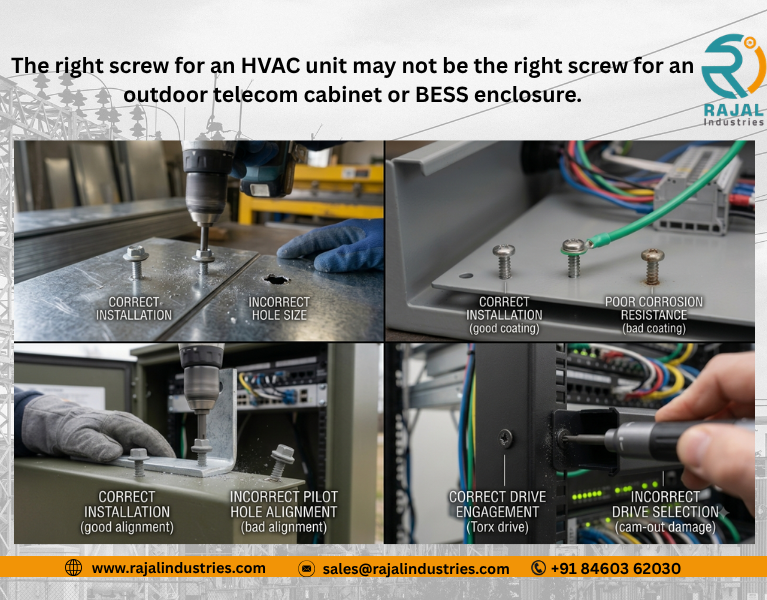
Self-tapping screws are widely used in industrial manufacturing because they can form or cut mating threads during installation. This makes them especially useful for sheet metal, electrical enclosures, HVAC equipment, steel fabrications, telecom cabinets and OEM assemblies where reducing tapping operations can improve production speed.
Different industries use these fasteners for different reasons. HVAC manufacturers often value fast sheet-metal assembly. Electrical panel builders need compact fastening inside enclosures. Steel fabricators need dependable joining of light-gauge components, while telecom manufacturers require reliable fastening for cabinets, racks and equipment housings.
Engineers and procurement teams frequently search for Self Tapping Screw Applications, HVAC Screws, Panel Screws, Steel Screws, Self Tapping Screws for Electrical Panels, and Industrial Self Tapping Screws when choosing fasteners for production.
This guide explains the main industrial applications, selection factors and technical considerations buyers should review before approving self-tapping screws for OEM use.
Quick Answer
Common self-tapping screw applications include:
- HVAC Equipment
- Electrical Panels
- Switchgear
- Steel Fabrication
- Telecom Cabinets
- Data Centers
- Industrial Machinery
- Automation Equipment
- BESS Enclosures
- Solar Equipment
- Elevator Systems
- Electronic Enclosures
- Material Handling Equipment
They are often selected because they can:
- Reduce separate tapping operations
- Speed up assembly
- Work well with sheet materials
- Support high-volume production
- Simplify component installation
- Reduce manufacturing steps
Why Self-Tapping Screws Are Popular in OEM Manufacturing
OEM manufacturers often look for ways to reduce assembly time without sacrificing joint reliability.
Self-tapping screws can help because they combine fastening and thread creation in one operation.
Key advantages include:
- Faster installation
- Reduced machining operations
- Suitable for thin metal sections
- Multiple head and drive options
- Easy automation
- Broad material compatibility
The final performance depends on the correct combination of screw type, pilot hole, base material, thickness and installation torque.
Major Industries Using Self-Tapping Screws
To keep the application section concise, the main industries include:
- HVAC Manufacturers
- Electrical Panel & Switchgear OEMs
- Sheet Metal Fabricators
- Telecom Equipment Manufacturers
- Data Center Infrastructure
- Industrial Machinery
- Automation Equipment
- Solar & Renewable Energy
- Battery Energy Storage Systems
- Elevator Manufacturers
- Railway Equipment
- Appliance Manufacturers
- Electronic Enclosures
- Material Handling Equipment
- Generator Manufacturers
- Process Equipment
The exact screw specification varies by material, thickness, environment and required joint performance.
Self-Tapping Screws in HVAC Equipment
HVAC manufacturers use self-tapping screws extensively because much of the equipment is fabricated from sheet metal.
Typical applications include:
- Air Handling Units
- Fan Housings
- Duct Components
- Access Panels
- Sheet-Metal Covers
- Ventilation Equipment
- Cooling Units
- Brackets
The main benefits are:
- Fast installation
- Reduced tapping operations
- Good suitability for sheet metal
- Easy field servicing
The correct screw diameter, point design and coating should be selected according to sheet thickness and environmental exposure.
Self-Tapping Screws in Electrical Panels
Electrical panel manufacturers use these fasteners for light sheet-metal assemblies and serviceable components.
Common applications include:
- Panel Covers
- Internal Brackets
- Cable Supports
- Junction Boxes
- Control Cabinets
- Mounting Plates
- Light Enclosure Components
Important considerations include:
- Screw protrusion
- Clearance behind the panel
- Wire location
- Corrosion protection
- Drive access
- Repeated servicing
Inside electrical equipment, excessive screw length can interfere with cables or electrical components, so length selection is especially important.
Self-Tapping Screws in Switchgear
Switchgear assemblies contain numerous sheet-metal and enclosure components.
Typical uses include:
- Protective Covers
- Internal Supports
- Access Panels
- Control Compartments
- Light Mounting Brackets
- Instrument Enclosures
For switchgear applications, buyers should evaluate:
- Material thickness
- Joint vibration
- Maintenance access
- Surface finish
- Electrical clearance
- Customer drawing requirements
Self-Tapping Screws in Steel Fabrication
In steel fabrication, self-tapping screws are mainly used for lighter sections rather than major structural joints.
Applications may include:
- Sheet-Metal Covers
- Light Support Brackets
- Equipment Housings
- Fabricated Cabinets
- Panels
- Light Steel Assemblies
They should not automatically be substituted for structural bolts where engineered structural fastening is required.
This distinction is important for both safety and procurement accuracy.
Self-Tapping Screws in Telecom Equipment
Telecom equipment manufacturers use compact sheet-metal enclosures and cabinets that often require efficient assembly.
Applications include:
- Outdoor Cabinets
- Network Enclosures
- Telecom Racks
- Power Cabinets
- Cable Management Components
- Equipment Covers
- Internal Brackets
For outdoor telecom equipment, corrosion resistance becomes a major selection factor.
Common options may include:
- Zinc-Nickel Coating
- Zinc Flake Systems
- Stainless Steel
The final choice should match the actual environment and customer specification.
Self-Tapping Screws in Data Centers
Data center infrastructure uses large quantities of precision sheet-metal equipment.
Applications may include:
- Server Cabinets
- Network Racks
- Cable Trays
- Power Distribution Enclosures
- Cooling Equipment
- Equipment Covers
Fasteners should support:
- Quick assembly
- Easy maintenance
- Dimensional consistency
- Clean installation
- Reliable corrosion resistance
Self-Tapping Screws in Industrial Machinery
Industrial machinery OEMs use these screws for lighter assembly components, including:
- Machine Guards
- Covers
- Sensor Brackets
- Control Boxes
- Sheet-Metal Housings
- Access Panels
For machinery exposed to vibration, joint design and installation torque should be validated carefully.
Self-Tapping Screws in Automation Equipment
Automation equipment includes many cabinets, guards and sensor mounting components.
Typical applications include:
- PLC Cabinets
- Machine Guards
- Sensor Mounting
- Control Boxes
- Light Structural Panels
- Cable Routing Components
High-volume automation assembly also benefits from consistent screw geometry and drive quality.
Self-Tapping Screws in Solar & Renewable Energy Equipment
Renewable energy applications may include:
- Inverter Cabinets
- Electrical Enclosures
- Monitoring Equipment
- Control Boxes
- Sheet-Metal Covers
- Auxiliary Equipment
Outdoor exposure makes corrosion protection especially important.
The correct fastener may require:
- Stainless Steel
- Zinc-Nickel
- Zinc Flake
- Other project-approved coating systems
Self-Tapping Screws in BESS Equipment
Battery Energy Storage Systems use large numbers of electrical cabinets, enclosures and supporting equipment.
Typical applications include:
- Battery Cabinets
- Inverter Enclosures
- Cooling Equipment
- Control Panels
- Monitoring Systems
- Service Covers
Because BESS equipment can operate outdoors, buyers should consider both corrosion resistance and long-term maintenance requirements.
Common Screw Types Used by These Industries
Depending on the application, buyers may specify:
- Thread Forming Screws
- Thread Cutting Screws
- Sheet Metal Screws
- Type A
- Type AB
- Type B
- Type F
- Custom OEM Designs
The correct type depends on:
- Base material
- Material hardness
- Thickness
- Pilot hole
- Required installation torque
- Joint strength
Common Head Styles
Industrial applications commonly use:
- Pan Head
- Countersunk Head
- Raised Countersunk Head
- Hex Washer Head
- Truss Head
- Wafer Head
Pan Head
Common for general enclosure and panel applications.
Countersunk Head
Selected where a flush surface is required.
Hex Washer Head
Useful where a larger bearing area and external wrench drive are preferred.
Truss Head
Useful where a broad bearing surface is needed on thinner materials.
Common Drive Types
Available options include:
- Phillips
- Pozidriv
- Torx
- Hex
- Hex Socket
- Slotted
- Combination Drive
Drive selection should consider:
- Torque transfer
- Assembly speed
- Tool engagement
- Automation
- Maintenance access
Material Selection by Industry
| Industry | Common Material Consideration |
| HVAC | Carbon Steel / Stainless Steel |
| Electrical Panels | Carbon Steel / SS304 |
| Switchgear | Carbon Steel / SS304 |
| Steel Fabrication | Hardened Carbon Steel |
| Telecom | SS304 / Coated Steel |
| Data Centers | SS304 / Coated Steel |
| Solar Equipment | SS304 / SS316 / Coated Steel |
| BESS | SS304 / Corrosion-Resistant Coated Steel |
| Industrial Machinery | Carbon Steel / Alloy Steel |
These are general considerations only. Final selection should follow the approved engineering specification.
How to Select the Right Screw for an Industry Application
Step 1 – Identify the Base Material
Confirm whether the fastener will enter:
- Steel
- Aluminium
- Stainless Steel Sheet
- Plastic
- Composite
Step 2 – Check Material Thickness
Thickness directly affects thread engagement and holding strength.
Step 3 – Select the Screw Type
Choose between:
- Thread Forming
- Thread Cutting
- Other tapping geometries
Step 4 – Verify Pilot Hole
The hole size should be validated for:
- Screw geometry
- Material
- Thickness
- Required joint performance
Step 5 – Select Material & Coating
Match them to:
- Indoor/outdoor environment
- Humidity
- Chemical exposure
- Corrosion requirement
- Customer specification
Surface Coating Selection by Industry
The correct surface finish depends on where the fastener will be used. A screw used inside an electrical cabinet may need very different corrosion protection from one installed in an outdoor telecom enclosure or solar system.
Zinc Plated
Commonly considered for:
- Indoor Electrical Panels
- Switchgear
- HVAC Equipment
- General Industrial Enclosures
Advantages:
- Economical
- Good indoor corrosion resistance
- Bright surface finish
- Suitable for many general-purpose industrial applications
Zinc-Nickel Coating
Often selected for:
- Outdoor Telecom Equipment
- High-Humidity Environments
- Automotive-Related Assemblies
- Industrial OEM Equipment
Advantages:
- Better corrosion resistance than standard zinc plating
- Good wear resistance
- Longer service life in demanding environments
Zinc Flake / Dacromet-Type Coatings
Common applications include:
- Renewable Energy Equipment
- Outdoor BESS Enclosures
- Heavy Engineering
- Certain automotive and industrial assemblies
Advantages:
- High corrosion resistance
- Good salt-spray performance
- Suitable for harsh service conditions
Black Oxide
Commonly used for:
- Indoor Machinery
- Automation Equipment
- Machine Guards
- Industrial Fixtures
Advantages:
- Uniform black appearance
- Suitable for indoor service
- Minimal dimensional build-up
Stainless Steel
Often selected where corrosion resistance is a priority.
Typical uses include:
- Food Processing Equipment
- Marine-Related Equipment
- Chemical Plants
- Outdoor Electrical Equipment
- Coastal Installations
Common grades include:
- SS304 / A2
- SS316 / A4
Final selection should follow the engineering specification and actual environment.
Installation and Pilot-Hole Considerations
Self-tapping fasteners work correctly only when the screw geometry, pilot hole and base material are properly matched.
Important factors include:
- Base material
- Sheet thickness
- Hole diameter
- Screw diameter
- Thread form
- Screw hardness
- Installation torque
A hole that is too small can cause:
- Excessive driving torque
- Drive damage
- Screw breakage
- Distortion of thin sheet
A hole that is too large can result in:
- Weak thread engagement
- Reduced pull-out resistance
- Stripping
- Loose joints
For OEM production, the pilot-hole size should be validated using the actual material and screw combination.
Driving Torque vs Stripping Torque
For high-volume industrial assembly, engineers should understand two important values:
Driving Torque
The torque needed to install the screw.
Stripping Torque
The torque at which the formed thread begins to fail.
A suitable application should provide a safe operating margin between these two values.
This becomes especially important in:
- Thin Sheet Metal
- Aluminium
- Electrical Enclosures
- HVAC Equipment
- Automated Assembly Lines
Self-Tapping Screw vs Self-Drilling Screw
These fasteners are related but not identical.
| Feature | Self-Tapping Screw | Self-Drilling Screw |
| Creates Mating Thread | Yes | Yes |
| Integral Drill Point | Not necessarily | Yes |
| Pilot Hole | Often required | Usually not within rated capacity |
| Sheet Metal | Excellent | Excellent |
| Roofing | Application dependent | Very common |
| Steel Framing | Application dependent | Common |
| Electrical Enclosures | Common | Common |
A self-tapping screw creates or forms threads in a prepared hole.
A self-drilling screw also creates its own hole through the use of a drill-type point.
Self-Tapping Screw vs Machine Screw
| Feature | Self-Tapping Screw | Machine Screw |
| Pre-Threaded Hole Needed | Usually No | Yes, or used with a nut |
| Creates Mating Thread | Yes | No |
| Sheet Metal Assembly | Excellent | Application dependent |
| Repeated Disassembly | Application dependent | Generally better suited |
| Electrical Panels | Common | Common |
| OEM Production | Common | Common |
Machine screws are generally better for assemblies that require regular dismantling, while self-tapping screws can reduce manufacturing steps in sheet-metal production.
Common Engineering & Procurement Mistakes
Selecting Only by Diameter and Length
An enquiry such as:
ST4.2 × 16
is usually incomplete.
The buyer should also define:
- Head style
- Drive type
- Thread design
- Point type
- Material
- Surface finish
- Standard
- Application
Ignoring Sheet Thickness
The same screw can behave differently in:
- 0.8 mm sheet
- 1.5 mm sheet
- 3 mm sheet
Thread engagement changes with material thickness, so the actual application must be considered.
Using the Wrong Pilot Hole
Incorrect hole size can cause excessive torque or poor holding strength.
This is one of the most common application problems.
Confusing Self-Tapping with Self-Drilling
If drilling is required during installation, specify a self-drilling design instead of assuming every self-tapping screw will drill its own hole.
Choosing Finish Only by Appearance
A bright finish does not automatically mean good corrosion resistance.
The required corrosion performance should be defined in the drawing or purchase specification.
Ignoring Production Testing
Before large-scale production, testing can help identify:
- Excessive installation torque
- Thread stripping
- Screw breakage
- Drive damage
- Automated feeding issues
- Dimensional variation
For high-volume OEM projects, production trials can prevent expensive assembly problems later.
Quality Inspection Checklist
Before dispatch, self-tapping screws should be checked for:
| Inspection Item | Verify |
| Drawing / Standard Compliance | ✔ |
| Diameter | ✔ |
| Length | ✔ |
| Thread Geometry | ✔ |
| Point Geometry | ✔ |
| Head Dimensions | ✔ |
| Drive Recess | ✔ |
| Material | ✔ |
| Hardness / Mechanical Requirement | ✔ |
| Surface Finish | ✔ |
| Coating Thickness | ✔ |
| Visual Condition | ✔ |
| Functional Installation Test | ✔ |
| Batch Traceability | ✔ |
| Required Certificates | ✔ |
A structured inspection process helps maintain consistent assembly performance across production batches.
OEM RFQ Checklist
For faster and more accurate quotations, provide:
☐ Screw Diameter
☐ Screw Length
☐ Thread Type
☐ Point Type
☐ Head Style
☐ Drive Type
☐ Material
☐ Hardness / Mechanical Requirements
☐ Surface Finish
☐ Corrosion Requirement
☐ Application Material
☐ Material Thickness
☐ Pilot-Hole Details, if available
☐ Quantity per Order
☐ Annual Requirement
☐ Engineering Drawing
☐ Inspection Requirements
☐ Packaging
☐ Delivery Schedule
The more application details provided at the RFQ stage, the easier it is to avoid technical mismatches later.
Why Rajal Industries?
Rajal Industries manufactures standard and custom industrial screws for OEM production requirements.
Depending on drawing approval and manufacturability, capabilities can include:
- Bulk production from 50,000+ pieces
- Standard and custom self-tapping screws
- Carbon steel
- Stainless steel
- Cold forming
- Thread rolling
- Heat treatment where required
- Zinc, zinc-nickel and other approved finishes
- Dimensional inspection
- Mechanical testing as specified
- Batch traceability
- OEM packaging
- Drawing-based manufacturing
- Export supply support
Typical target sectors include:
- HVAC Manufacturers
- Electrical Panel OEMs
- Switchgear Companies
- Sheet Metal Fabricators
- Telecom Equipment Manufacturers
- Industrial Machinery OEMs
- Automation Companies
- Renewable Energy Equipment Manufacturers
- BESS Equipment Manufacturers
Frequently Asked Questions
Where are self-tapping screws most commonly used?
They are widely used in HVAC equipment, electrical panels, sheet-metal assemblies, telecom cabinets, industrial machinery, automation equipment and electronic enclosures.
Are self-tapping screws suitable for electrical panels?
Yes. They are commonly used for covers, brackets, cable supports and light sheet-metal components where the joint design allows thread formation during installation.
Which screws are commonly used in HVAC equipment?
Self-tapping screws and self-drilling screws are both widely used in HVAC systems, depending on whether a pilot hole is already provided.
Can self-tapping screws be used in steel fabrication?
Yes, mainly for light-gauge steel, covers, cabinets and secondary components. They should not automatically replace engineered structural bolts in load-critical joints.
Which coating is suitable for outdoor telecom equipment?
Options such as zinc-nickel, zinc-flake coatings or stainless steel may be considered depending on the corrosion environment and customer specification.
Can custom screws be manufactured for OEM applications?
Yes. Custom designs can be produced according to drawings when dimensions, materials, thread geometry, performance requirements and order quantities are technically feasible.
What information should an OEM buyer include in an RFQ?
The RFQ should include size, length, head, drive, thread type, point, material, coating, application material, thickness, quantity and drawing where available.
Key Takeaways
- Self Tapping Screw Applications cover HVAC, electrical panels, steel fabrication, telecom, BESS, automation and many other OEM sectors.
- The same screw should not be used blindly across different materials and thicknesses.
- Pilot-hole size, screw geometry and base material must be treated as one fastening system.
- Corrosion protection should match the actual operating environment.
- Self-tapping and self-drilling screws are not the same product.
- Detailed RFQs and production testing help reduce installation problems in high-volume OEM manufacturing.
Conclusion
Self-tapping screws are valuable in industrial manufacturing because they can reduce tapping operations and speed up assembly across HVAC, electrical panels, telecom equipment, steel fabrication, industrial machinery and renewable energy systems.
However, reliable performance depends on selecting the correct thread type, point design, diameter, length, pilot hole, material and coating for the actual application.
For OEM manufacturers buying in volume, consistency becomes just as important as the nominal screw specification. Dimensional control, material quality, installation performance and batch traceability all affect production efficiency.
Rajal Industries can evaluate standard and custom self-tapping screw requirements for bulk OEM production based on customer drawings, technical specifications and annual demand.