

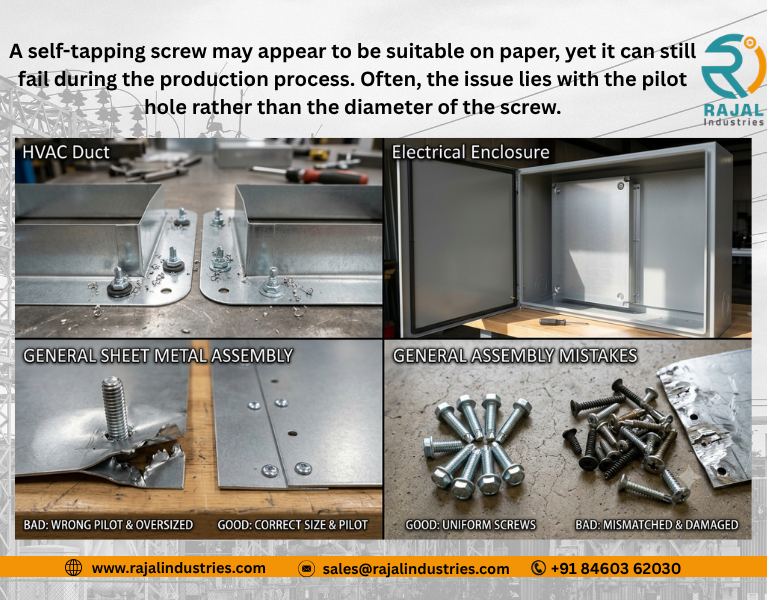
A self tapping screw is designed to form or cut mating threads as it enters a prepared hole. This makes it an efficient fastening option for sheet metal, electrical enclosures, HVAC equipment, industrial machinery, plastic components and OEM assemblies where adding a separate tapping operation may increase production time and cost.
However, selecting the correct screw requires much more than choosing its diameter and length. Engineers must consider thread type, pilot-hole size, material thickness, screw material, point design, head style, drive type, hardness and surface finish.
The wrong combination can cause stripped threads, poor clamping, installation failure, screw breakage or damage to the mating component.
This technical guide explains self tapping screw sizes, thread types, materials and specifications to help engineers, procurement teams and OEM manufacturers select suitable fasteners for industrial production.
Quick Answer: How Do You Select a Self Tapping Screw?
Before selecting a screw, confirm:
- Base material
- Material thickness
- Screw diameter
- Screw length
- Thread type
- Pilot-hole requirement
- Point design
- Head style
- Drive type
- Screw material
- Surface coating
- Required joint performance
- Applicable DIN, ISO or customer specification
The correct combination depends on the material being fastened and the required performance of the joint.
What Is a Self Tapping Screw?
A self-tapping screw creates or forms its mating thread during installation rather than relying on a previously tapped internal thread.
Depending on its design, the screw may:
- Form threads by displacing the mating material, or
- Cut threads by removing a small amount of material.
This can reduce separate machining and tapping operations during high-volume assembly.
They are commonly used with:
- Thin steel sheet
- Aluminium
- Plastics
- Electrical enclosures
- Fabricated metal components
- HVAC assemblies
- Industrial cabinets
The correct screw design must still be matched to the substrate, thickness and pilot hole.
Understanding Self Tapping Screw Sizes
A screw specification normally contains several dimensions rather than one size.
Important dimensions include:
- Major thread diameter
- Thread pitch
- Screw length
- Head diameter
- Head height
- Point length
- Drive dimensions
- Pilot-hole requirement
OEM drawings may also specify tolerances, hardness, coating thickness and performance requirements.
Common Self Tapping Screw Sizes
Depending on the applicable standard and design, metric self-tapping screws may be available in sizes such as:
| Nominal Size | Common Industrial Use |
| ST2.2 | Small electrical/electronic assemblies |
| ST2.9 | Light sheet-metal components |
| ST3.5 | Electrical enclosures and light fabrication |
| ST3.9 | Sheet-metal assemblies |
| ST4.2 | HVAC, cabinets and fabricated equipment |
| ST4.8 | Industrial sheet-metal assemblies |
| ST5.5 | Larger fabricated components |
| ST6.3 | Heavier sheet-metal applications |
Important: This table is only a general reference. Final size selection should follow the applicable standard, engineering drawing and joint design.
How Is Self Tapping Screw Length Measured?
Length measurement depends on the head design.
For many non-countersunk head styles, the nominal length is generally measured from under the head to the tip.
For countersunk designs, the measurement convention can differ because the head sits inside the countersink.
This is why buyers should not rely only on a description such as:
ST4.2 × 16 mm
The RFQ should also specify the:
- Head style
- Drive
- Point
- Standard
- Material
- Finish
This reduces the risk of receiving a technically different fastener with the same nominal diameter and length.
Thread Forming Screw vs Thread Cutting Screw
One of the most important decisions is choosing how the mating thread will be produced.
| Feature | Thread Forming Screw | Thread Cutting Screw |
| Basic Action | Displaces material | Cuts mating material |
| Chips Produced | Normally No | Can Produce Chips |
| Common Use | Ductile materials | Suitable materials requiring cutting action |
| Assembly Cleanliness | Higher | Chip management may be required |
| Installation Torque | Application dependent | Application dependent |
| Pilot Hole | Critical | Critical |
Neither design is automatically better. Selection depends on the substrate, thickness, hole geometry and required joint performance.
What Is a Thread Forming Screw?
A thread forming screw produces mating threads by displacing material rather than cutting it away.
Potential advantages include:
- No cutting chips in suitable applications
- Efficient high-volume assembly
- Strong thread engagement when correctly engineered
- Reduced need for a separate tapping operation
Thread-forming performance depends heavily on the pilot-hole diameter and properties of the mating material.
A hole that is too small can increase installation torque or damage the screw. A hole that is too large can reduce thread engagement and holding strength.
What Is a Thread Cutting Screw?
A thread-cutting design uses cutting features to create mating threads as the screw is installed.
It can be useful where controlled material removal is preferred.
Important considerations include:
- Base material
- Pilot-hole diameter
- Material hardness
- Chip generation
- Required installation torque
- Number of installation cycles
Engineers should validate the screw and pilot-hole combination before mass production.
Why Pilot-Hole Size Matters
The pilot hole is one of the most important factors in a self-tapping joint.
An undersized hole can result in:
- Excessive installation torque
- Head or drive damage
- Screw breakage
- Distortion of thin sheet
- Assembly problems
An oversized hole can cause:
- Poor thread engagement
- Reduced stripping resistance
- Loose fastening
- Lower joint strength
There is no single universal pilot-hole size for every screw of the same nominal diameter.
The correct hole depends on:
- Screw geometry
- Material thickness
- Material hardness
- Thread-forming or cutting design
- Required joint performance
For production applications, use the applicable manufacturer’s technical data, standard or validated engineering specification.
Selecting Screw Diameter
Diameter selection should consider:
- Sheet thickness
- Required holding force
- Available edge distance
- Pilot-hole diameter
- Head size
- Space limitations
- Customer drawing
A larger screw does not automatically create a better joint. The entire fastening system should be engineered together.
Selecting the Correct Length
Screw length should provide sufficient thread engagement without creating unnecessary protrusion or interference.
Check:
- Total material thickness
- Number of layers
- Washer thickness, if used
- Point penetration
- Clearance behind the assembly
- Nearby electrical or mechanical components
This is especially important inside electrical cabinets where excessive protrusion may interfere with wiring or components.
Common Head Styles
Self-tapping fasteners can be produced with different head geometries, including:
- Pan Head
- Countersunk Head
- Raised Countersunk Head
- Hex Washer Head
- Truss Head
- Wafer Head
- Oval Head
- Custom OEM Heads
Pan Head
Useful where a relatively broad bearing surface is required and the head can remain above the component.
Countersunk Head
Used where a flush finished surface is required.
Hex Washer Head
Provides convenient external wrench or socket engagement and an integrated bearing surface.
Truss Head
Offers a broad head surface and a comparatively low-profile appearance for suitable assemblies.
Head dimensions should be checked against the applicable standard rather than assumed from the head name alone.
Common Drive Types
Available drive systems may include:
- Phillips
- Pozidriv
- Torx
- Slotted
- Hex
- Hex Socket
- Combination Drives
- Customer-Specific Drives
Drive selection affects:
- Torque transfer
- Tool engagement
- Assembly speed
- Cam-out tendency
- Serviceability
- Automation compatibility
For high-volume OEM production, the drive should also be tested with the actual assembly equipment.
Materials Used for Self-Tapping Screws
Material selection depends on both manufacturing requirements and the final operating environment.
| Material | Typical Consideration |
| Carbon Steel | General industrial production |
| Hardenable Steel | Applications requiring suitable tapping performance |
| Stainless Steel 304 | Corrosion-resistant industrial assemblies |
| Stainless Steel 316 | More demanding corrosive environments |
| Other Materials | Drawing-specific or specialised applications |
The final material should be selected according to the screw design, required mechanical properties and customer specification.
Carbon Steel Self-Tapping Screws
Carbon steel is widely used because it offers a practical balance between:
- Manufacturing efficiency
- Mechanical performance
- Availability
- Cost
- Surface coating options
Depending on the application, heat treatment may be required to obtain the necessary installation and tapping characteristics.
Stainless Steel Self-Tapping Screws
Stainless steel is considered where corrosion resistance is important.
Common choices include:
SS304
Often considered for:
- Electrical equipment
- Industrial cabinets
- Indoor humid environments
- Food-related equipment, where the complete specification permits
SS316
Often considered for:
- Coastal environments
- Chemical processing equipment
- Marine-related applications
- More aggressive corrosive environments
Material selection should not be based on corrosion resistance alone. Thread-forming or cutting performance, mating material and joint requirements must also be considered.
Industries Using Self-Tapping Screws
These fasteners are widely used across:
- Sheet Metal Fabrication
- HVAC Equipment
- Electrical Panels & Switchgear
- Industrial Machinery
- Telecom Equipment
- Data Centers
- BESS & Energy Storage
- Solar and Renewable Energy Equipment
- Elevator Systems
- Automation Equipment
- Railway Equipment
- Appliances
- Electronic Enclosures
- Material Handling Equipment
- Generator Manufacturing
- Steel Fabrication
- Process Equipment
The specification varies by industry according to material thickness, environment, assembly speed and service requirements.
Self-Tapping Screws for Electrical Panels
Electrical equipment manufacturers may use these screws for:
- Covers
- Enclosures
- Internal brackets
- Cable-management components
- Light sheet-metal assemblies
- Access panels
Engineers should carefully control screw protrusion, material compatibility and installation torque where electrical components or wiring are located behind the mounting surface.
Self-Tapping Screws for HVAC Equipment
Typical applications can include:
- Sheet-metal housings
- Equipment covers
- Fan assemblies
- Air-handling equipment
- Duct-related components
- Service panels
High-volume HVAC production can benefit from fast installation, but screw type, coating and joint design should match the operating environment.
Self-Tapping Screws for Industrial OEM Production
OEM buyers should evaluate more than unit price when comparing suppliers.
Important sourcing factors include:
- Dimensional consistency
- Thread geometry
- Point consistency
- Material control
- Heat-treatment control
- Surface coating
- Drive quality
- Batch traceability
- Inspection documentation
- Repeatability between production lots
For high-volume assembly, even a small dimensional variation can affect installation torque, automated feeding and production efficiency.
Surface Finishes for Self-Tapping Screws
Surface finish affects corrosion protection, appearance and service life. The correct coating should be selected according to the operating environment and customer specification.
Before selecting a finish, consider:
- Indoor or outdoor use
- Humidity and moisture
- Chemical exposure
- Coastal conditions
- Required corrosion resistance
- Operating temperature
- Mating material
- Customer specification
Zinc Plating
Zinc-plated screws are commonly considered for:
- Electrical panels
- Switchgear
- Indoor HVAC equipment
- Industrial enclosures
- General sheet-metal assemblies
Advantages:
- Economical
- Suitable corrosion protection for many indoor applications
- Good appearance
- Widely specified for industrial equipment
The required plating thickness and corrosion performance should be defined in the drawing or purchase specification.
Zinc-Nickel Coating
Zinc-nickel may be selected where higher corrosion protection is required.
Typical applications include:
- Outdoor electrical equipment
- Telecom cabinets
- Automotive-related assemblies
- Industrial equipment exposed to humidity
Advantages:
- Higher corrosion resistance than conventional zinc systems
- Good wear resistance
- Suitable for demanding industrial environments
Zinc Flake Coatings
Zinc flake systems may be considered for applications requiring enhanced corrosion protection.
Typical uses include:
- Renewable energy equipment
- Outdoor industrial assemblies
- Heavy engineering
- Certain automotive applications
The required coating system and performance should be clearly stated in the technical specification.
Black Oxide
Black oxide is mainly considered for indoor applications where appearance and dimensional control are important.
Applications can include:
- Industrial machinery
- Equipment housings
- Automation assemblies
- Machine components
Black oxide alone generally provides limited corrosion protection compared with dedicated corrosion-resistant coating systems.
Stainless Steel
For corrosive environments, stainless steel may be selected instead of applying a protective coating to carbon steel.
Common options include:
- SS304 / A2
- SS316 / A4
SS316 is generally considered where exposure conditions are more aggressive, such as coastal or chemical environments.
DIN Standards for Self-Tapping Screws
Buyers often search for a DIN self tapping screw because the applicable standard helps define important characteristics such as head geometry, drive and dimensional requirements.
Common legacy DIN designations associated with tapping screws include:
| Standard | General Description |
| DIN 7971 | Slotted pan head tapping screw |
| DIN 7972 | Slotted countersunk tapping screw |
| DIN 7973 | Slotted raised countersunk tapping screw |
| DIN 7981 | Cross recessed pan head tapping screw |
| DIN 7982 | Cross recessed countersunk tapping screw |
| DIN 7983 | Cross recessed raised countersunk tapping screw |
Many DIN fastener standards have corresponding or successor ISO standards. For new engineering specifications, buyers should confirm the current applicable DIN/ISO standard and exact dimensional requirements rather than assuming two standards are fully interchangeable.
What Should a Self-Tapping Screw Specification Include?
A complete specification should define more than diameter and length.
For example, an OEM specification may include:
- Applicable DIN / ISO / customer standard
- Nominal diameter
- Length
- Thread form
- Point geometry
- Head style
- Drive type
- Material
- Hardness or mechanical requirements
- Heat treatment
- Surface coating
- Coating thickness
- Corrosion requirement
- Dimensional tolerances
- Inspection requirements
- Packaging
- Traceability
For custom parts, an approved engineering drawing should normally control the final product.
How to Select the Pilot Hole
Pilot-hole selection is especially important because it directly affects installation torque and thread engagement.
Engineers should consider:
Base Material
Steel, aluminium and plastic behave differently during thread formation or cutting.
Material Thickness
Thin sheet provides less available thread engagement than thicker material.
Screw Geometry
Different thread profiles and points may require different hole dimensions.
Joint Performance
The design may need to balance:
- Driving torque
- Stripping torque
- Pull-out resistance
- Clamp load
- Assembly speed
A pilot hole should therefore not be selected from a generic size table without checking the specific screw design and application.
For an OEM production line, sample testing using the actual screw, material and hole condition is a safer approach before final approval.
Installation Torque and Stripping Torque
Two important values during application testing are:
Driving torque:
The torque required to install the screw.
Stripping torque:
The torque at which the formed mating thread or joint begins to fail.
A properly designed application should provide a suitable operating margin between installation torque and failure torque.
This is particularly important for:
- Thin sheet metal
- Aluminium
- Plastics
- Automated assembly
- High-volume OEM production
Torque values should be established through the applicable standard, engineering validation or application testing. A universal torque value should not be assumed based only on nominal screw diameter.
Thread Engagement
Adequate thread engagement is required to create a reliable joint.
Insufficient engagement can lead to:
- Thread stripping
- Reduced pull-out resistance
- Loose components
- Premature joint failure
However, excessive screw length can also create problems, including:
- Unnecessary protrusion
- Interference with wiring
- Contact with internal components
- Assembly difficulties
This is especially important for electrical panels, switchgear, telecom cabinets and BESS enclosures, where space behind the mounting surface can be limited.
Self-Tapping Screw vs Machine Screw
These fasteners solve different assembly requirements.
| Feature | Self-Tapping Screw | Machine Screw |
| Pre-Tapped Hole | Usually Not Required | Required, or used with nut |
| Creates/Forms Mating Thread | Yes | No |
| Sheet-Metal Assembly | Excellent | Application dependent |
| Production Speed | High | Depends on preparation |
| Repeated Disassembly | Application dependent | Generally better suited |
| Electrical Enclosures | Common | Common |
| Automated Assembly | Suitable | Suitable |
Choose based on the complete joint design rather than simply replacing one type with another.
Self-Tapping Screw vs Self-Drilling Screw
These terms are sometimes incorrectly used as if they mean exactly the same thing.
A self-tapping screw forms or cuts mating threads during installation.
A self-drilling screw incorporates a drill-like point designed to create its own hole before or while forming the mating thread.
| Feature | Self-Tapping | Self-Drilling |
| Forms/Cuts Thread | Yes | Yes |
| Integral Drill Point | Not necessarily | Yes |
| Pilot Hole | Often required | Usually not required within rated drilling capacity |
| Thin Sheet Metal | Common | Common |
| Roofing / Cladding | Application dependent | Very common |
| Steel Fabrication | Common | Very common |
The correct choice depends on substrate thickness, material strength, production method and required joint performance.
Common Engineering & Procurement Mistakes
1. Buying Only by Diameter and Length
An RFQ stating only:
ST4.2 × 16
may be incomplete.
The buyer should also define:
- Head
- Drive
- Point
- Material
- Finish
- Standard
- Performance requirements
2. Using the Wrong Pilot Hole
A hole that is too small may create excessive driving torque.
A hole that is too large may provide insufficient thread engagement.
Pilot-hole validation should be part of the joint design.
3. Ignoring Sheet Thickness
The same screw can perform differently in different material thicknesses.
Always evaluate the actual assembly.
4. Confusing Self-Tapping and Self-Drilling Screws
These products are related but not identical.
A buyer should clearly specify whether an integral drilling point is required.
5. Selecting Coating Only by Appearance
A bright or attractive finish does not automatically mean adequate corrosion resistance.
Define the required coating system and performance.
6. Ignoring Installation Testing
For high-volume OEM projects, production trials can identify:
- Excessive driving torque
- Drive damage
- Thread stripping
- Screw breakage
- Feeding problems
- Assembly variation
Testing before mass production can prevent much larger production problems later.
Quality Inspection Checklist
A production inspection plan can include:
| Inspection Item | Check |
| Drawing / Standard Compliance | ✓ |
| Major Diameter | ✓ |
| Length | ✓ |
| Thread Geometry | ✓ |
| Point Geometry | ✓ |
| Head Dimensions | ✓ |
| Drive Recess | ✓ |
| Material | ✓ |
| Hardness / Mechanical Requirement | ✓ |
| Surface Finish | ✓ |
| Coating Thickness | ✓ |
| Visual Condition | ✓ |
| Functional Installation Test | ✓ |
| Batch Traceability | ✓ |
| Required Certificates | ✓ |
Additional tests should be defined according to the customer’s specification and application.
OEM RFQ Checklist
For an accurate quotation, procurement teams should provide:
☐ Product / Standard Number
☐ Screw Diameter
☐ Screw Length
☐ Thread Type
☐ Point Type
☐ Head Style
☐ Drive Type
☐ Material
☐ Mechanical / Hardness Requirement
☐ Surface Finish
☐ Corrosion Requirement
☐ Quantity per Order
☐ Annual Consumption
☐ Engineering Drawing
☐ Application Material & Thickness
☐ Pilot-Hole Information, if available
☐ Inspection / Documentation Requirement
☐ Packaging Requirement
☐ Delivery Schedule
For custom OEM parts, sharing the drawing and application information at the RFQ stage can significantly reduce technical clarification later.
Why Rajal Industries for OEM Screw Requirements?
Rajal Industries manufactures standard and drawing-based industrial fasteners for bulk OEM requirements.
Depending on the approved specification and manufacturing feasibility, requirements can include:
- Standard and custom screw designs
- Bulk production from 50,000+ pieces
- Carbon steel
- Stainless steel
- Cold forming
- Thread rolling
- Heat treatment where required
- Surface finishing
- Dimensional inspection
- Mechanical testing as specified
- Batch traceability
- OEM packaging
- Drawing-based manufacturing
- Export supply requirements
Target OEM sectors include:
- Sheet Metal Fabrication
- HVAC
- Electrical Panels
- Switchgear
- Industrial Machinery
- Telecom Equipment
- Automation
- Renewable Energy Equipment
- BESS
- Material Handling Equipment
For technical parts, final manufacturability, material, treatment, tolerances and testing requirements should be confirmed against the customer’s drawing before production.
Frequently Asked Questions
What are common self tapping screw sizes?
Common metric tapping-screw designations include sizes such as ST2.2, ST2.9, ST3.5, ST3.9, ST4.2, ST4.8, ST5.5 and ST6.3, depending on the applicable standard and application.
What is the difference between thread forming and thread cutting screws?
Thread-forming designs displace mating material to create a thread, while thread-cutting designs remove material while creating the mating thread.
Does a self tapping screw need a pilot hole?
Many designs require a correctly sized pilot hole. The required diameter depends on screw geometry, mating material, thickness and desired joint performance.
What is a DIN self tapping screw?
It is a tapping screw specified according to an applicable DIN standard. Examples of legacy DIN designations include DIN 7971, DIN 7972, DIN 7973, DIN 7981, DIN 7982 and DIN 7983 for different head and drive configurations.
Which material is suitable for sheet-metal applications?
Carbon steel is common, while stainless steel may be selected when corrosion resistance is required. The correct material also depends on tapping performance, substrate and mechanical requirements.
What information should an OEM buyer provide when requesting a quotation?
The RFQ should include size, length, head, drive, thread and point design, material, finish, standard, quantity, application information and engineering drawing where available.
Can custom self-tapping screws be manufactured?
Yes. Custom screws can be produced according to engineering drawings where dimensions, material, thread geometry, mechanical requirements and manufacturing volume are technically feasible.
Key Takeaways
- Self tapping screw sizes should be selected together with material thickness and pilot-hole requirements.
- Thread-forming and thread-cutting designs operate differently and should not be treated as interchangeable.
- Head style, drive type and point geometry are important parts of the specification.
- Material and coating should match the actual operating environment.
- DIN or ISO references should be checked carefully against the current drawing requirements.
- High-volume OEM applications should validate installation torque, stripping performance and assembly consistency before mass production.
- A detailed RFQ helps manufacturers quote accurately and reduces technical problems later.
Conclusion
Selecting the correct self tapping screw requires understanding the complete fastening joint, not simply choosing a diameter and length.
Engineers should evaluate screw size, thread design, pilot-hole diameter, material thickness, head style, drive type, material, coating and applicable DIN or ISO requirements before approving a fastener for production.
This is especially important for sheet metal, HVAC equipment, electrical panels, switchgear, telecom cabinets, industrial machinery and renewable energy equipment, where thousands of screws may be installed during OEM production.
For bulk requirements, Rajal Industries can evaluate standard and custom screw requirements based on customer drawings, technical specifications and production quantities.