
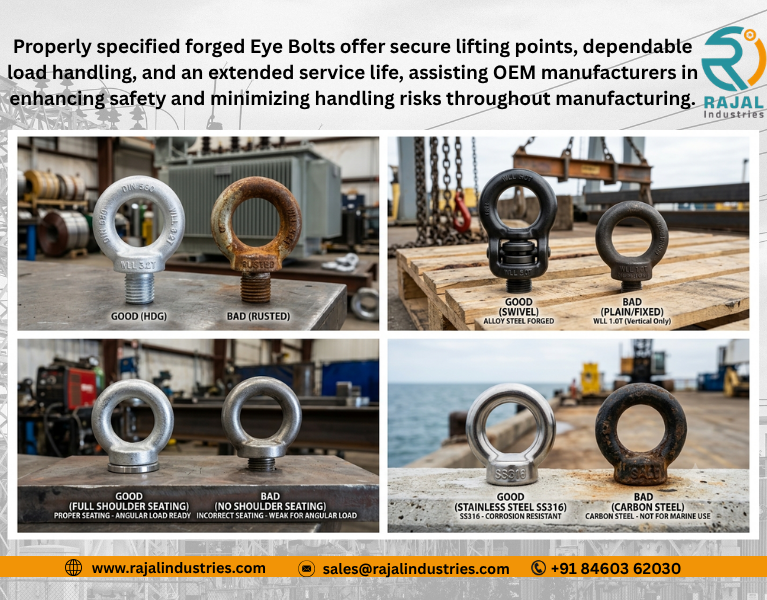
Lifting heavy industrial equipment safely requires more than cranes and lifting slings. The lifting point itself must be designed to carry the load securely while maintaining stability throughout the lifting operation. Whether handling power transformers, distribution transformers, heavy electrical equipment, industrial machinery, generators, fabricated structures or material handling equipment, selecting the correct Eye Bolt is critical for safety and operational efficiency.
An eye bolt provides a strong threaded lifting point that allows hooks, shackles, chains or wire rope slings to be attached during lifting, installation and maintenance. Depending on the application, eye bolts may be used for vertical lifting, angular lifting, rotating equipment, transportation and permanent lifting points. Many lifting-grade eye bolts are manufactured to standards such as DIN 580 or equivalent lifting specifications and require proof testing before use.
Every month, procurement engineers and OEM buyers search for Eye Bolt Manufacturer, Lifting Eye Bolt Manufacturer, Forged Eye Bolt Supplier, Industrial Eye Bolt, Transformer Lifting Eye Bolt, DIN 580 Eye Bolt, and Material Handling Eye Bolt while sourcing lifting hardware for industrial projects.
At Rajal Industries, we manufacture forged Eye Bolts and custom lifting fasteners for transformer manufacturers, electrical equipment OEMs, material handling companies, heavy machinery builders, steel fabricators and industrial equipment manufacturers requiring bulk production from 50,000+ pieces. Our products are manufactured according to customer drawings, recognised industry standards and OEM specifications.
Quick Answer
Eye Bolts are widely used for:
- Power Transformers
- Distribution Transformers
- Generator Sets
- Industrial Machinery
- Heavy Fabricated Structures
- Material Handling Equipment
- Steel Structures
- Construction Equipment
- Process Equipment
- Marine Equipment
- Lifting Fixtures
- Maintenance Operations
OEM manufacturers choose forged eye bolts because they provide:
- Safe lifting points
- High mechanical strength
- Reliable load handling
- Easy installation
- Multiple lifting configurations
- Long service life
- Available in carbon steel, alloy steel and stainless steel grades.
What is an Eye Bolt?
An Eye Bolt is a threaded fastener with a circular eye or loop formed at one end. The threaded shank is installed into the equipment or structure, while the eye provides a secure attachment point for:
- Hooks
- Shackles
- Chains
- Wire rope slings
- Lifting accessories
Unlike ordinary bolts, lifting eye bolts are specifically designed to support lifting loads and must be selected according to the required Working Load Limit (WLL), lifting angle and installation method.
Why Industrial OEMs Use Eye Bolts
Heavy equipment manufacturers use eye bolts because they simplify lifting during:
- Manufacturing
- Assembly
- Transportation
- Site installation
- Maintenance
- Equipment replacement
Properly specified eye bolts help improve:
- Lifting safety
- Equipment handling
- Installation efficiency
- Maintenance accessibility
- Worker safety
- Project productivity
Industries Using Eye Bolts
Transformer Manufacturing
Eye bolts are widely used for:
- Transformer tank lifting
- Core and coil handling
- Radiator lifting
- Conservator installation
- Transformer transportation
- Maintenance operations
Reliable lifting points help reduce handling risks during factory production and site installation.
Material Handling Equipment
Applications include:
- Hoists
- Lifting beams
- Spreader bars
- Handling fixtures
- Industrial lifting frames
Heavy Industrial Machinery
Eye bolts are commonly used on:
- Compressors
- Pumps
- CNC machines
- Gearboxes
- Industrial presses
- Process equipment
These lifting points simplify equipment movement during installation and maintenance.
Steel Fabrication
Fabricators use eye bolts for:
- Heavy fabricated assemblies
- Structural modules
- Skid-mounted equipment
- Industrial platforms
- Large welded structures
Generator & Power Equipment
Applications include:
- Generator sets
- Alternators
- Power skids
- Engine packages
- Auxiliary equipment
Marine & Offshore Equipment
Eye bolts are used for lifting:
- Marine machinery
- Ship components
- Offshore equipment
- Fabricated modules
Corrosion-resistant materials are typically specified for these environments.
Common Types of Eye Bolts
Different lifting applications require different eye bolt designs.
Common types include:
- Shoulder Eye Bolts
- Plain Eye Bolts
- Machinery Eye Bolts
- Forged Eye Bolts
- Swivel Lifting Eye Bolts
- DIN 580 Eye Bolts
- Custom OEM Eye Bolts
The final selection depends on:
- Load direction
- Lifting angle
- Working Load Limit (WLL)
- Equipment design
- Customer specifications
Common Materials
Material selection depends on lifting requirements and environmental conditions.
| Material | Typical Applications |
| Carbon Steel | General Industrial Equipment |
| Alloy Steel | Heavy Lifting Applications |
| High Strength Steel | Transformer & Heavy Machinery |
| SS304 | Food & Pharmaceutical Equipment |
| SS316 | Marine & Chemical Industries |
Material selection should consider:
- Working Load Limit
- Tensile strength
- Corrosion resistance
- Operating environment
- Expected service life
Step 1 – Determine the Lifting Requirement
Before selecting an eye bolt, determine:
- Equipment weight
- Centre of gravity
- Number of lifting points
- Lifting angle
- Lifting method
- Safety factor
These factors determine the required eye bolt size and Working Load Limit.
Step 2 – Review the Mounting Arrangement
Engineers should verify:
- Thread size
- Thread engagement
- Mounting surface
- Base material
- Available clearance
- Equipment drawing
Proper mounting is essential for safe lifting operations.
Step 3 – Select the Correct Eye Bolt Size
The eye bolt size should match:
- Equipment weight
- Thread size
- Working Load Limit
- Engineering calculations
- Lifting equipment capacity
Selecting the correct size improves lifting safety and equipment stability.
Step 4 – Select the Correct Material
Material selection should consider:
- Mechanical strength
- Corrosion exposure
- Operating environment
- Customer specifications
- Expected operating life
The correct material ensures reliable lifting performance throughout the product lifecycle.
Step 5 – Select the Correct Surface Coating
The service life of an Eye Bolt depends not only on its material but also on selecting the correct surface protection. Since eye bolts are frequently used during transportation, outdoor installation and maintenance activities, corrosion resistance is essential for maintaining lifting safety.
Before selecting a coating, engineers should evaluate:
- Indoor or outdoor use
- Humidity
- Rain exposure
- Coastal atmosphere
- Chemical exposure
- Operating temperature
- Expected service life
- Maintenance frequency
Selecting the appropriate coating helps improve durability, reduce maintenance and extend the safe operating life of the lifting point.
Zinc Plated Eye Bolts
Recommended for:
- Indoor industrial equipment
- Factory machinery
- Electrical equipment
- Material handling systems
Advantages:
- Economical
- Good indoor corrosion resistance
- Smooth surface finish
- Easy maintenance
Hot Dip Galvanized (HDG) Eye Bolts
Commonly used for:
- Outdoor transformers
- Steel structures
- Utility infrastructure
- Construction equipment
- Renewable energy projects
Advantages:
- Excellent corrosion resistance
- Long outdoor service life
- Reduced maintenance
- Suitable for harsh weather conditions
Black Oxide Eye Bolts
Suitable for:
- Industrial machinery
- Manufacturing equipment
- Indoor lifting applications
Advantages:
- Uniform appearance
- Light corrosion protection
- Suitable for controlled indoor environments
Stainless Steel Eye Bolts
Recommended for:
- Marine equipment
- Food processing plants
- Pharmaceutical industries
- Chemical plants
- Offshore installations
Advantages:
- Excellent corrosion resistance
- Long operating life
- Low maintenance
- Suitable for aggressive environments
Understanding Working Load Limit (WLL)
The Working Load Limit (WLL) is the maximum load that an eye bolt is designed to lift under specified conditions.
When selecting an eye bolt, engineers should consider:
- Equipment weight
- Number of lifting points
- Lifting angle
- Centre of gravity
- Dynamic loading
- Safety factor
The selected eye bolt should always have an adequate WLL based on approved engineering calculations.
Vertical vs Angular Lifting
The lifting angle has a direct effect on the load carried by an eye bolt.
Vertical Lifting
Suitable when:
- Load is directly below the eye bolt.
- Lifting force is aligned with the bolt axis.
- The eye bolt is fully seated.
This is the preferred lifting method because it places the least stress on the fastener.
Angular Lifting
Angular lifting introduces additional forces into the eye bolt.
Before approving angular lifting, engineers should verify:
- Permitted lifting angle
- Working Load Limit reduction
- Thread engagement
- Equipment design
- Manufacturer recommendations
As the lifting angle increases, the safe lifting capacity generally decreases. Always follow the manufacturer’s lifting instructions and applicable standards.
Installation Best Practices
Proper installation is essential for safe lifting operations.
Before using an eye bolt:
- Verify thread compatibility.
- Ensure full thread engagement.
- Tighten the eye bolt correctly against the seating surface.
- Position the eye in the intended lifting direction when required.
- Inspect for visible damage before every lift.
- Never exceed the rated Working Load Limit.
Following proper installation procedures helps improve lifting safety and equipment reliability.
Common Engineering & Procurement Mistakes
Many lifting incidents occur because the wrong eye bolt is selected or installed incorrectly.
Selecting Based Only on Thread Size
Thread size alone does not determine lifting capacity.
Selection should also consider:
- Working Load Limit
- Lifting angle
- Material
- Equipment weight
- Engineering calculations
Ignoring Lifting Direction
Some eye bolts are designed primarily for vertical lifting.
Always confirm whether the selected eye bolt is suitable for angular lifting before use.
Using Damaged Eye Bolts
Never use eye bolts that show:
- Bent eye
- Cracks
- Corrosion
- Thread damage
- Permanent deformation
Damaged lifting hardware should be removed from service immediately.
Choosing the Wrong Material
Material selection should match:
- Operating environment
- Corrosion exposure
- Mechanical loading
- Customer specifications
Sending Incomplete RFQs
Every enquiry should include:
- Thread size
- Eye bolt type
- Material
- Surface coating
- Working Load Limit (WLL)
- Quantity
- Engineering drawing
- Annual requirement
Providing complete engineering information helps suppliers recommend the correct lifting solution and prepare accurate quotations.
Quality Inspection Checklist
Before dispatch, eye bolts should be inspected for:
| Inspection Item | Verify |
| Drawing Compliance | ✔ |
| Thread Size | ✔ |
| Overall Dimensions | ✔ |
| Eye Diameter | ✔ |
| Material Grade | ✔ |
| Surface Coating | ✔ |
| Coating Thickness | ✔ |
| Working Load Limit Identification | ✔ |
| Thread Quality | ✔ |
| Dimensional Accuracy | ✔ |
| Visual Inspection | ✔ |
| Batch Traceability | ✔ |
| Material Test Certificate (If Required) | ✔ |
A documented quality inspection process helps ensure lifting safety and consistent product performance.
Why Rajal Industries?
Rajal Industries manufactures Forged Eye Bolts and Custom Lifting Fasteners for transformer manufacturers, heavy equipment OEMs and industrial lifting applications requiring dependable, high-volume production.
Our manufacturing capabilities include:
- MOQ from 50,000+ pieces
- Standard & Custom Eye Bolts
- Manufacturing as per Customer Drawings
- Carbon Steel, Alloy Steel, SS304 & SS316
- Zinc Plated, HDG, Black Oxide & Stainless Steel Finishes
- Precision Hot Forging
- CNC Thread Rolling & Machining
- Mechanical Property Verification
- Dimensional Inspection
- Batch Traceability
- OEM Packaging
- Long-Term Supply Programmes
- Export Manufacturing Support
We supply:
- Transformer Manufacturers
- Electrical Equipment OEMs
- Heavy Machinery Manufacturers
- Material Handling Equipment Companies
- Steel Fabricators
- Renewable Energy Companies
- EPC Contractors
- Industrial Infrastructure Projects
OEM RFQ Checklist
Before requesting a quotation, include:
☐ Eye Bolt Type
☐ Thread Size
☐ Working Load Limit (WLL)
☐ Material
☐ Surface Coating
☐ Quantity
☐ Annual Requirement
☐ Engineering Drawing
☐ Lifting Direction (Vertical/Angular)
☐ Packaging Specification
☐ Delivery Schedule
Providing complete technical information enables suppliers to recommend the correct eye bolt and prepare accurate commercial quotations.
Key Takeaways
- Eye bolts provide safe and reliable lifting points for transformers, heavy machinery and industrial equipment.
- Working Load Limit (WLL), lifting angle and thread engagement are critical selection factors.
- Material and surface coating should match the operating environment.
- Proper installation and regular inspection improve lifting safety and reduce operational risk.
- Working with an experienced OEM manufacturer ensures consistent quality, engineering support and dependable long-term supply.
Frequently Asked Questions
What is an eye bolt used for?
An eye bolt provides a secure lifting point for attaching hooks, shackles, chains or wire rope slings when lifting, transporting or installing equipment.
Where are eye bolts commonly used?
They are widely used on transformers, generators, industrial machinery, fabricated structures, material handling equipment, construction machinery and marine equipment.
What is the Working Load Limit (WLL)?
The Working Load Limit (WLL) is the maximum load that an eye bolt is designed to lift safely under specified operating conditions.
Can eye bolts be used for angular lifting?
Some eye bolts are suitable for angular lifting, but their safe lifting capacity usually decreases as the lifting angle increases. Always follow the manufacturer’s recommendations and engineering calculations.
Can Rajal Industries manufacture custom eye bolts?
Yes. We manufacture standard and drawing-based eye bolts according to customer drawings, technical specifications and OEM requirements.
What is your minimum production quantity?
Rajal Industries primarily manufactures bulk OEM orders from 50,000+ pieces, depending on the product design and manufacturing process.
Conclusion
Eye Bolts are essential lifting components for transformers, heavy industrial machinery, fabricated structures and material handling equipment. Selecting the correct Working Load Limit, material, coating and installation method improves lifting safety, reduces operational risk and supports reliable long-term equipment handling.
For transformer manufacturers, electrical equipment OEMs, heavy machinery builders, steel fabricators and material handling companies, partnering with an experienced Eye Bolt Manufacturer ensures consistent product quality, engineering support and dependable long-term supply.
If your company requires Eye Bolts with bulk production from 50,000+ pieces, Rajal Industries can manufacture according to your engineering drawings, technical specifications and long-term production programmes.
Related Keywords
Eye Bolt Manufacturer, Eye Bolt, Lifting Eye Bolt, Forged Eye Bolt, DIN 580 Eye Bolt, Transformer Lifting Eye Bolt, Industrial Eye Bolt, Material Handling Eye Bolt, Heavy Duty Eye Bolt, Lifting Fasteners, Working Load Limit Eye Bolt, OEM Eye Bolt Manufacturer, Bulk Eye Bolt Supplier, Industrial Lifting Hardware.