
Heavy engineering companies design equipment that must operate reliably under some of the harshest conditions in the world. Whether manufacturing railway rolling stock, mining machinery, heavy trucks, trailers, cranes, construction equipment, structural steel or industrial process machinery, every mechanical joint must withstand continuous vibration, shock loading and years of demanding service.
A fastening failure in these applications can lead to expensive downtime, safety risks, equipment damage and significant maintenance costs. Because of this, many OEM manufacturers choose Huck Bolts instead of conventional nuts, bolts or rivets for critical structural joints.
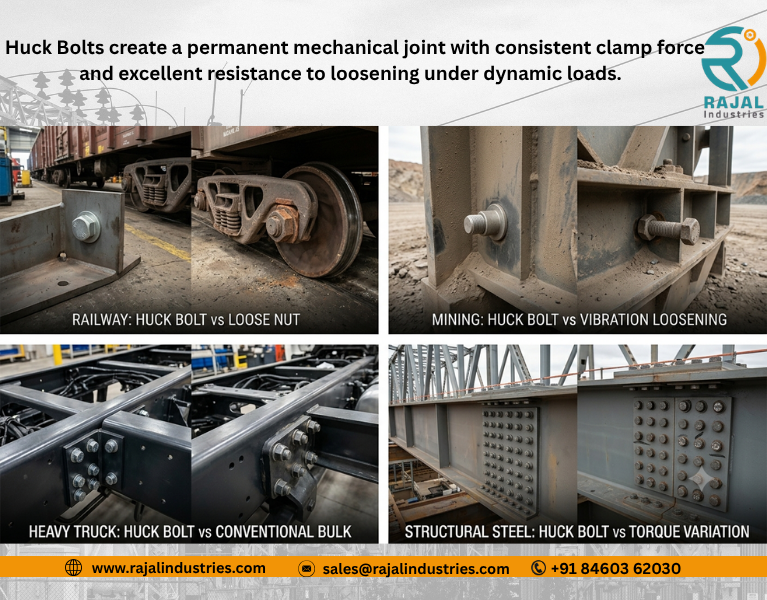
Huck bolts create a permanent, high-strength mechanical connection that delivers consistent clamp force and excellent resistance to vibration and fatigue. These characteristics have made them a preferred fastening solution across many heavy engineering industries.
Every month, engineers, procurement managers and design teams search for Huck Bolt Applications, Industrial Huck Bolt, Heavy Equipment Fasteners, Railway Huck Bolt, Mining Equipment Fasteners, Structural Lock Bolt, and Heavy Duty Lock Bolt while selecting fastening systems for OEM production.
At Rajal Industries, we manufacture Huck Bolts and custom lock bolt assemblies for railway manufacturers, mining equipment companies, truck and trailer OEMs, construction equipment manufacturers, steel fabricators and industrial machinery builders requiring bulk production from 50,000+ pieces. We manufacture according to customer drawings, recognised industry standards and OEM specifications.
Quick Answer
Heavy engineering companies use Huck Bolts because they provide:
- Permanent mechanical locking
- High clamp force
- Excellent vibration resistance
- Superior fatigue performance
- High shear and tensile strength
- Fast production assembly
- Reduced maintenance
- Long service life
These benefits make Huck bolts suitable for:
- Railway rolling stock
- Mining equipment
- Heavy trucks
- Construction machinery
- Steel structures
- Industrial machinery
- Material handling systems
- Infrastructure equipment
Why Fastener Selection Matters in Heavy Engineering
Unlike general industrial equipment, heavy engineering products operate under constant mechanical stress.
Typical operating conditions include:
- Continuous vibration
- Dynamic loading
- Heavy static loads
- Shock loading
- Fatigue cycles
- Outdoor weather
- Dust and contamination
- Temperature variations
Fasteners used in these applications must maintain joint integrity throughout the equipment’s operating life.
A well-designed fastening system improves:
- Equipment reliability
- Operator safety
- Structural stability
- Production efficiency
- Maintenance intervals
- Overall lifecycle performance
What Makes Huck Bolts Different?
Unlike conventional threaded fasteners, Huck bolts create a permanent mechanical joint using:
- High-strength pin
- Precision locking collar
- Hydraulic or pneumatic installation tool
Once installed, the collar is permanently swaged into the locking grooves of the pin, creating a joint that resists loosening under vibration without relying on thread friction.
This makes Huck bolts particularly suitable for equipment exposed to repeated dynamic loading.
Industries That Depend on Huck Bolts
Railway Industry
Railway manufacturers rely on Huck bolts for components subjected to continuous movement and vibration.
Typical applications include:
- Freight wagons
- Passenger coaches
- Locomotive assemblies
- Bogies
- Rail maintenance equipment
- Structural frames
Reliable fastening helps improve long-term operational safety while reducing maintenance requirements.
Mining Equipment
Mining equipment operates under some of the harshest working conditions.
Common applications include:
- Crushers
- Screens
- Excavators
- Conveyors
- Haul trucks
- Material handling systems
Permanent fastening helps reduce downtime caused by joint loosening and repeated maintenance.
Heavy Truck & Trailer Manufacturing
Truck and trailer manufacturers commonly use Huck bolts for:
- Chassis assemblies
- Trailer frames
- Container trailers
- Tipper bodies
- Heavy commercial vehicles
- Special-purpose transport equipment
High clamp force helps maintain structural integrity even under heavy road vibration.
Construction Equipment
Construction machinery experiences frequent impact loading and continuous vibration.
Typical applications include:
- Cranes
- Earthmoving equipment
- Concrete machinery
- Asphalt equipment
- Mobile lifting equipment
- Utility vehicles
Reliable fastening contributes to equipment durability and reduced service interruptions.
Structural Steel Fabrication
Steel fabricators use Huck bolts for:
- Industrial platforms
- Steel bridges
- Pipe racks
- Utility structures
- Heavy fabricated assemblies
Permanent locking improves structural reliability in demanding environments.
Industrial Machinery
Industrial OEMs commonly use Huck bolts in:
- Process equipment
- Manufacturing machinery
- Material handling systems
- Industrial presses
- Power generation equipment
- Heavy fabrication equipment
Why OEM Manufacturers Prefer Huck Bolts
Modern OEM manufacturers focus on:
- Product reliability
- Faster assembly
- Reduced warranty claims
- Lower maintenance
- Improved customer satisfaction
Huck bolts support these objectives by providing:
- Consistent installation quality
- Reliable clamp force
- Excellent fatigue resistance
- Permanent fastening
- Reduced inspection requirements
Step 1 – Evaluate the Operating Environment
Before selecting a fastening system, engineers should review:
- Indoor or outdoor installation
- Vibration levels
- Operating temperature
- Corrosion exposure
- Maintenance access
- Expected service life
These conditions influence the required fastener design, material and coating.
Step 2 – Analyse Joint Loading
Every structural joint should be evaluated for:
- Static loading
- Dynamic loading
- Impact loading
- Fatigue cycles
- Shear forces
- Tensile forces
Accurate load analysis helps determine whether a Huck bolt is the appropriate fastening solution.
Step 3 – Consider Production Efficiency
OEM manufacturers should assess:
- Assembly time
- Installation consistency
- Tooling requirements
- Production volume
- Automation capability
Huck bolts are widely used in high-volume manufacturing because they allow fast, repeatable installation with consistent joint quality.
Step 4 – Plan for Long-Term Reliability
Heavy engineering equipment is expected to operate for many years.
During fastener selection, consider:
- Maintenance intervals
- Joint accessibility
- Replacement costs
- Downtime impact
- Overall lifecycle cost
Selecting the right fastening system during the design stage helps reduce long-term operating costs and improve equipment reliability.
Industry-Specific Advantages of Huck Bolts
Different industries choose Huck bolts for different engineering reasons. While the fastening system remains the same, the benefits vary depending on the operating environment and equipment design.
Railway Industry
Railway rolling stock operates under continuous vibration, impact loading and changing weather conditions.
Huck bolts help railway manufacturers achieve:
- Permanent structural fastening
- High vibration resistance
- Reliable clamp force
- Reduced maintenance intervals
- Improved passenger safety
- Longer service life
Typical railway applications include:
- Freight wagons
- Passenger coaches
- Bogies
- Locomotive structures
- Rail maintenance vehicles
Mining Industry
Mining equipment works in dusty, abrasive and high-impact environments.
Huck bolts help improve:
- Joint reliability
- Structural integrity
- Equipment uptime
- Resistance to repeated shock loading
- Maintenance efficiency
Common applications include:
- Crushers
- Screens
- Conveyors
- Excavators
- Haul trucks
- Processing equipment
Heavy Truck & Trailer Industry
Commercial vehicles experience continuous road vibration throughout their operating life.
Huck bolts provide:
- Consistent clamp force
- Reduced joint loosening
- Improved chassis durability
- Lower maintenance requirements
- Long-term structural reliability
Applications include:
- Truck chassis
- Trailer frames
- Tipper bodies
- Tanker trailers
- Container trailers
- Heavy transport equipment
Construction Equipment
Construction machinery operates under heavy mechanical stress.
Huck bolts improve:
- Equipment durability
- Structural stability
- Resistance to impact loading
- Long service life
Applications include:
- Cranes
- Excavators
- Concrete pumps
- Asphalt plants
- Earthmoving equipment
- Mobile lifting systems
Structural Steel Industry
Steel fabricators use Huck bolts where permanent fastening is required.
Applications include:
- Steel bridges
- Industrial platforms
- Pipe racks
- Utility structures
- Heavy fabricated assemblies
Reliable fastening improves long-term structural performance while reducing inspection requirements.
Selecting the Correct Material & Surface Coating
Material selection should always match the operating environment and structural requirements.
Common materials include:
| Material | Typical Applications |
| Carbon Steel | General Industrial Equipment |
| Alloy Steel | Heavy Structural Applications |
| High Strength Steel | Railway & Mining Equipment |
| Stainless Steel | Marine & Chemical Industries |
Material selection should consider:
- Mechanical strength
- Fatigue resistance
- Corrosion resistance
- Service environment
- Expected operating life
Common Surface Coatings
Depending on the operating conditions, Huck bolts are available with:
- Zinc Plated
- Hot Dip Galvanized (HDG)
- Geomet Coating
- Zinc Flake Coatings
- Stainless Steel Finish
Outdoor infrastructure, mining operations and coastal projects typically require higher corrosion protection than indoor industrial installations.
Huck Bolts vs Conventional Nuts & Bolts
Many heavy engineering companies replace conventional threaded fasteners with Huck bolts because of their superior performance in demanding applications.
| Feature | Huck Bolt | Conventional Nut & Bolt |
| Permanent Locking | ✔ | ✘ |
| Clamp Force Consistency | Excellent | Depends on Torque |
| Resistance to Loosening | Excellent | Moderate |
| Vibration Resistance | Excellent | Moderate |
| Fatigue Performance | Excellent | Good |
| Re-Tightening Required | No | Often Required |
| Maintenance | Low | Higher |
| Heavy Engineering Applications | ✔ | Limited |
For equipment exposed to constant vibration and dynamic loading, Huck bolts generally provide a more dependable long-term fastening solution.
Common Engineering & Procurement Mistakes
Many fastening problems originate during the design or procurement stage.
Selecting Fasteners Based Only on Purchase Price
A lower-priced fastener may result in:
- More maintenance
- Increased downtime
- Higher replacement costs
- Reduced equipment reliability
Evaluate the total life-cycle cost rather than only the purchase price.
Ignoring Installation Equipment
Huck bolts require compatible hydraulic or pneumatic installation tools.
Before approving production, verify:
- Tool availability
- Nose assembly compatibility
- Operator training
- Production line integration
Selecting the Wrong Grip Range
Grip range should match:
- Total material thickness
- Manufacturing tolerances
- Joint design
- Engineering drawings
Incorrect grip range may reduce clamp force and installation quality.
Choosing the Wrong Material or Coating
Material and coating should match:
- Operating environment
- Corrosion exposure
- Mechanical loading
- Customer specifications
Using an unsuitable material or finish can reduce fastener life and increase maintenance.
Sending Incomplete RFQs
Every enquiry should include:
- Bolt diameter
- Grip range
- Material
- Surface coating
- Quantity
- Engineering drawing
- Annual requirement
- Performance requirements
Complete technical information helps suppliers recommend the correct Huck bolt system and prepare accurate quotations.
Quality Inspection Checklist
Before dispatch, Huck bolts should be inspected for:
| Inspection Item | Verify |
| Drawing Compliance | ✔ |
| Bolt Diameter | ✔ |
| Grip Range | ✔ |
| Pin Dimensions | ✔ |
| Collar Dimensions | ✔ |
| Material Grade | ✔ |
| Surface Coating | ✔ |
| Coating Thickness | ✔ |
| Mechanical Properties | ✔ |
| Hardness (If Required) | ✔ |
| Dimensional Accuracy | ✔ |
| Visual Inspection | ✔ |
| Batch Traceability | ✔ |
| Material Test Certificate (If Required) | ✔ |
A structured inspection process helps ensure consistent quality and dependable field performance across every production batch.
Why Rajal Industries?
Rajal Industries manufactures Huck Bolts and Lock Bolt Assemblies for heavy engineering OEMs requiring dependable, large-scale production.
Our manufacturing capabilities include:
- MOQ from 50,000+ pieces
- Standard & Custom Huck Bolt Systems
- Manufacturing as per Customer Drawings
- Carbon Steel, Alloy Steel & Stainless Steel
- Zinc Plated, HDG, Geomet & Zinc Flake Coatings
- Precision Cold Forging
- CNC Machining & Precision Manufacturing
- Controlled Heat Treatment
- Mechanical Property Verification
- Dimensional Inspection
- Batch Traceability
- OEM Packaging
- Long-Term Supply Programmes
- Export Manufacturing Support
We support:
- Railway Manufacturers
- Mining Equipment OEMs
- Heavy Truck & Trailer Manufacturers
- Construction Equipment Companies
- Steel Fabricators
- Heavy Industrial Machinery Manufacturers
- Material Handling Equipment OEMs
- Infrastructure Projects
OEM RFQ Checklist
Before requesting a quotation, include:
☐ Bolt Diameter
☐ Grip Range
☐ Material
☐ Surface Coating
☐ Quantity
☐ Annual Requirement
☐ Engineering Drawing
☐ Performance Requirements
☐ Installation Tool Information (If Applicable)
☐ Packaging Specification
☐ Delivery Schedule
Providing complete technical information helps suppliers recommend the correct Huck bolt solution and prepare accurate commercial quotations.
Key Takeaways
- Huck bolts are widely used across railway, mining, construction, heavy trucks, structural steel and industrial machinery because they provide permanent, vibration-resistant fastening.
- High clamp force and excellent fatigue resistance improve equipment reliability in demanding operating conditions.
- Proper material selection, coating and grip range are essential for long-term performance.
- Compatible installation tools and quality inspection ensure consistent joint integrity.
- Working with an experienced OEM manufacturer supports reliable production, consistent quality and dependable long-term supply.
Frequently Asked Questions
Why do heavy engineering companies prefer Huck bolts?
Heavy engineering companies prefer Huck bolts because they provide permanent fastening, high clamp force, excellent vibration resistance and lower maintenance than conventional threaded fasteners in demanding applications.
Which industries commonly use Huck bolts?
Huck bolts are widely used in railway manufacturing, mining equipment, heavy trucks, trailers, construction machinery, structural steel fabrication, material handling systems and industrial process equipment.
Can Huck bolts replace conventional nuts and bolts?
In many high-vibration and high-load applications they can, provided the design, installation method and engineering requirements support their use.
Are Huck bolts suitable for outdoor equipment?
Yes. With the correct material and corrosion-resistant coating such as Hot Dip Galvanized (HDG) or Geomet, Huck bolts are suitable for many outdoor industrial applications.
Can Rajal Industries manufacture custom Huck bolts?
Yes. We manufacture standard and drawing-based Huck bolts and lock bolt assemblies according to customer drawings, technical specifications and OEM requirements.
What is your minimum production quantity?
Rajal Industries primarily manufactures bulk OEM orders from 50,000+ pieces, depending on the product design, dimensions and manufacturing process.
Conclusion
Heavy engineering companies choose Huck Bolts because they deliver the combination of high clamp force, permanent mechanical locking, excellent vibration resistance and long-term durability required in demanding industrial environments. From railway rolling stock and mining equipment to heavy trucks, construction machinery and structural steel, Huck bolts help improve equipment reliability while reducing maintenance and lifecycle costs.
For railway manufacturers, mining equipment companies, truck and trailer OEMs, construction equipment manufacturers, steel fabricators and heavy industrial machinery builders, partnering with an experienced Huck Bolt Manufacturer ensures consistent product quality, engineering support and dependable long-term supply.
If your company requires Huck Bolts with bulk production from 50,000+ pieces, Rajal Industries can manufacture according to your engineering drawings, OEM specifications and long-term production programmes.
Related Keywords
Huck Bolt Applications, Huck Bolt, Industrial Huck Bolt, Heavy Equipment Fasteners, Railway Huck Bolt, Mining Equipment Fasteners, Lock Bolt Applications, Structural Lock Bolt, Permanent Fastening System, High Strength Lock Bolt, Heavy Engineering Fasteners, OEM Huck Bolt Manufacturer, Bulk Lock Bolt Supplier, Industrial Fasteners.