

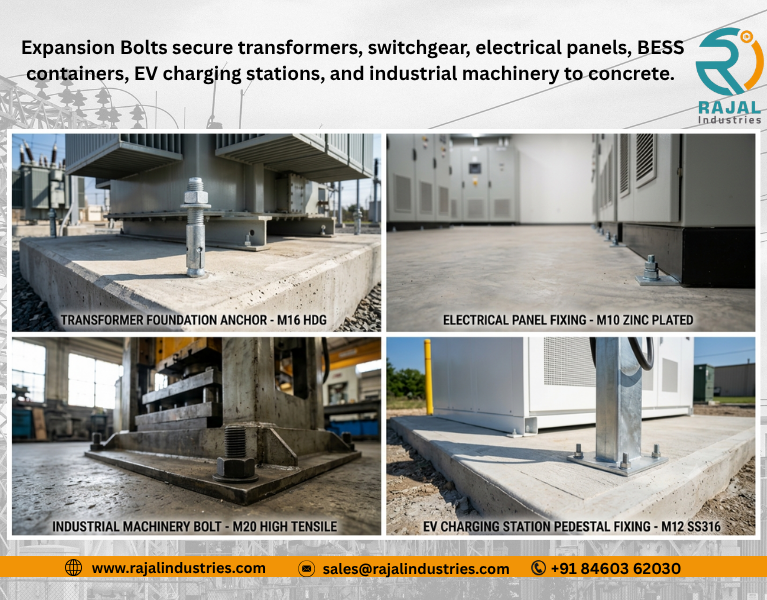
Every electrical installation depends on one critical but often overlooked component—the foundation fastening system. Whether installing a power transformer, switchgear, electrical panel, Battery Energy Storage System (BESS), industrial control panel or utility equipment, the entire system relies on secure anchoring to maintain alignment, withstand vibration and ensure long-term operational safety.
Among the most widely used post-installed concrete anchors in the electrical industry is the Expansion Bolt. It provides a reliable mechanical connection between equipment and concrete foundations, making it an ideal solution for new installations, plant expansions and retrofit projects.
Every month, engineers, consultants, EPC contractors and procurement managers search for Expansion Bolt Applications, Expansion Bolt for Transformer, Expansion Bolt for Electrical Panel, Switchgear Expansion Bolt, Concrete Expansion Bolt, Heavy Duty Expansion Bolt, and Industrial Expansion Bolt while preparing technical specifications and procurement documents.
At Rajal Industries, we manufacture Expansion Bolts for transformer manufacturers, electrical equipment OEMs, switchgear manufacturers, industrial machinery builders, renewable energy companies and EPC contractors requiring bulk production from 50,000+ pieces. Our products are manufactured according to customer drawings and engineering specifications with consistent quality, dimensional accuracy and reliable long-term supply.
Quick Answer
Expansion Bolts are commonly used in:
- Power Transformers
- Distribution Transformers
- Compact Substations
- Electrical Panels
- LT & HT Panels
- Switchgear
- Motor Control Centres (MCC)
- Power Control Centres (PCC)
- Battery Energy Storage Systems (BESS)
- EV Charging Stations
- Cable Tray Supports
- Industrial Machinery
- Steel Structures
- Utility Infrastructure
They are selected because they provide:
- Fast installation
- Reliable holding strength
- Excellent vibration resistance
- Easy maintenance
- Suitable for existing concrete foundations
Why Expansion Bolts Are Widely Used in Electrical Projects
Electrical equipment is expected to operate continuously for decades under varying environmental and mechanical conditions.
Typical operating conditions include:
- Equipment weight
- Continuous vibration
- Thermal expansion
- Switching operations
- Cable pulling forces
- Maintenance activities
- Outdoor weather exposure
Expansion bolts help maintain:
- Equipment stability
- Foundation integrity
- Accurate equipment alignment
- Safe electrical clearances
- Long-term operational reliability
Expansion Bolts Used in Power Transformer Installations
Power transformers are among the heaviest electrical assets installed in substations and industrial facilities.
Expansion bolts are commonly used for:
Transformer Base Frame Installation
Applications include:
- Transformer skid mounting
- Base channel fixing
- Foundation plate installation
- Equipment support structures
Proper anchoring reduces equipment movement and helps maintain alignment throughout the transformer’s service life.
Distribution Transformer Installations
Distribution transformers installed in:
- Industrial plants
- Commercial buildings
- Utility substations
- Renewable energy projects
often require expansion bolts when mounted on existing concrete foundations.
Compact Substations
Expansion bolts secure:
- Transformer compartments
- RMU foundations
- Control panels
- Structural support frames
Reliable anchoring is essential because compact substations combine multiple electrical systems within a limited installation space.
Expansion Bolts Used in Electrical Panel Installations
Electrical panels require rigid mounting to maintain equipment alignment and ensure safe cable termination.
Typical applications include:
- Main Distribution Boards (MDB)
- Power Control Centres (PCC)
- Motor Control Centres (MCC)
- LT Panels
- HT Panels
- PLC Panels
- Automation Panels
- Distribution Boards
Expansion bolts provide secure fixing while allowing relatively simple installation on finished concrete floors.
Expansion Bolts Used in Switchgear Installations
Modern switchgear systems contain heavy electrical components that require reliable anchoring.
Applications include:
- Indoor switchgear
- Outdoor switchgear
- Ring Main Units (RMU)
- GIS switchgear
- AIS switchgear
- Relay panels
Secure anchoring helps minimise movement during switching operations and maintenance activities.
Expansion Bolts Used in Battery Energy Storage Systems (BESS)
BESS projects continue to grow worldwide, creating increasing demand for reliable fastening systems.
Expansion bolts are widely used for:
- Battery container foundations
- Inverter skids
- Transformer skids
- Cooling systems
- Fire protection equipment
- Electrical control cabinets
Because many BESS projects are installed outdoors, corrosion-resistant coatings are commonly specified.
Expansion Bolts Used in EV Charging Infrastructure
EV charging stations require dependable anchoring for:
- Charging pedestals
- Electrical cabinets
- Transformer kiosks
- Equipment enclosures
- Protection barriers
- Foundation frames
Fast installation makes expansion bolts particularly suitable for large EV infrastructure projects.
Expansion Bolts Used in Cable Tray & Busbar Support Systems
Electrical distribution systems rely on properly supported cable routes.
Expansion bolts are commonly used for:
- Cable tray brackets
- Busbar support structures
- Junction box supports
- Instrumentation frames
- Conduit supports
Secure anchoring prevents movement caused by cable weight and maintenance activities.
Expansion Bolts Used in Industrial Machinery
Manufacturing facilities often install machinery after the factory floor has already been completed.
Expansion bolts are widely used for:
- CNC machines
- Hydraulic presses
- Compressors
- Pumps
- Packaging equipment
- Conveyor systems
Proper anchoring helps improve machine stability, reduce vibration and maintain production accuracy.
Step 1 – Identify the Equipment
Before selecting an expansion bolt, determine:
- Equipment type
- Equipment weight
- Installation location
- Expected service life
Different electrical equipment requires different anchor capacities.
Step 2 – Review Foundation Conditions
Engineers should verify:
- Concrete grade
- Foundation thickness
- Edge distance
- Anchor spacing
- Existing reinforcement
- Installation environment
Foundation quality directly influences anchor performance.
Step 3 – Select the Correct Expansion Bolt Size
Common industrial sizes include:
| Thread Size | Typical Applications |
| M8 | Junction Boxes & Small Panels |
| M10 | Electrical Panels |
| M12 | Distribution Transformers |
| M16 | Switchgear & Heavy Panels |
| M20 | Industrial Machinery |
| M24 | Steel Structures |
| M30 | Utility Infrastructure |
Final anchor size should always be based on engineering calculations, equipment loads and project specifications.
Step 4 – Select the Correct Material
Material selection should consider:
- Equipment load
- Corrosion exposure
- Installation environment
- Customer specifications
- Expected operating life
Common materials include:
- Carbon Steel
- High Tensile Steel
- SS304
- SS316
Selecting the correct material improves safety, corrosion resistance and long-term reliability.
Step 5 – Select the Correct Surface Coating
The service life of an Expansion Bolt depends not only on its design but also on selecting the correct corrosion protection. Electrical installations are often exposed to rain, humidity, industrial pollution and changing temperatures, making surface coating an important part of the specification.
Before selecting a coating, engineers should evaluate:
- Indoor or outdoor installation
- Humidity
- Rain exposure
- Coastal atmosphere
- Chemical exposure
- Operating temperature
- Expected service life
- Maintenance accessibility
Selecting the correct coating helps reduce corrosion, improve equipment reliability and minimise maintenance costs.
Zinc Plated Expansion Bolts
Recommended for:
- Indoor electrical panels
- Switchgear rooms
- Control rooms
- Automation systems
- Factory machinery
Advantages:
- Economical
- Smooth finish
- Suitable for dry indoor environments
- Easy maintenance
Hot Dip Galvanized (HDG) Expansion Bolts
Commonly used for:
- Outdoor transformers
- Electrical substations
- Steel structures
- Utility infrastructure
- Solar projects
- Telecom installations
Advantages:
- Excellent corrosion resistance
- Long outdoor service life
- Lower maintenance costs
- Suitable for harsh weather conditions
Geomet & Dacromet Coated Expansion Bolts
Recommended for:
- Battery Energy Storage Systems (BESS)
- EV charging infrastructure
- Renewable energy projects
- Coastal installations
- Heavy industrial environments
Advantages:
- Excellent salt spray resistance
- Uniform coating thickness
- Long-term corrosion protection
- Better durability in corrosive environments
Stainless Steel Expansion Bolts
Suitable for:
- Food processing plants
- Pharmaceutical industries
- Chemical plants
- Marine applications
Advantages:
- Excellent corrosion resistance
- Long operating life
- Low maintenance
- Suitable for highly corrosive environments
Industry-Wise Recommendations
Different electrical applications have different fastening requirements.
| Industry | Typical Applications |
| Transformer Manufacturing | Base Frame & Foundation Fixing |
| Electrical Panels | Floor Mounted Panels |
| Switchgear | Equipment Foundations |
| BESS | Battery Container Foundations |
| EV Charging Stations | Charging Pedestals |
| Cable Tray Systems | Support Brackets |
| Industrial Machinery | Machine Foundations |
| Steel Structures | Base Plate Installation |
| Utility Infrastructure | Outdoor Equipment Foundations |
The final expansion bolt specification should always follow the engineering drawing and project requirements.
Installation Best Practices
Correct installation is essential for achieving reliable holding strength.
Before installation:
- Verify concrete has reached the required strength.
- Drill holes to the specified diameter and depth.
- Remove all dust and debris from the hole.
- Ensure the anchor is fully seated.
- Check alignment with the equipment base plate.
- Tighten according to the recommended torque.
Proper installation helps maximise holding capacity and improve long-term equipment stability.
Common Engineering & Procurement Mistakes
Many field failures occur because of incorrect selection or installation.
Selecting the Wrong Expansion Bolt Size
Expansion bolt size should always be selected according to:
- Equipment weight
- Dynamic loading
- Foundation design
- Safety factor
- Engineering calculations
Ignoring Concrete Quality
Expansion bolts rely on the surrounding concrete to develop their holding strength.
Always verify:
- Concrete grade
- Foundation thickness
- Edge distance
- Existing cracks
- Installation location
Choosing the Wrong Surface Coating
Indoor zinc-plated fasteners should not be used in outdoor substations, transformer yards or coastal environments.
Always match the coating with the service conditions.
Poor Hole Preparation
Before installation, confirm:
- Hole diameter
- Hole depth
- Hole cleanliness
- Proper anchor seating
Incorrect drilling or dirty holes may reduce holding capacity.
Buying Only on Price
The lowest-cost expansion bolt may not provide:
- Consistent material quality
- Accurate dimensions
- Reliable coatings
- Batch traceability
- Engineering support
OEM buyers should evaluate the supplier’s technical capability, quality systems and production capacity in addition to price.
Sending Incomplete RFQs
Every enquiry should include:
- Thread size
- Anchor diameter
- Overall length
- Material
- Surface coating
- Quantity
- Engineering drawing
- Installation environment
Complete technical information helps suppliers recommend the correct expansion bolt and prepare accurate quotations.
Quality Inspection Checklist
Before dispatch, expansion bolts should be inspected for:
| Inspection Item | Verify |
| Drawing Compliance | ✔ |
| Thread Size | ✔ |
| Anchor Diameter | ✔ |
| Overall Length | ✔ |
| Expansion Sleeve Dimensions | ✔ |
| Material Grade | ✔ |
| Surface Coating | ✔ |
| Coating Thickness | ✔ |
| Thread Quality | ✔ |
| Dimensional Accuracy | ✔ |
| Visual Inspection | ✔ |
| Batch Traceability | ✔ |
| Material Test Certificate (If Required) | ✔ |
A structured inspection process helps ensure reliable installation and consistent product performance across large projects.
Why Rajal Industries?
Rajal Industries manufactures Expansion Bolts for transformer manufacturers, electrical equipment OEMs and industrial infrastructure projects requiring dependable, high-volume production.
Our manufacturing capabilities include:
- MOQ from 50,000+ pieces
- Standard & Custom Expansion Bolts
- Manufacturing as per Customer Drawings
- Carbon Steel, High Tensile Steel, SS304 & SS316
- Zinc Plated, Hot Dip Galvanized, Geomet & Dacromet Coatings
- Precision Cold Forging
- CNC Thread Rolling
- Dimensional Inspection
- Batch Traceability
- OEM Packaging
- Long-Term Supply Programmes
- Export Manufacturing Support
We supply:
- Transformer Manufacturers
- Electrical Panel Manufacturers
- Switchgear Manufacturers
- Industrial Machinery OEMs
- Steel Structure Fabricators
- Renewable Energy Companies
- EPC Contractors
- Utility Infrastructure Projects
OEM & EPC RFQ Checklist
Before requesting a quotation, include:
☐ Thread Size
☐ Anchor Diameter
☐ Overall Length
☐ Material
☐ Surface Coating
☐ Quantity
☐ Annual Requirement
☐ Engineering Drawing
☐ Concrete Grade (If Applicable)
☐ Installation Environment
☐ Packaging Specification
☐ Delivery Schedule
Providing complete engineering information helps suppliers recommend the correct expansion bolt and prepare accurate commercial quotations.
Key Takeaways
- Expansion bolts are widely used for transformers, switchgear, electrical panels, cable tray systems and industrial machinery.
- Proper anchor selection improves equipment stability, vibration resistance and long-term operational safety.
- Surface coating should always match the installation environment.
- Correct installation and quality inspection maximise holding performance and service life.
- Working with an experienced OEM manufacturer ensures consistent quality, engineering support and dependable long-term supply.
Frequently Asked Questions
Where are expansion bolts commonly used in the electrical industry?
They are widely used for transformers, electrical panels, switchgear, MCCs, PCCs, Battery Energy Storage Systems (BESS), EV charging stations, cable tray supports and utility infrastructure.
Are expansion bolts suitable for outdoor transformer installations?
Yes. Expansion bolts with Hot Dip Galvanized (HDG), Geomet or Dacromet coatings are commonly used for outdoor transformer and substation applications where corrosion resistance is important.
Which expansion bolt size is commonly used for electrical equipment?
M10, M12, M16 and M20 are commonly used, depending on the equipment weight and engineering design. The final size should always follow project calculations and approved drawings.
Can expansion bolts be installed in existing concrete?
Yes. Expansion bolts are specifically designed for post-installed applications and are widely used in retrofit projects and equipment upgrades.
Can Rajal Industries manufacture custom expansion bolts?
Yes. We manufacture standard and drawing-based expansion bolts according to customer drawings, technical specifications and OEM requirements.
What is your minimum production quantity?
Rajal Industries primarily manufactures bulk OEM orders from 50,000+ pieces, depending on the product, design and manufacturing process.
Conclusion
Expansion Bolts play an important role in securing transformers, switchgear, electrical panels, industrial machinery and utility infrastructure to concrete foundations. Selecting the correct bolt size, material, coating and installation method helps improve equipment stability, reduce maintenance and support reliable long-term operation.
For transformer manufacturers, electrical equipment OEMs, switchgear manufacturers, EPC contractors and industrial infrastructure companies, partnering with an experienced Expansion Bolt Manufacturer ensures consistent product quality, engineering support and dependable long-term supply.
If your company requires Expansion Bolts with bulk production from 50,000+ pieces, Rajal Industries can manufacture according to your engineering drawings, project specifications and long-term production requirements.
Related Keywords
Expansion Bolt, Expansion Bolt Applications, Expansion Bolt for Transformer, Expansion Bolt for Switchgear, Expansion Bolt for Electrical Panel, Concrete Expansion Bolt, Heavy Duty Expansion Bolt, Industrial Expansion Bolt, Transformer Foundation Bolt, Electrical Equipment Anchor Bolt, Utility Expansion Bolt, OEM Expansion Bolt Manufacturer, Bulk Expansion Bolt Supplier, Industrial Fasteners.