

When engineers prepare a structural steel project, selecting the correct HSFG Bolt Specifications is one of the most important design decisions. A bolt with the wrong grade, dimensions or standard can affect preload, slip resistance and the long-term performance of the complete structure.
Procurement teams often search for HSFG Bolt Specifications, HSFG Bolt Grades, HSFG Bolt Standards, HSFG Bolt Dimensions, IS 3757 HSFG Bolt, DIN 6914 Bolt, and High Strength Friction Grip Bolt Specifications while qualifying suppliers or preparing RFQs for large infrastructure projects.
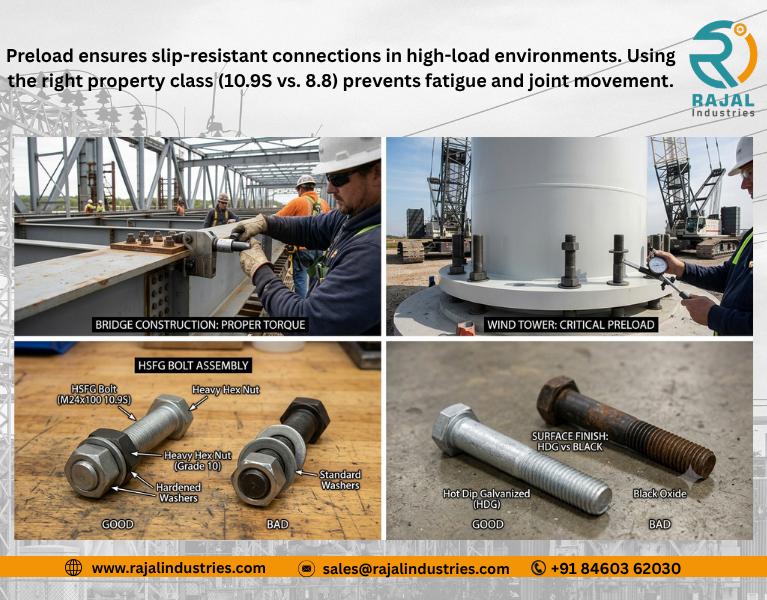
Unlike ordinary structural fasteners, HSFG bolts are designed to work as part of a complete bolting assembly. The bolt, nut and washer are engineered to achieve a specified preload so that loads are transferred through friction between steel plates instead of allowing movement within the joint.
At Rajal Industries, we manufacture HSFG Bolt Assemblies for structural steel fabricators, EPC contractors, bridge contractors, PEB manufacturers and industrial OEMs requiring bulk production from 50,000+ pieces. Our products are manufactured according to recognised international standards and customer drawings.
Quick Answer
An HSFG bolt specification normally includes:
- Applicable standard
- Bolt diameter
- Bolt length
- Property class
- Thread type
- Material
- Nut grade
- Washer specification
- Surface coating
- Required preload
- Inspection requirements
Every parameter should match the approved engineering drawing and project specification.
What is an HSFG Bolt Assembly?
Many buyers think only the bolt is important.
In reality, an HSFG connection consists of:
- HSFG Bolt
- Heavy Hex Nut
- Hardened Washers
These components are manufactured and supplied together so they achieve the required preload during installation.
Using unmatched components from different sources may affect joint performance.
Why Specifications Matter
Structural steel connections carry significant loads throughout the life of a project.
Incorrect bolt specifications may result in:
- Joint slip
- Reduced preload
- Uneven load distribution
- Installation delays
- Rework during erection
- Increased maintenance
- Reduced structural reliability
Correct specifications help ensure safe installation and predictable structural performance.
Common HSFG Bolt Standards
Different countries and projects specify different structural standards.
The most commonly used standards include:
| Standard | Typical Application |
| IS 3757 | Structural Steel Projects in India |
| DIN 6914 | Structural Steel Connections |
| EN 14399 | Preloaded Structural Bolting Assemblies |
| ASTM F3125 | Structural Steel Projects |
The applicable standard should always follow the structural design documents and project specifications.
Common HSFG Bolt Grades
The property class defines the mechanical performance of the bolt.
The most common grades include:
- 8.8S
- 10.9S
These grades are specifically intended for structural friction grip connections and are designed to work with compatible nuts and hardened washers.
The final grade selection depends on:
- Structural calculations
- Design loads
- Applicable standards
- Customer specifications
Understanding HSFG Bolt Specifications
A complete HSFG bolt specification contains several engineering parameters.
Bolt Diameter
Common structural sizes include:
- M16
- M20
- M22
- M24
- M27
- M30
- M36
The bolt diameter is selected according to structural calculations, connection design and plate thickness.
Bolt Length
Bolt length should provide:
- Proper thread engagement
- Correct nut installation
- Washer clearance
- Required grip length
An incorrect bolt length may affect preload and installation quality.
Thread Type
HSFG bolts are generally supplied with thread dimensions that comply with the applicable structural standard.
Thread quality should be carefully inspected because it directly affects tightening performance.
Nut Specification
The nut should always be compatible with:
- Bolt property class
- Applicable standard
- Mechanical requirements
Mixing incompatible nuts with HSFG bolts is not recommended.
Washer Specification
Hardened washers distribute the clamping force and protect the steel surface during tightening.
They are an important part of the complete HSFG bolting assembly.
Common Materials Used
HSFG bolts are generally manufactured from high-strength alloy steels that can achieve the required mechanical properties after heat treatment.
Material selection should consider:
- Mechanical strength
- Toughness
- Heat treatment response
- Service environment
- Applicable standards
Industries Using HSFG Bolts
Structural Steel Fabricators
Applications include:
- Columns
- Beams
- Trusses
- Roof structures
- Mezzanine floors
Pre-Engineered Building (PEB) Manufacturers
Used for:
- Portal frames
- Primary steel
- Crane structures
- Roof systems
Bridge Construction
Applications include:
- Main girders
- Cross girders
- Structural splice joints
- Steel bridge assemblies
Power Sector
Used for:
- Transformer support structures
- Switchyard steel
- Transmission towers
- Gantry structures
Renewable Energy
Widely used in:
- Wind towers
- Solar structures
- Battery Energy Storage Systems (BESS)
- Utility steelwork
Heavy Industrial Plants
Applications include:
- Steel plants
- Cement plants
- Refineries
- Petrochemical facilities
- Heavy process equipment
Step 1 – Verify the Applicable Standard
Before preparing an RFQ, confirm:
- Project standard
- Engineering drawing
- Customer specification
- Structural design requirement
The applicable standard determines the bolt dimensions, mechanical properties and inspection requirements.
Step 2 – Select the Correct Property Class
Property class should be selected according to:
- Structural load
- Joint type
- Required preload
- Engineering calculations
- Project specifications
Using a higher grade than specified does not automatically improve the connection.
Step 3 – Verify Bolt Assembly Compatibility
An HSFG bolting assembly should always be checked for compatibility.
Verify:
- Bolt
- Nut
- Hardened washer
- Property class
- Applicable standard
Using matched components helps achieve the specified preload and reliable structural performance.
Step 4 – Review Dimensional Requirements
Before releasing production, verify:
- Bolt diameter
- Bolt length
- Thread dimensions
- Grip length
- Washer size
- Nut dimensions
Even small dimensional differences can create installation problems on structural projects.
Step 5 – Understand HSFG Bolt Preload Requirements
The most important feature of an HSFG Bolt Assembly is its ability to achieve the specified preload during installation.
Unlike ordinary bolts, HSFG bolts are tightened until the required clamping force is developed between the connected steel plates. This preload allows loads to be transferred through friction rather than allowing movement within the joint.
Correct preload provides:
- Slip-resistant connections
- Improved fatigue performance
- Better vibration resistance
- Reduced joint movement
- Long-term structural reliability
- Lower maintenance requirements
For this reason, correct tightening procedures are as important as selecting the correct bolt specification.
Step 6 – Select the Correct Surface Finish
The surface finish should always match the project environment.
Before selecting a finish, engineers should evaluate:
- Indoor or outdoor installation
- Humidity
- Rain exposure
- Coastal atmosphere
- Chemical exposure
- Service life
- Maintenance schedule
Black Finish HSFG Bolts
Commonly used for:
- Factory buildings
- Indoor structural steel
- Heavy industrial equipment
- Mechanical structures
Advantages:
- Good dimensional accuracy
- Cost-effective
- Suitable for controlled indoor environments
Hot Dip Galvanized (HDG) HSFG Bolts
Recommended for:
- Transmission towers
- Outdoor substations
- Bridges
- Solar mounting systems
- Wind energy projects
- Utility infrastructure
Advantages:
- Excellent corrosion resistance
- Long outdoor service life
- Lower maintenance costs
- Suitable for severe weather conditions
Zinc Flake (Geomet / Dacromet) Coatings
Widely used for:
- Renewable energy projects
- Telecom infrastructure
- Heavy industrial structures
- Corrosive environments
Advantages:
- Excellent salt spray resistance
- Uniform coating thickness
- Long-term corrosion protection
Mechanical Property Verification
HSFG bolts should never be accepted based only on appearance.
Proper verification should include:
- Property class confirmation
- Material verification
- Heat treatment verification
- Thread inspection
- Dimensional inspection
- Surface finish inspection
- Mechanical property testing (when specified)
These inspections help ensure that every bolting assembly performs as designed.
Common Specification & Procurement Mistakes
Many structural installation problems begin before the bolts reach the project site.
Ordering Only the Bolt
An HSFG connection requires a complete assembly consisting of:
- HSFG Bolt
- Heavy Hex Nut
- Hardened Washers
Ordering only the bolt may create compatibility issues.
Selecting the Wrong Property Class
Choosing an incorrect grade can affect preload, structural performance and compliance with project specifications.
Always follow the structural drawings.
Ignoring Applicable Standards
Every project should clearly specify the required standard, such as:
- IS 3757
- DIN 6914
- EN 14399
- ASTM F3125
Mixing standards without engineering approval may create dimensional or performance differences.
Incorrect Surface Finish
Using indoor finishes on outdoor structures may reduce corrosion resistance and shorten service life.
Incomplete RFQs
Every enquiry should include:
- Applicable standard
- Bolt diameter
- Bolt length
- Property class
- Nut and washer specification
- Surface finish
- Quantity
- Engineering drawing
Complete specifications help suppliers prepare accurate quotations and manufacture the correct bolting assembly.
Quality Inspection Checklist
Before dispatch, every HSFG bolt assembly should be inspected for:
| Inspection Item | Verify |
| Drawing Compliance | ✔ |
| Applicable Standard | ✔ |
| Bolt Diameter | ✔ |
| Bolt Length | ✔ |
| Thread Accuracy | ✔ |
| Property Class | ✔ |
| Material Grade | ✔ |
| Heat Treatment | ✔ |
| Nut Compatibility | ✔ |
| Washer Specification | ✔ |
| Surface Finish | ✔ |
| Mechanical Properties | ✔ |
| Visual Inspection | ✔ |
| Batch Traceability | ✔ |
| Test Certificates (If Required) | ✔ |
A documented inspection process helps ensure consistent quality and reliable installation on site.
Why Rajal Industries?
Rajal Industries manufactures HSFG Bolt Assemblies for structural steel fabricators, EPC contractors and industrial OEMs requiring dependable, large-scale production.
Our manufacturing capabilities include:
- MOQ from 50,000+ pieces
- Complete HSFG Bolt, Nut & Washer Assemblies
- Property Classes 8.8S & 10.9S
- Manufacturing as per IS, DIN, EN, ASTM & Customer Drawings
- Precision Cold Forging
- CNC Thread Rolling
- Controlled Heat Treatment
- Hot Dip Galvanized, Black Finish & Zinc Flake Coatings
- Mechanical Testing Support
- Batch Traceability
- OEM Packaging
- Long-Term Supply Programmes
- Export Manufacturing Support
We supply:
- Structural Steel Fabricators
- PEB Manufacturers
- Bridge Contractors
- Transformer Manufacturers
- Power Transmission Companies
- EPC Contractors
- Renewable Energy Companies
- Heavy Engineering Companies
OEM & EPC RFQ Checklist
Before requesting a quotation, include:
☐ Applicable Standard (IS / DIN / EN / ASTM)
☐ Bolt Diameter
☐ Bolt Length
☐ Property Class
☐ Bolt, Nut & Washer Requirement
☐ Surface Finish
☐ Quantity
☐ Annual Requirement
☐ Engineering Drawing
☐ Inspection & Testing Requirements
☐ Packaging Specification
☐ Delivery Schedule
Providing complete engineering information allows suppliers to recommend the correct HSFG bolting assembly and prepare accurate quotations.
Key Takeaways
- HSFG bolt specifications include the bolt, nut and hardened washers as a complete assembly.
- Property class, dimensions and applicable standards should always match the approved engineering drawings.
- Proper preload is essential for achieving slip-resistant structural connections.
- Surface finish should be selected according to the installation environment.
- A detailed inspection process improves installation quality and long-term structural reliability.
- Partnering with an experienced HSFG bolt manufacturer ensures consistent quality, engineering support and dependable long-term supply.
Frequently Asked Questions
What does an HSFG bolt specification include?
A complete specification includes the applicable standard, bolt diameter, bolt length, property class, bolt, nut and washer requirements, surface finish and inspection requirements.
Which HSFG bolt grades are commonly used?
The most common grades are 8.8S and 10.9S, depending on the structural design and project requirements.
Which standards are commonly used for HSFG bolts?
Common standards include IS 3757, DIN 6914, EN 14399 and ASTM F3125.
Why are hardened washers used?
Hardened washers help distribute the clamping force, protect the steel surface and support proper preload during installation.
Can Rajal Industries manufacture HSFG bolt assemblies according to customer drawings?
Yes. We manufacture complete HSFG bolt assemblies according to engineering drawings, recognised international standards and OEM specifications.
What is your minimum production quantity?
Rajal Industries primarily manufactures bulk OEM orders from 50,000+ pieces, depending on the product, project requirements and manufacturing process.
Conclusion
Understanding HSFG Bolt Specifications, Grades and Standards is essential for designing safe and reliable structural steel connections. Selecting the correct standard, property class, dimensions, bolt assembly and surface finish helps improve installation quality, achieve the required preload and support long-term structural performance.
For structural steel fabricators, PEB manufacturers, bridge contractors, transformer manufacturers, EPC contractors and heavy engineering companies, working with an experienced HSFG Bolt Manufacturer ensures consistent quality, engineering support and dependable long-term supply.
If your project requires HSFG Bolt Assemblies with bulk production from 50,000+ pieces, Rajal Industries can manufacture according to your engineering drawings, recognised international standards and project specifications.
Related Keywords
HSFG Bolt Specifications, HSFG Bolt Grades, HSFG Bolt Standards, High Strength Friction Grip Bolt, HSFG Bolt Assembly, IS 3757 HSFG Bolt, DIN 6914 Bolt, EN 14399 Bolt, ASTM F3125 Bolt, Structural Bolt Specifications, HSFG Nut and Washer Assembly, Structural Steel Fasteners, Bridge Fasteners, PEB Fasteners, Transmission Tower Bolts, OEM Structural Fasteners, Bulk HSFG Bolt Manufacturer.