

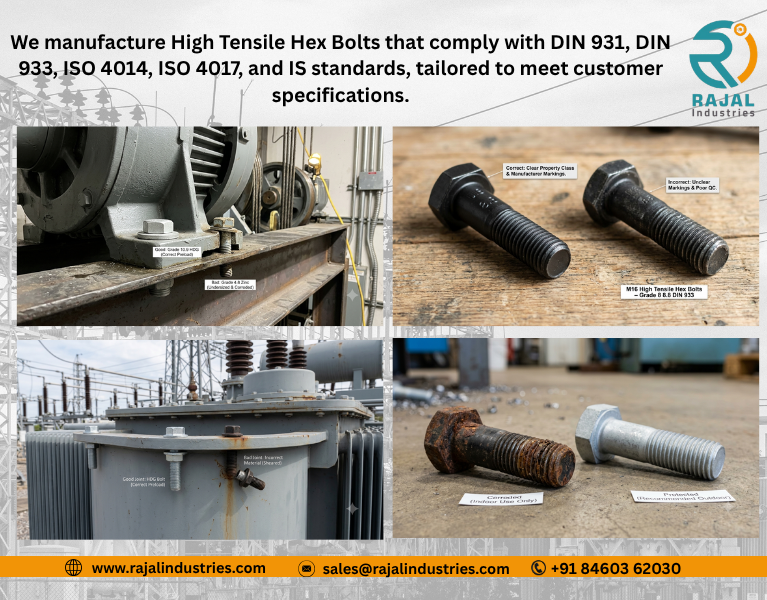
When OEM buyers search for High Tensile Hex Bolt Specifications, they are usually preparing a new product design, qualifying a supplier or purchasing bolts for long-term production. They need more than a simple size chart. They need complete information about standards, dimensions, property classes, materials, coatings and engineering requirements before approving a fastener.
High tensile hex bolts are used in transformers, elevators, electrical panels, switchgear, Battery Energy Storage Systems (BESS), EV charging stations, telecom cabinets, steel structures and industrial machinery because these applications require strong and reliable bolted joints.
At Rajal Industries, we manufacture High Tensile Hex Bolts for OEM manufacturers requiring bulk production from 50,000+ pieces. Our bolts are manufactured according to DIN, ISO, IS and customer drawings, ensuring consistent quality, dimensional accuracy and dependable long-term supply.
Quick Answer
A High Tensile Hex Bolt should be selected according to:
- Applicable standard
- Thread size
- Bolt length
- Property class
- Material
- Surface coating
- Operating environment
- Load requirements
- Customer drawing
- Engineering specifications
Selecting the correct combination improves joint reliability, simplifies assembly and increases equipment life.
What is a High Tensile Hex Bolt?
A High Tensile Hex Bolt is a heat-treated, high-strength fastener designed for applications where higher clamp force, tensile strength and fatigue resistance are required.
Compared with standard bolts, high tensile bolts provide:
- Higher tensile strength
- Higher yield strength
- Better preload retention
- Improved vibration resistance
- Longer service life
- Reliable performance under heavy loads
These bolts are widely used where equipment operates continuously and joint failure cannot be accepted.
Common Standards for High Tensile Hex Bolts
Industrial OEM manufacturers generally specify bolts according to recognised international standards.
Some of the most common standards include:
| Standard | Description |
| DIN 931 | Hex Bolt with Partial Thread |
| DIN 933 | Hex Bolt with Full Thread |
| ISO 4014 | Hex Bolt with Partial Thread |
| ISO 4017 | Hex Bolt with Full Thread |
| IS 1364 | Indian Hex Bolt Standard |
| ASTM Standards | Project-specific applications |
| Customer Drawings | OEM & EPC projects |
Following recognised standards improves interchangeability, quality consistency and procurement efficiency.
Understanding High Tensile Bolt Specifications
A complete bolt specification includes several important parameters.
Thread Size
Common industrial sizes include:
- M6
- M8
- M10
- M12
- M16
- M20
- M24
- M30
- M36
The thread size should match the engineering drawing and load requirements.
Bolt Length
Bolt length should provide:
- Proper thread engagement
- Washer clearance
- Nut engagement
- Required clamp length
An incorrect bolt length can affect assembly quality and maintenance access.
Across Flats (AF)
Across Flats refers to the wrench size required to tighten the bolt.
Accurate AF dimensions ensure:
- Proper tool fit
- Correct tightening
- Easy maintenance
- Standardisation across assemblies
Head Height
Head height contributes to the overall strength of the bolt head and should comply with the applicable standard.
Thread Type
High tensile hex bolts are available with:
- Full Thread
- Partial Thread
The selection depends on joint design and engineering requirements.
Common Property Classes
Property class indicates the mechanical strength of the bolt.
The most common industrial property classes include:
- Grade 8.8
- Grade 10.9
- Grade 12.9
Each grade is selected according to:
- Load
- Clamp force
- Equipment type
- Safety factor
- Engineering calculations
For many transformer, elevator and electrical equipment applications, Grade 8.8 remains the preferred choice.
Common Materials Used
Material selection affects both strength and corrosion resistance.
Typical materials include:
| Material | Typical Applications |
| Medium Carbon Steel | Grade 8.8 Bolts |
| Alloy Steel | Grade 10.9 & 12.9 |
| SS304 | Food & Pharmaceutical Industries |
| SS316 | Marine & Chemical Industries |
The correct material should satisfy both mechanical and environmental requirements.
Industries Using High Tensile Hex Bolts
Transformer Manufacturers
Applications include:
- Tank assembly
- Radiator mounting
- Cover fastening
- Base frames
- Structural supports
Elevator Manufacturers
Used for:
- Guide rail brackets
- Machine frames
- Motor supports
- Structural assemblies
Electrical Panel & Switchgear Manufacturers
Applications include:
- Structural framework
- Bus duct systems
- Equipment mounting
- Support brackets
Steel Structure Manufacturers
Common uses:
- Building structures
- Pipe racks
- Equipment platforms
- Industrial fabrication
Renewable Energy Projects
Widely used in:
- Solar structures
- Battery Energy Storage Systems (BESS)
- EV Charging Stations
- Wind energy equipment
Industrial Machinery
Applications include:
- CNC machines
- Compressors
- Pumps
- Material handling equipment
- Heavy fabrication
Step 1 – Verify the Applicable Standard
Before selecting a bolt, confirm:
- DIN requirement
- ISO requirement
- IS requirement
- Customer drawing
- OEM specification
Standard compliance improves product interchangeability and manufacturing consistency.
Step 2 – Select the Correct Property Class
The property class should be selected according to:
- Static load
- Dynamic load
- Joint design
- Safety factor
- Engineering calculations
Selecting a higher grade than necessary increases cost without always improving performance.
Step 3 – Review Material Requirements
Before approving production, verify:
- Material grade
- Heat treatment
- Corrosion resistance
- Operating temperature
- Customer specifications
Material selection should match the intended application rather than using one material for every project.
Step 4 – Confirm Dimensions
Before releasing production, confirm:
- Thread size
- Bolt length
- Across flats
- Head height
- Thread length
- Standard compliance
Small dimensional differences can affect assembly quality, especially in automated OEM production lines.
Step 5 – Select the Correct Surface Coating
Selecting the correct surface coating is essential for extending the service life of a High Tensile Hex Bolt. Even the strongest bolt can fail prematurely if corrosion protection is not suitable for the operating environment.
Before selecting a coating, engineers should evaluate:
- Indoor or outdoor installation
- Humidity
- Rain exposure
- Coastal atmosphere
- Chemical exposure
- Operating temperature
- Maintenance schedule
- Expected equipment life
The correct coating reduces corrosion, improves durability and lowers maintenance costs.
Zinc Plated High Tensile Hex Bolts
Recommended for:
- Electrical panels
- Indoor switchgear
- Factory machinery
- Dry industrial environments
Advantages:
- Economical
- Good surface finish
- Suitable for indoor use
- Easy availability
Hot Dip Galvanized (HDG) High Tensile Hex Bolts
Commonly used for:
- Power transformers
- Outdoor substations
- Steel structures
- Solar mounting systems
- Telecom towers
- Utility infrastructure
Advantages:
- Excellent corrosion resistance
- Long outdoor service life
- Reduced maintenance
- Preferred for infrastructure projects
Black Oxide High Tensile Hex Bolts
Suitable for:
- Machine tools
- Industrial machinery
- Precision assemblies
- Indoor engineering applications
Advantages:
- Uniform black finish
- Good dimensional accuracy
- Suitable where corrosion exposure is limited
Geomet & Dacromet Coatings
Recommended for:
- Renewable energy projects
- Outdoor electrical equipment
- Heavy industrial applications
- Telecom infrastructure
Advantages:
- High salt spray resistance
- Uniform coating thickness
- Long-term corrosion protection
DIN vs ISO Standards
Many OEM buyers ask whether they should specify DIN or ISO standards.
Both are widely accepted in industrial manufacturing.
| DIN Standard | Equivalent ISO Standard | Application |
| DIN 931 | ISO 4014 | Partially Threaded Hex Bolts |
| DIN 933 | ISO 4017 | Fully Threaded Hex Bolts |
For new product development, many international OEMs reference ISO standards, while DIN standards continue to be widely used in India and global industrial projects.
The final selection should always follow the customer’s engineering drawing or procurement specification.
Mechanical Property Verification
High tensile bolts should not be accepted based only on visual inspection.
Quality verification should include:
- Property class confirmation
- Heat treatment verification
- Thread accuracy
- Dimensional inspection
- Surface coating inspection
- Material verification
- Mechanical property testing (when required)
Proper verification improves consistency and reduces the risk of assembly failures.
Common Specification & Procurement Mistakes
Many quality issues begin before production starts.
Ordering Without Specifying the Standard
Always mention:
- DIN
- ISO
- IS
- Customer drawing
This avoids dimensional differences during manufacturing.
Choosing the Wrong Property Class
Using Grade 10.9 where Grade 8.8 is sufficient may increase cost without improving performance.
Likewise, selecting Grade 8.8 where higher strength is required can reduce joint reliability.
Ignoring Surface Coating
Outdoor transformer yards, substations and coastal projects require corrosion-resistant coatings suitable for long-term exposure.
Not Reviewing Complete Drawings
Always verify:
- Thread size
- Bolt length
- Thread type
- Head dimensions
- Surface finish
- Material
- Property class
before approving production.
Buying Only on Price
The lowest-priced bolt may not provide consistent dimensions, correct heat treatment or reliable coating quality.
OEM buyers should evaluate:
- Manufacturing capability
- Quality system
- Process control
- Long-term supply reliability
Quality Inspection Checklist
Before approving production, quality teams should verify:
| Inspection Item | Verify |
| Drawing Compliance | ✔ |
| DIN / ISO / IS Standard | ✔ |
| Thread Size | ✔ |
| Bolt Length | ✔ |
| Across Flats | ✔ |
| Head Height | ✔ |
| Thread Accuracy | ✔ |
| Material Grade | ✔ |
| Property Class | ✔ |
| Heat Treatment | ✔ |
| Surface Coating | ✔ |
| Coating Thickness | ✔ |
| Visual Inspection | ✔ |
| Batch Traceability | ✔ |
| Material Test Certificate (If Required) | ✔ |
A structured inspection process helps maintain consistent quality across every production batch.
Why Rajal Industries?
Rajal Industries manufactures High Tensile Hex Bolts for transformer manufacturers, elevator OEMs, electrical equipment companies and industrial OEMs requiring dependable, large-scale production.
Our manufacturing capabilities include:
- MOQ from 50,000+ pieces
- Grade 8.8, Grade 10.9 & Grade 12.9 High Tensile Hex Bolts
- DIN, ISO, IS & Drawing-Based Manufacturing
- Medium Carbon Steel, Alloy Steel, SS304 & SS316
- Zinc Plated, Hot Dip Galvanized, Black Oxide, Geomet & Dacromet Coatings
- Precision Cold Forging
- CNC Thread Rolling
- Controlled Heat Treatment
- Dimensional Inspection
- Batch Traceability
- OEM Packaging
- Long-Term Supply Programmes
- Export Manufacturing Support
We supply:
- Transformer Manufacturers
- Elevator Manufacturers
- Electrical Panel Manufacturers
- Switchgear Manufacturers
- Steel Structure Manufacturers
- Renewable Energy Companies
- Industrial Machinery OEMs
- EPC Contractors
OEM RFQ Checklist
Before requesting a quotation, include:
☐ Applicable standard (DIN / ISO / IS)
☐ Thread size
☐ Bolt length
☐ Full or partial thread
☐ Property class
☐ Material
☐ Surface coating
☐ Quantity
☐ Annual requirement
☐ Engineering drawing
☐ Inspection requirements
☐ Packaging specification
☐ Delivery schedule
Providing complete technical information helps suppliers recommend the correct bolt specification and prepare accurate quotations.
Key Takeaways
- High tensile hex bolts should always be selected according to standards, dimensions, material and operating conditions.
- DIN 931/DIN 933 and ISO 4014/ISO 4017 are among the most widely used international standards.
- Grade 8.8 remains the preferred choice for many transformer, elevator and electrical equipment applications.
- Material, coating and heat treatment should match the service environment.
- A detailed inspection process improves assembly quality and long-term equipment reliability.
- Working with an experienced OEM manufacturer ensures consistent quality, engineering support and dependable supply.
Frequently Asked Questions
Which standards are commonly used for high tensile hex bolts?
DIN 931, DIN 933, ISO 4014, ISO 4017 and IS 1364 are among the most widely used standards for industrial applications.
What is the difference between DIN 931 and DIN 933?
DIN 931 specifies partially threaded hex bolts, while DIN 933 specifies fully threaded hex bolts.
Which property class is commonly used?
Grade 8.8 is widely used for transformers, elevators, electrical equipment and general industrial machinery.
Which coating is recommended for outdoor installations?
Hot Dip Galvanized (HDG), Geomet or Dacromet coatings are commonly selected depending on environmental conditions.
Can Rajal Industries manufacture custom high tensile hex bolts?
Yes. We manufacture standard and drawing-based high tensile hex bolts according to customer drawings, international standards and OEM specifications.
Which industries use high tensile hex bolts?
Transformer manufacturers, elevator OEMs, electrical panel manufacturers, switchgear companies, steel structure fabricators, industrial machinery manufacturers, renewable energy companies and EPC contractors.
What is your minimum production quantity?
Rajal Industries primarily manufactures bulk OEM orders from 50,000+ pieces, depending on the product and manufacturing process.
Conclusion
Understanding High Tensile Hex Bolt specifications, standards and materials helps OEM buyers choose the correct fastener for long-term industrial performance. Selecting the right DIN or ISO standard, property class, material and surface coating improves joint reliability, simplifies production and reduces maintenance throughout the equipment’s service life.
For transformer manufacturers, elevator OEMs, electrical equipment companies, steel structure fabricators and industrial machinery builders, partnering with an experienced High Tensile Hex Bolt Manufacturer ensures consistent quality, engineering support and dependable long-term supply.
If your company requires Grade 8.8, 10.9 or 12.9 High Tensile Hex Bolts with bulk production from 50,000+ pieces, Rajal Industries can manufacture according to your engineering drawings, international standards and long-term production requirements.
Related Keywords
High Tensile Hex Bolt, High Tensile Hex Bolt Specifications, High Tensile Bolt Standards, DIN 931 Hex Bolt, DIN 933 Hex Bolt, ISO 4014 Hex Bolt, ISO 4017 Hex Bolt, Grade 8.8 Bolt, Grade 10.9 Bolt, Grade 12.9 Bolt, High Strength Hex Bolt, Industrial Hex Bolt, Alloy Steel Hex Bolt, Transformer Hex Bolt, Elevator Hex Bolt, OEM Fastener Manufacturer, Bulk Bolt Supplier, Drawing-Based Bolt Manufacturer, Industrial Fasteners.