

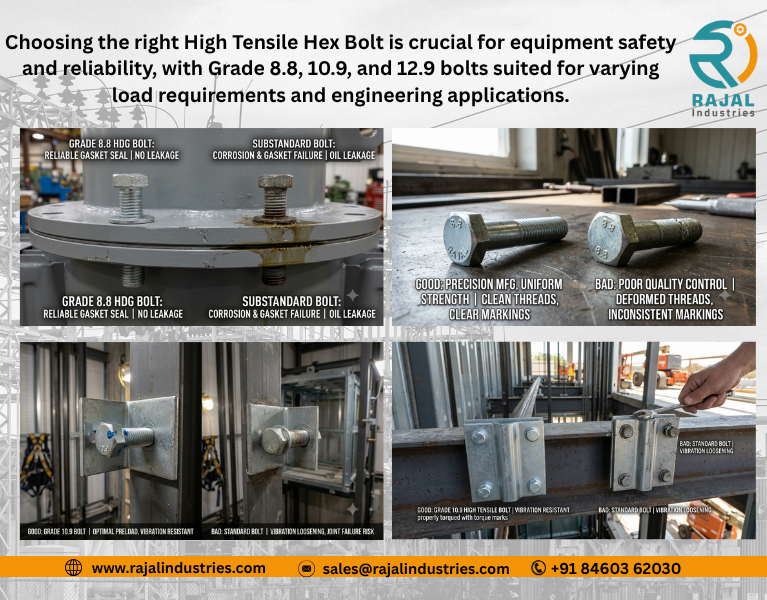
One of the most common questions asked by OEM buyers, design engineers and procurement managers is:
Which high tensile bolt grade should I choose?
Many buyers search Google using terms like Grade 8.8 Bolt, Grade 10.9 Bolt, Grade 12.9 Bolt, High Tensile Bolt Grades, High Strength Hex Bolt, and 8.8 vs 10.9 Bolt Difference because selecting the wrong property class can affect equipment safety, joint performance and maintenance costs.
A common misunderstanding is that a higher grade is always better. In reality, every bolt grade is designed for a specific range of mechanical loads and engineering applications. Choosing a bolt that is stronger than necessary may increase cost and require different tightening procedures, while choosing a lower grade than required may reduce joint reliability.
At Rajal Industries, we manufacture Grade 8.8, Grade 10.9 and Grade 12.9 High Tensile Hex Bolts for transformer manufacturers, elevator OEMs, electrical equipment manufacturers, industrial machinery builders and EPC contractors requiring bulk production from 50,000+ pieces.
Quick Answer
The three most common high tensile bolt grades are:
- Grade 8.8 – General industrial and heavy-duty OEM applications.
- Grade 10.9 – Higher load and higher clamp force applications.
- Grade 12.9 – Critical engineering applications requiring very high strength.
The correct bolt should always be selected according to:
- Engineering calculations
- Equipment load
- Safety factor
- Joint design
- Operating conditions
- Customer specifications
What Does Bolt Grade Mean?
A bolt grade, also called a property class, indicates the mechanical strength of the fastener.
It defines important properties such as:
- Tensile strength
- Yield strength
- Hardness
- Load-carrying capacity
- Mechanical performance
Bolt grades help engineers select the correct fastener for different applications while ensuring reliable joint performance.
Understanding Grade 8.8 High Tensile Bolts
Grade 8.8 is one of the most widely used property classes in industrial manufacturing.
It offers an excellent balance of:
- Strength
- Availability
- Cost
- Reliability
- Manufacturing consistency
Typical applications include:
- Power transformers
- Distribution transformers
- Electrical panels
- Switchgear
- Elevator assemblies
- Steel fabrication
- Industrial machinery
- Renewable energy equipment
Because of its versatility, Grade 8.8 is commonly specified by OEM manufacturers around the world.
Understanding Grade 10.9 High Tensile Bolts
Grade 10.9 bolts provide significantly higher mechanical strength than Grade 8.8.
These bolts are commonly selected where:
- Higher preload is required
- Larger structural loads are present
- Equipment experiences vibration
- Heavy machinery is involved
- Space limitations require higher-strength fasteners
Typical applications include:
- Heavy industrial machinery
- Mining equipment
- Material handling systems
- Structural assemblies
- Construction equipment
- Heavy engineering projects
Grade 10.9 should only be used when supported by engineering calculations or customer specifications.
Understanding Grade 12.9 High Tensile Bolts
Grade 12.9 represents one of the highest-strength property classes used for industrial hex bolts.
These bolts are designed for demanding engineering applications where very high clamp loads and strength are required.
Typical applications include:
- Precision machinery
- Heavy industrial equipment
- High-load machine assemblies
- Tooling systems
- Automotive engineering
- Defence equipment
- Special engineering applications
Because of their high strength, Grade 12.9 bolts require proper tightening procedures and should be used only where specified.
Grade 8.8 vs Grade 10.9 vs Grade 12.9
| Property | Grade 8.8 | Grade 10.9 | Grade 12.9 |
| Strength | High | Very High | Extremely High |
| Common Industrial Use | Very Common | Common | Specialised |
| Cost | Lower | Medium | Higher |
| Transformer Applications | ✔ | Some Applications | Rare |
| Elevator Applications | ✔ | ✔ | Selected Projects |
| Heavy Machinery | ✔ | ✔✔ | ✔✔ |
| General Industrial Equipment | ✔ | ✔ | Limited |
The correct selection should always balance strength, performance and project cost.
Industries That Commonly Use Grade 8.8 Bolts
Grade 8.8 bolts are widely used because they meet the requirements of many industrial applications.
Common industries include:
Transformer Manufacturers
Applications include:
- Tank assembly
- Cover fastening
- Radiator mounting
- Structural frames
- Base assemblies
Elevator Manufacturers
Used for:
- Machine frames
- Guide rail supports
- Structural brackets
- Support assemblies
Electrical Equipment Manufacturers
Applications include:
- Electrical panels
- Switchgear
- Bus duct systems
- Control cabinets
Renewable Energy Projects
Used in:
- Solar structures
- Battery Energy Storage Systems (BESS)
- EV charging equipment
- Inverter structures
Industrial Machinery
Applications include:
- CNC machines
- Pumps
- Compressors
- Material handling systems
- Industrial fabrication
Step 1 – Understand the Load Requirement
The first step in selecting a bolt grade is understanding the load applied to the joint.
Engineering teams evaluate:
- Static load
- Dynamic load
- Vibration
- Fatigue
- Clamp force
- Safety factor
- Equipment weight
The selected bolt grade should safely withstand these operating conditions throughout the equipment’s service life.
Step 2 – Review the Engineering Drawing
Never select a bolt grade based only on previous experience.
Always verify:
- Customer drawing
- Bill of Materials (BOM)
- Engineering specification
- Applicable standards
- Property class requirement
This helps avoid assembly issues and ensures compliance with project requirements.
Step 3 – Consider the Operating Environment
Besides mechanical strength, engineers should also consider:
- Indoor or outdoor installation
- Corrosion exposure
- Temperature
- Humidity
- Chemical exposure
- Maintenance access
The operating environment influences both the material and the surface coating required for the bolt.
Tensile Strength Comparison
Although all three property classes are classified as high tensile bolts, their mechanical properties are different. The correct selection should always be based on engineering calculations rather than choosing the highest available grade.
| Property | Grade 8.8 | Grade 10.9 | Grade 12.9 |
| Tensile Strength | High | Very High | Extremely High |
| Yield Strength | High | Very High | Extremely High |
| Clamp Load Capacity | Excellent | Higher | Highest |
| Fatigue Resistance | Excellent | Excellent | Excellent (Application Specific) |
| Typical Cost | Lower | Medium | Higher |
| OEM Usage | Very Common | Common | Special Applications |
For most transformer manufacturers, elevator OEMs, electrical panel manufacturers and industrial machinery builders, Grade 8.8 remains the preferred choice because it provides an excellent balance between strength, reliability and cost.
Step 4 – Select the Correct Surface Coating
Selecting the correct coating is just as important as selecting the correct property class. A high-strength bolt without proper corrosion protection may fail prematurely in harsh environments.
Before selecting a coating, engineers should evaluate:
- Indoor or outdoor installation
- Humidity
- Coastal atmosphere
- Chemical exposure
- Operating temperature
- Expected service life
- Maintenance schedule
Zinc Plated High Tensile Bolts
Recommended for:
- Indoor electrical panels
- Switchgear
- Factory machinery
- Dry industrial environments
Advantages:
- Economical
- Good appearance
- Suitable for indoor use
Hot Dip Galvanized (HDG) High Tensile Bolts
Commonly used for:
- Transformer yards
- Outdoor substations
- Steel structures
- Solar mounting systems
- Utility infrastructure
Advantages:
- Excellent corrosion resistance
- Long outdoor service life
- Reduced maintenance
Black Oxide High Tensile Bolts
Suitable for:
- Industrial machinery
- Machine tools
- Mechanical assemblies
- Indoor engineering applications
Advantages:
- Uniform finish
- Good dimensional accuracy
- Suitable where corrosion exposure is limited
Geomet & Dacromet Coatings
Recommended for:
- Renewable energy projects
- Telecom infrastructure
- Outdoor electrical equipment
- Heavy industrial environments
Advantages:
- Excellent corrosion resistance
- High salt spray performance
- Uniform coating thickness
Which Grade Should OEM Buyers Choose?
There is no single “best” bolt grade for every application.
Choose Grade 8.8 When:
✔ Manufacturing transformers
✔ Electrical panels
✔ Elevator structures
✔ General industrial machinery
✔ Steel fabrication
✔ Standard OEM production
Choose Grade 10.9 When:
✔ Higher preload is required
✔ Heavy industrial machinery is involved
✔ Structural loads are higher
✔ Engineering calculations specify Grade 10.9
Choose Grade 12.9 When:
✔ Very high mechanical strength is required
✔ Precision engineering applications
✔ Tooling systems
✔ Special machine assemblies
✔ Customer drawings specifically require Grade 12.9
The final selection should always follow the approved engineering drawing and project specification.
Common Engineering & Procurement Mistakes
Many bolted joint failures are caused by incorrect grade selection rather than poor manufacturing.
Assuming Higher Grade Is Always Better
Higher-strength bolts are not automatically the best choice.
Selecting Grade 12.9 where Grade 8.8 is sufficient only increases cost and may require different tightening procedures.
Ignoring Joint Design
The bolt, nut, washer and clamped components should all be compatible.
A stronger bolt cannot compensate for poor joint design.
Ignoring Surface Protection
Outdoor transformer yards and substations require corrosion-resistant coatings suitable for long-term exposure.
Buying Only on Price
Low-cost fasteners may have inconsistent heat treatment, poor dimensional accuracy or inadequate coating quality.
Reliable long-term performance is usually more valuable than the lowest purchase price.
Ordering Without Complete Specifications
Every RFQ should clearly mention:
- Bolt standard
- Thread size
- Bolt length
- Property class
- Material
- Surface coating
- Quantity
- Engineering drawing
Complete technical information reduces manufacturing errors and quotation delays.
Quality Inspection Checklist
Before approving production, OEM quality teams should verify:
| Inspection Item | Verify |
| Drawing Compliance | ✔ |
| Thread Size | ✔ |
| Bolt Length | ✔ |
| Across Flats | ✔ |
| Head Height | ✔ |
| Thread Accuracy | ✔ |
| Material Grade | ✔ |
| Property Class | ✔ |
| Heat Treatment | ✔ |
| Surface Coating | ✔ |
| Mechanical Properties | ✔ |
| Visual Inspection | ✔ |
| Batch Traceability | ✔ |
| Material Test Certificate (If Required) | ✔ |
Following a structured inspection process helps ensure consistent quality and reliable assembly performance.
Why Rajal Industries?
Rajal Industries manufactures Grade 8.8, Grade 10.9 and Grade 12.9 High Tensile Hex Bolts for OEM manufacturers requiring reliable, large-scale production.
Our manufacturing capabilities include:
- MOQ from 50,000+ pieces
- Grade 8.8, 10.9 & 12.9 High Tensile Hex Bolts
- DIN, ISO, IS & Drawing-Based Manufacturing
- Medium Carbon Steel, Alloy Steel, SS304 & SS316
- Zinc Plated, Hot Dip Galvanized, Black Oxide, Geomet & Dacromet Coatings
- Precision Cold Forging
- CNC Thread Rolling
- Controlled Heat Treatment
- Batch Traceability
- OEM Packaging
- Long-Term Supply Programmes
- Export Manufacturing Support
We support:
- Transformer Manufacturers
- Elevator Manufacturers
- Electrical Panel Manufacturers
- Switchgear Manufacturers
- Steel Structure Companies
- Renewable Energy Companies
- Industrial Machinery OEMs
- EPC Contractors
OEM RFQ Checklist
Before requesting a quotation, include:
☐ Bolt standard (DIN / ISO / IS)
☐ Thread size
☐ Bolt length
☐ Property class
☐ Material
☐ Surface coating
☐ Quantity
☐ Annual requirement
☐ Engineering drawing
☐ Inspection requirements
☐ Packaging specification
☐ Delivery schedule
Providing complete engineering information allows suppliers to recommend the correct bolt grade and prepare accurate commercial quotations.
Key Takeaways
- Grade 8.8, 10.9 and 12.9 are designed for different engineering requirements.
- Grade 8.8 is widely used for transformers, elevators, electrical equipment and general industrial machinery.
- Grade 10.9 is selected for higher structural loads where specified by engineering calculations.
- Grade 12.9 is mainly used for specialised engineering applications requiring very high strength.
- Surface coating should match the operating environment to maximise service life.
- Choosing the correct bolt grade improves safety, reliability and long-term equipment performance.
Frequently Asked Questions
What is the difference between Grade 8.8, 10.9 and 12.9 bolts?
The main difference is their mechanical strength. Grade 8.8 is suitable for many industrial applications, while Grades 10.9 and 12.9 provide higher strength for demanding engineering applications.
Which grade is commonly used for transformer manufacturing?
Grade 8.8 is commonly used for transformer tanks, base frames, radiators and structural assemblies because it offers a good balance between strength and cost.
Which grade is used in elevators?
Grade 8.8 and 10.9 are commonly used depending on the application and engineering requirements.
Is Grade 12.9 always better?
No. Grade 12.9 should only be used where required by engineering calculations or customer specifications.
Which coating is recommended for outdoor installations?
Hot Dip Galvanized (HDG), Geomet or Dacromet coatings are commonly selected depending on the service environment.
Can Rajal Industries manufacture custom high tensile bolts?
Yes. We manufacture standard and custom high tensile hex bolts according to customer drawings and international standards.
What is your minimum production quantity?
Rajal Industries primarily manufactures bulk OEM orders from 50,000+ pieces, depending on the product and manufacturing process.
Conclusion
Understanding the difference between Grade 8.8, Grade 10.9 and Grade 12.9 High Tensile Hex Bolts helps OEM manufacturers select the correct fastener for their equipment. Choosing the appropriate property class, material and surface coating improves joint reliability, reduces maintenance and supports long-term equipment performance.
For transformer manufacturers, elevator OEMs, electrical equipment manufacturers, steel structure fabricators and industrial machinery builders, working with an experienced High Tensile Hex Bolt Manufacturer ensures consistent quality, engineering support and dependable long-term supply.
If your company requires Grade 8.8, 10.9 or 12.9 High Tensile Hex Bolts with bulk production from 50,000+ pieces, Rajal Industries can manufacture according to your engineering drawings, international standards and long-term production requirements.
Related Keywords
Grade 8.8 Bolt, Grade 10.9 Bolt, Grade 12.9 Bolt, High Tensile Bolt Grades, High Tensile Hex Bolt, Grade 8.8 Hex Bolt, Grade 10.9 Hex Bolt, Grade 12.9 Hex Bolt, High Strength Bolt, Alloy Steel Hex Bolt, DIN 933 High Tensile Bolt, DIN 931 High Tensile Bolt, Industrial Hex Bolt, Transformer Hex Bolt, Elevator Hex Bolt, OEM Fastener Manufacturer, Bulk Bolt Supplier, Drawing-Based Bolt Manufacturer, Industrial Fasteners.