
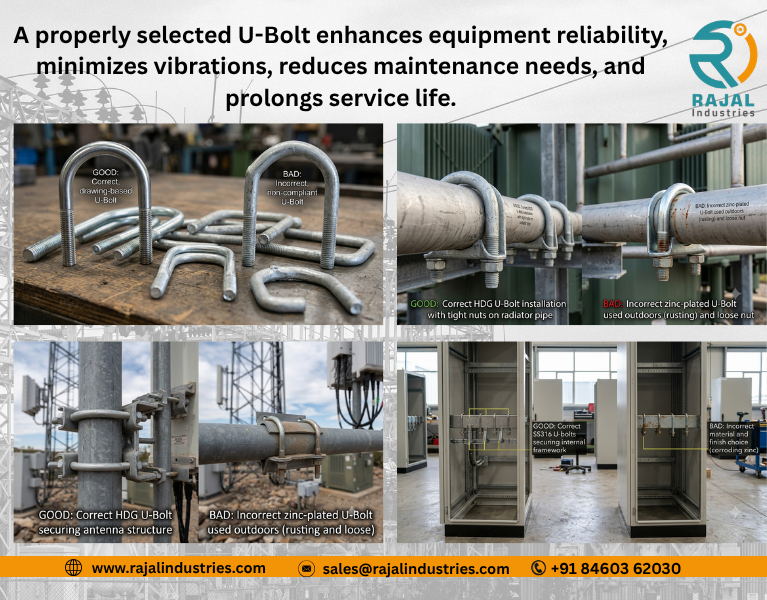
A U-Bolt may appear to be a simple fastening component, but it performs an important role in electrical and industrial equipment. From securing transformer oil pipes to supporting cable trays and busbar systems, U-bolts help maintain alignment, reduce vibration and keep critical components safely fixed throughout the equipment’s operating life.
OEM manufacturers and EPC contractors often search for U Bolt Applications, Industrial U Bolt Uses, Transformer U Bolt, Cable Tray U Bolt, and Busbar Support U Bolt because each application has different mechanical and environmental requirements.
Selecting the correct U-bolt size, material, coating and design improves equipment reliability, reduces maintenance and helps avoid failures caused by loose supports or pipe movement.
At Rajal Industries, we manufacture standard and custom U-Bolts for OEM manufacturers requiring bulk production from 50,000+ pieces. We support transformer manufacturers, electrical panel builders, switchgear companies, telecom infrastructure projects and industrial equipment manufacturers with drawing-based manufacturing and long-term supply programmes.
Quick Answer
U-Bolts are widely used to secure:
- Transformer oil pipes
- Radiator assemblies
- Cable trays
- Busbar support systems
- Cable conduits
- Pipe support systems
- Telecom structures
- Solar mounting systems
- Industrial machinery
- Hydraulic and pneumatic pipelines
The correct U-bolt should be selected according to:
- Pipe outside diameter (OD)
- Rod diameter
- Material
- Surface coating
- Operating temperature
- Vibration level
- Load requirements
- Installation environment
Why U-Bolts Are Important in Electrical Equipment
Electrical equipment is expected to operate continuously for many years.
During operation, support systems experience:
- Mechanical vibration
- Thermal expansion
- Wind loading
- Maintenance activities
- Transportation movement
- Equipment weight
- Environmental exposure
A properly selected U-bolt keeps pipes and structural members securely clamped while maintaining alignment and reducing stress on connected components.
Incorrect U-bolt selection may result in:
- Pipe movement
- Loose supports
- Busbar misalignment
- Cable tray vibration
- Increased maintenance
- Premature equipment failure
U-Bolts Used in Power Transformers
Power transformers contain several systems that require secure pipe and conduit supports.
Typical applications include:
Transformer Radiator Pipes
Radiator piping carries transformer oil between the main tank and cooling radiators.
U-bolts help:
- Secure piping
- Reduce vibration
- Maintain pipe alignment
- Prevent movement during transportation
Conservator Oil Pipes
Conservator systems contain long pipe runs that require multiple support points.
Properly selected U-bolts reduce:
- Pipe sagging
- Vibration
- Joint stress
- Maintenance requirements
Cooling System Supports
Transformer cooling systems often include:
- Oil pipes
- Auxiliary piping
- Instrument tubing
- Protective conduits
Reliable pipe supports improve long-term operating performance.
Earthing Conductor Supports
U-bolts are also used to secure:
- Earthing conductors
- Grounding strips
- Protective conduit systems
Proper support helps maintain electrical safety and simplifies maintenance.
U-Bolts Used in Cable Tray Systems
Cable trays support power and control cables across industrial facilities.
U-bolts are commonly used for:
- Tray support brackets
- Suspension systems
- Structural supports
- Cable ladder installations
Benefits include:
- Secure installation
- Easy maintenance
- Simple replacement
- Reliable structural support
U-Bolts Used in Busbar Support Systems
Busbar systems carry high electrical currents inside:
- LT Panels
- HT Panels
- PCC Panels
- MCC Panels
- Bus Duct Systems
- Switchgear Assemblies
Although busbars themselves are supported using insulated systems, U-bolts are widely used for:
- Structural framework
- Bus duct supports
- Protective enclosures
- Mounting brackets
- Auxiliary support systems
Proper support helps minimise movement caused by vibration during equipment operation.
U-Bolts Used in Electrical Panels
Electrical panel manufacturers use U-bolts for several applications.
These include:
- Cable conduit supports
- Earthing conductor clamps
- Auxiliary pipe supports
- Instrument tubing
- Control panel accessories
- Structural frame assemblies
Using standardised U-bolts across multiple panel designs simplifies production and inventory management.
U-Bolts Used in Switchgear Manufacturing
Switchgear manufacturers use U-bolts in:
- Instrument pipe supports
- Cable routing systems
- Auxiliary framework
- Structural assemblies
- Control wiring supports
Selecting corrosion-resistant materials helps improve long-term reliability, especially in outdoor installations.
U-Bolts Used in Battery Energy Storage Systems (BESS)
Battery Energy Storage Systems contain numerous electrical and mechanical support systems.
Common applications include:
- Cooling pipe supports
- Cable management
- Battery enclosure framework
- Fire protection piping
- Structural support systems
As BESS installations continue to grow, demand for reliable industrial fastening systems is also increasing.
U-Bolts Used in EV Charging Infrastructure
EV charging stations use U-bolts in:
- Cable management systems
- Conduit supports
- Structural brackets
- Equipment mounting frames
The selected coating should match the installation environment, especially for outdoor charging stations.
U-Bolts Used in Telecom Infrastructure
Telecom equipment manufacturers use U-bolts for:
- Antenna support systems
- Pole mounting
- Cable routing
- Equipment brackets
- Conduit supports
Outdoor telecom installations typically require high-corrosion-resistant coatings such as Hot Dip Galvanized (HDG) or Stainless Steel.
Step 1 – Identify the Application
The first step in selecting a U-bolt is understanding exactly where it will be used.
Engineering teams should determine whether the application involves:
- Pipe support
- Cable tray support
- Busbar support
- Conduit clamping
- Structural support
- Equipment mounting
- Vibration control
Different applications require different materials, rod diameters and coatings.
Step 2 – Evaluate the Operating Conditions
Before selecting a U-bolt, engineers should evaluate:
- Operating temperature
- Humidity
- Corrosion exposure
- Pipe movement
- Vibration
- Static load
- Dynamic load
- Outdoor or indoor installation
Selecting the correct U-bolt during the design stage improves equipment reliability and reduces maintenance over the product’s life cycle.
Step 3 – Select the Correct Material
Material selection depends on both mechanical strength and environmental conditions.
Common materials include:
| Material | Typical Applications |
| Mild Steel | Indoor Pipe Supports |
| Carbon Steel | Electrical Equipment |
| High Tensile Steel | Heavy Industrial Applications |
| SS304 | Food & Pharmaceutical Plants |
| SS316 | Marine & Chemical Industries |
The correct material should always satisfy the project’s engineering specification and expected service environment.
Step 4 – Select the Correct Surface Coating
The operating environment has a direct impact on the service life of a U-bolt. A U-bolt installed inside a control panel has very different corrosion requirements than one installed on an outdoor transformer or pipe support structure.
Before selecting the surface finish, engineering teams should consider:
- Indoor or outdoor installation
- Humidity
- Rain exposure
- Coastal atmosphere
- Chemical exposure
- Operating temperature
- Maintenance accessibility
- Expected equipment life
Selecting the right coating helps reduce corrosion, extend equipment life and minimise maintenance.
Zinc Plated U-Bolts
Recommended for:
- Indoor electrical panels
- Control cabinets
- Indoor switchgear
- Factory pipe supports
Advantages:
- Economical
- Good appearance
- Suitable for dry environments
- Readily available
Hot Dip Galvanized (HDG) U-Bolts
Commonly used for:
- Power transformers
- Outdoor substations
- Cable tray support structures
- Pipe racks
- Telecom towers
- Solar mounting systems
Advantages:
- Excellent corrosion resistance
- Long outdoor service life
- Reduced maintenance
- Preferred for utility and infrastructure projects
Stainless Steel U-Bolts
Recommended for:
- Chemical plants
- Marine installations
- Coastal environments
- Food processing plants
- Pharmaceutical industries
Advantages:
- Excellent corrosion resistance
- Long operating life
- Hygienic finish
- Low maintenance
Geomet & Dacromet Coated U-Bolts
Suitable for:
- Renewable energy projects
- Industrial equipment
- Utility infrastructure
- Heavy-duty outdoor applications
Advantages:
- Excellent salt spray resistance
- Uniform coating thickness
- Long-term corrosion protection
Step 5 – Consider Vibration & Thermal Expansion
Many transformer and industrial support systems experience continuous vibration and temperature changes.
Examples include:
- Transformer cooling systems
- Bus duct installations
- Pipe support systems
- Industrial machinery
- HVAC piping
- BESS cooling circuits
Engineering teams should consider:
- Equipment vibration
- Pipe movement
- Thermal expansion
- Support spacing
- Operating temperature
- Load direction
Properly selected U-bolts help minimise:
- Pipe movement
- Fatigue failures
- Loose supports
- Noise
- Maintenance requirements
Common U-Bolt Application Mistakes
Incorrect application often causes more problems than poor manufacturing.
Using the Wrong Pipe Size
Always select the U-bolt using the actual pipe outside diameter (OD) rather than the nominal pipe size.
Selecting an Undersized Rod Diameter
A smaller rod diameter may reduce the load-carrying capacity and shorten service life.
Using Indoor Coatings Outdoors
Zinc-plated U-bolts may corrode quickly when used in outdoor transformer yards or substations.
Ignoring Vibration
Equipment such as transformers, pumps and compressors requires support systems that can withstand continuous vibration.
Ignoring Pipe Insulation
Insulated pipes require additional clearance, longer legs and proper support design.
Ordering Without Engineering Drawings
Every enquiry should clearly specify:
- Pipe OD
- Rod diameter
- Inside width
- Leg length
- Thread length
- Material
- Surface coating
- Quantity
- Drawing number
Complete technical information helps suppliers manufacture the correct product and reduces installation issues.
Quality Inspection Checklist
Before approving production, OEM quality teams should verify:
| Inspection Item | Verify |
| Drawing Compliance | ✔ |
| Pipe Outside Diameter | ✔ |
| Rod Diameter | ✔ |
| Inside Width | ✔ |
| Leg Length | ✔ |
| Thread Length | ✔ |
| Bend Radius | ✔ |
| Material Grade | ✔ |
| Surface Coating | ✔ |
| Thread Accuracy | ✔ |
| Visual Inspection | ✔ |
| Batch Traceability | ✔ |
| Material Test Certificate (If Required) | ✔ |
A structured inspection process ensures consistent quality and smooth installation at the customer’s site.
Why Rajal Industries?
Rajal Industries manufactures U-Bolts for OEM manufacturers, EPC contractors and industrial equipment companies requiring dependable, high-volume production.
Our capabilities include:
- MOQ from 50,000+ pieces
- Round U-Bolts
- Square U-Bolts
- Heavy Duty U-Bolts
- Long Leg U-Bolts
- Custom Drawing-Based Manufacturing
- Carbon Steel, High Tensile Steel, SS304 & SS316
- Zinc Plated, Hot Dip Galvanized, Geomet & Dacromet Coatings
- Precision Bending & CNC Thread Rolling
- Consistent Dimensional Accuracy
- Batch Traceability
- OEM Packaging
- Long-Term Supply Programmes
- Export Manufacturing Support
We support:
- Transformer Manufacturers
- Electrical Panel Manufacturers
- Switchgear Manufacturers
- Cable Tray Manufacturers
- Bus Duct Manufacturers
- Pipe Support System Manufacturers
- Renewable Energy Companies
- Telecom Infrastructure Companies
- Industrial Machinery OEMs
OEM RFQ Checklist
Before requesting a quotation, include:
☐ Application (Transformer / Cable Tray / Busbar / Pipe Support)
☐ Pipe outside diameter (OD)
☐ Rod diameter
☐ Inside width
☐ Leg length
☐ Thread length
☐ Material
☐ Surface coating
☐ Quantity
☐ Annual consumption
☐ Engineering drawing
☐ Inspection requirements
☐ Packaging specification
☐ Delivery schedule
Providing complete technical details helps suppliers recommend the correct U-bolt and prepare accurate quotations.
Key Takeaways
- U-bolts are widely used in transformers, cable trays, busbar support systems and industrial piping.
- The application determines the correct size, material and coating.
- Outdoor transformer and utility projects generally require Hot Dip Galvanized or Stainless Steel U-bolts.
- Correct support design helps minimise vibration, movement and maintenance.
- Drawing-based U-bolts improve installation accuracy and reduce site modifications.
- Working with an experienced OEM manufacturer ensures consistent quality and long-term supply.
Frequently Asked Questions
Where are U-bolts used in transformers?
U-bolts are commonly used for radiator pipes, conservator oil pipes, cooling systems, earthing conductors and structural pipe supports.
Are U-bolts used in cable tray systems?
Yes. U-bolts are widely used to secure cable trays, ladder trays and support brackets in industrial electrical installations.
Are U-bolts used for busbar systems?
Yes. U-bolts are mainly used to support bus duct structures, enclosures and auxiliary framework rather than directly clamping live busbars.
Which material is commonly used?
Carbon steel is widely used for general industrial applications, while SS304 and SS316 are selected for corrosive environments.
Which coating is best for outdoor transformer installations?
Hot Dip Galvanized (HDG) is one of the most common choices because it provides excellent long-term corrosion resistance.
Can Rajal Industries manufacture custom U-bolts?
Yes. We manufacture standard and drawing-based U-bolts according to customer specifications and engineering drawings.
What is your minimum production quantity?
Rajal Industries primarily manufactures bulk OEM orders from 50,000+ pieces, depending on the product and manufacturing process.
Conclusion
U-Bolts are widely used across transformer manufacturing, cable tray systems, busbar support structures and industrial piping because they provide a simple, reliable and cost-effective method of securing round components. Selecting the correct U-bolt size, material, coating and dimensions improves equipment reliability, reduces maintenance and supports long-term industrial performance.
For transformer manufacturers, cable tray manufacturers, bus duct manufacturers, EPC contractors and industrial OEMs, working with an experienced U-Bolt Manufacturer ensures consistent quality, drawing-based manufacturing and dependable long-term supply.
If your company requires standard or custom U-bolts with bulk production from 50,000+ pieces, Rajal Industries can manufacture according to your engineering drawings, project specifications and long-term production requirements.
Related Keywords
U Bolt Applications, U Bolt Uses, Transformer U Bolt, Cable Tray U Bolt, Busbar Support U Bolt, Industrial U Bolt, Pipe Support U Bolt, Heavy Duty U Bolt, Stainless Steel U Bolt, HDG U Bolt, Round U Bolt, Square U Bolt, U Clamp Bolt, Custom U Bolt Manufacturer, OEM U Bolt Supplier, Bulk U Bolt Manufacturer, Drawing-Based U Bolt, Industrial Fasteners, Electrical Equipment Fasteners, Pipe Support Fasteners.