

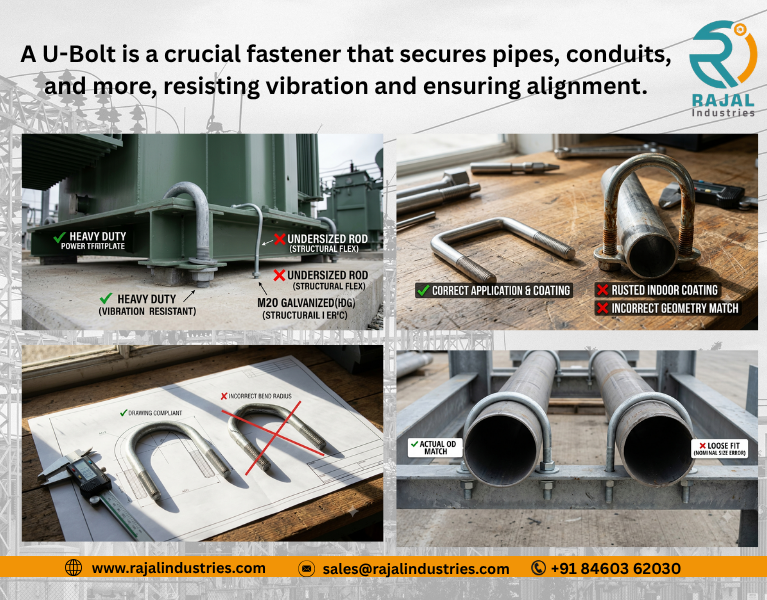
When engineers or procurement teams search for a U-Bolt Size Chart, they are usually looking for more than standard dimensions. They need to know which U-bolt size is suitable for a specific pipe, how to select the correct rod diameter, what material should be used and which surface coating will provide the required service life.
Selecting the wrong U-bolt can cause loose pipe supports, excessive vibration, damaged pipelines, difficult installation and increased maintenance costs. For power transformers, pipe support systems, electrical panels, switchgear, HVAC systems, telecom infrastructure, Battery Energy Storage Systems (BESS) and industrial machinery, choosing the correct U-bolt dimensions is just as important as selecting the correct pipe itself.
At Rajal Industries, we manufacture standard and custom U-Bolts for OEM manufacturers requiring bulk production from 50,000+ pieces. We manufacture according to customer drawings, pipe dimensions, DIN, ISO and project specifications.
Quick Answer
A U-Bolt Size Chart helps engineers select the correct:
- Pipe outside diameter (OD)
- Inside width
- Rod diameter
- Leg length
- Thread length
- Material
- Property class
- Surface coating
Selecting the correct combination improves installation quality, reduces pipe movement and extends the service life of the complete support system.
What Does a U-Bolt Size Mean?
Many buyers believe a U-bolt is selected using only the pipe’s nominal size.
In reality, a U-bolt is manufactured according to several important dimensions.
The most critical are:
- Pipe Outside Diameter (OD)
- Inside Width
- Rod Diameter
- Leg Length
- Thread Length
- Bend Radius
Every one of these dimensions affects installation, clamp load and long-term performance.
Understanding U-Bolt Dimensions
Before placing an order, every OEM buyer should understand the basic dimensions used on engineering drawings.
1. Pipe Outside Diameter (OD)
This is the most important dimension.
The U-bolt must fit the actual outside diameter of the pipe.
It should never be selected only by the pipe’s nominal size.
2. Inside Width
The inside width is the distance between the two threaded legs.
The width should allow:
- Easy installation
- Proper pipe clearance
- Even clamping force
3. Rod Diameter
Rod diameter determines the mechanical strength of the U-bolt.
Typical sizes include:
- M6
- M8
- M10
- M12
- M16
- M20
- M24
Larger diameters are used for higher structural loads.
4. Leg Length
The leg length should provide enough space for:
- Flat washers
- Spring washers
- Nuts
- Pipe insulation (where applicable)
Short leg lengths can make installation difficult, while excessive lengths increase material cost and may interfere with nearby equipment.
5. Thread Length
Thread length should provide sufficient engagement for secure tightening while avoiding unnecessary exposed threads.
Standard U-Bolt Size Chart
The following chart provides a general reference for commonly used industrial U-bolt sizes. Final dimensions should always follow the approved engineering drawing.
| Pipe OD (Approx.) | Recommended Rod Size | Common Applications |
| Up to 25 mm | M6 | Instrument Tubing |
| 26–40 mm | M8 | Small Pipe Supports |
| 41–60 mm | M10 | Electrical Panels |
| 61–90 mm | M12 | Transformer Oil Pipes |
| 91–140 mm | M16 | Industrial Pipelines |
| 141–220 mm | M20 | Process Piping |
| Above 220 mm | M24 & Above | Heavy Pipe Support Systems |
This chart is intended as a general engineering reference. Final selection should be based on project calculations and design requirements.
Step 1 – Measure the Pipe Correctly
The first step is measuring the actual outside diameter (OD) of the pipe.
Never assume the nominal pipe size is the same as the outside diameter.
Incorrect measurement may result in:
- Loose clamping
- Pipe movement
- Uneven loading
- Difficult installation
For OEM manufacturing, pipe OD should always be verified from the approved engineering drawing.
Step 2 – Select the Correct Rod Diameter
The rod diameter should match the expected load.
Engineering teams normally evaluate:
- Pipe weight
- Fluid weight
- Operating pressure
- Support spacing
- Vibration level
- Safety factor
Larger pipe diameters generally require larger rod diameters, but the final selection should always be supported by engineering calculations.
Step 3 – Choose the Correct Material
Material selection depends on:
- Mechanical strength
- Corrosion resistance
- Operating temperature
- Industry requirements
- Project specifications
Common materials include:
| Material | Typical Applications |
| Mild Steel | Indoor Pipe Supports |
| Carbon Steel | Industrial Equipment |
| High Tensile Steel | Heavy Pipe Supports |
| SS304 | Food & Pharmaceutical Plants |
| SS316 | Marine & Chemical Industries |
Selecting the correct material improves service life and reduces maintenance costs.
Where Different U-Bolt Sizes Are Used
Different industries require different U-bolt sizes.
Power Transformers
Used for:
- Conservator oil pipes
- Radiator piping
- Cooling systems
- Earthing conductors
Pipe Support Systems
Applications include:
- Water pipelines
- Steam lines
- Chemical pipelines
- Fire protection systems
Electrical Equipment
Common uses:
- Cable conduits
- Bus duct supports
- Instrument tubing
- Cable management systems
Renewable Energy
Used in:
- Solar mounting structures
- Battery Energy Storage Systems (BESS)
- EV Charging Infrastructure
- Cable support assemblies
Industrial Machinery
Applications include:
- Hydraulic pipes
- Pneumatic systems
- Cooling lines
- Lubrication systems
- Process equipment
Step 4 – Consider Pipe Movement
Industrial pipelines often expand and contract because of temperature changes.
Before selecting a U-bolt, engineers should evaluate:
- Thermal expansion
- Vibration
- Pipe insulation
- Pipe support spacing
- Operating temperature
The selected U-bolt should secure the pipe while allowing the movement specified by the piping design.
Step 5 – Select the Correct Surface Coating
Selecting the correct surface coating is just as important as choosing the correct U-bolt size. Many U-bolts are installed outdoors or in environments exposed to moisture, chemicals and temperature changes. The wrong coating may lead to corrosion, reduced clamping force and early replacement.
Before selecting a finish, engineers should evaluate:
- Indoor or outdoor installation
- Humidity level
- Chemical exposure
- Coastal atmosphere
- Operating temperature
- Expected service life
- Maintenance schedule
Zinc Plated U-Bolts
Recommended for:
- Indoor electrical panels
- Factory pipe supports
- Control cabinets
- Dry industrial environments
Advantages:
- Economical
- Good appearance
- Suitable for indoor applications
- Readily available
Hot Dip Galvanized (HDG) U-Bolts
Widely used for:
- Power transformers
- Outdoor substations
- Solar mounting structures
- Pipe racks
- Telecom towers
- Water treatment plants
Advantages:
- Excellent corrosion resistance
- Long outdoor service life
- Lower maintenance
- Preferred for utility projects
Stainless Steel U-Bolts
Recommended for:
- Chemical plants
- Food processing industries
- Pharmaceutical plants
- Marine installations
- Coastal environments
Advantages:
- Excellent corrosion resistance
- Hygienic surface
- Long operating life
- Low maintenance
Geomet & Dacromet Coatings
Suitable for:
- Renewable energy projects
- Heavy industrial equipment
- Utility infrastructure
- Corrosive environments
Advantages:
- High salt spray resistance
- Uniform coating thickness
- Long-term corrosion protection
Heavy Duty vs Standard U-Bolts
Not every application requires a heavy-duty U-bolt.
Selecting the correct design improves both safety and project cost.
| Feature | Standard U-Bolt | Heavy Duty U-Bolt |
| Rod Diameter | Smaller | Larger |
| Pipe Size | Small & Medium | Large Pipelines |
| Load Capacity | Medium | High |
| Typical Applications | Electrical Panels, HVAC | Transformers, Pipe Racks, Heavy Equipment |
| Cost | Lower | Higher |
For power transformers, industrial piping and heavy pipe support systems, heavy-duty U-bolts are commonly specified.
Common U-Bolt Selection Mistakes
Many installation problems occur because incorrect dimensions are ordered.
Selecting by Nominal Pipe Size
Always use the actual outside diameter (OD) of the pipe.
Choosing the Wrong Rod Diameter
A rod that is too small may reduce strength, while an oversized rod increases cost unnecessarily.
Ignoring Thread Length
Insufficient thread engagement makes installation difficult and may reduce clamping reliability.
Wrong Material Selection
Carbon steel should not be used where stainless steel or corrosion-resistant coatings are required.
Ignoring Pipe Insulation
Insulated pipelines require larger inside widths and longer legs to accommodate insulation thickness.
Ordering Without Drawings
Every enquiry should clearly specify:
- Pipe outside diameter
- Rod diameter
- Inside width
- Leg length
- Thread length
- Material
- Surface coating
- Quantity
Complete specifications help suppliers manufacture correctly the first time.
Quality Inspection Checklist
Before dispatching U-bolts, quality teams should verify:
| Inspection Item | Verify |
| Drawing Compliance | ✔ |
| Pipe OD | ✔ |
| Rod Diameter | ✔ |
| Inside Width | ✔ |
| Leg Length | ✔ |
| Thread Length | ✔ |
| Bend Radius | ✔ |
| Material Grade | ✔ |
| Surface Coating | ✔ |
| Thread Accuracy | ✔ |
| Visual Inspection | ✔ |
| Batch Traceability | ✔ |
| Material Test Certificate (If Required) | ✔ |
A detailed inspection process reduces installation problems and improves consistency across production batches.
Why Rajal Industries?
Rajal Industries manufactures U-Bolts for OEM manufacturers, EPC contractors and industrial projects requiring reliable, high-volume production.
Our manufacturing capabilities include:
- MOQ from 50,000+ pieces
- Round U-Bolts
- Square U-Bolts
- Heavy Duty U-Bolts
- Long Leg U-Bolts
- Custom Drawing-Based U-Bolts
- Carbon Steel, High Tensile Steel, SS304 & SS316
- Zinc Plated, Hot Dip Galvanized, Geomet & Dacromet Coatings
- CNC Thread Rolling
- Precision Bending & Forming
- Batch Traceability
- OEM Packaging
- Long-Term Supply Programmes
- Export Manufacturing Support
We supply:
- Transformer Manufacturers
- Pipe Support System Manufacturers
- Electrical Panel Manufacturers
- Switchgear Manufacturers
- HVAC Companies
- Renewable Energy Companies
- Telecom Infrastructure Companies
- Industrial Machinery OEMs
OEM RFQ Checklist
Before requesting a quotation, include:
☐ Pipe outside diameter (OD)
☐ Rod diameter
☐ Inside width
☐ Leg length
☐ Thread length
☐ Material
☐ Surface coating
☐ Quantity
☐ Annual requirement
☐ Engineering drawing
☐ Inspection requirements
☐ Packaging requirements
☐ Delivery schedule
Providing complete technical details helps suppliers recommend the correct U-bolt and prepare accurate quotations.
Key Takeaways
- Always select a U-bolt using the actual pipe outside diameter (OD), not the nominal pipe size.
- Rod diameter should match the load and support requirements.
- Material and coating should suit the operating environment.
- Heavy-duty U-bolts are preferred for transformers, pipe racks and industrial equipment.
- Drawing-based U-bolts reduce installation modifications and improve assembly quality.
- Working with an experienced OEM manufacturer ensures consistent dimensions and reliable long-term supply.
Frequently Asked Questions
How is a U-bolt size measured?
A U-bolt is measured using the pipe outside diameter (OD), rod diameter, inside width, leg length and thread length.
What is the most important dimension?
The pipe outside diameter (OD) is the most critical dimension because it determines how the U-bolt fits around the pipe.
Which material is commonly used for industrial U-bolts?
Carbon steel is widely used for general industrial applications, while SS304 and SS316 are selected where higher corrosion resistance is required.
Which coating is best for outdoor installations?
Hot Dip Galvanized (HDG) is commonly used for outdoor transformer yards, substations and pipe support systems because it provides excellent corrosion protection.
Can U-bolts be manufactured according to customer drawings?
Yes. Rajal Industries manufactures standard and custom U-bolts according to engineering drawings and project specifications.
Which industries use U-bolts?
Transformer manufacturers, pipe support companies, electrical panel manufacturers, switchgear manufacturers, HVAC contractors, renewable energy companies, telecom infrastructure providers and industrial OEMs.
What is your minimum production quantity?
Rajal Industries primarily manufactures bulk OEM orders from 50,000+ pieces, depending on the product and manufacturing process.
Conclusion
Selecting the correct U-Bolt size, dimensions and material is essential for safe and reliable pipe support systems. Choosing the correct pipe OD, rod diameter, leg length, material and coating helps reduce vibration, improve installation quality and extend the service life of industrial equipment.
For transformer manufacturers, pipe support system manufacturers, electrical panel OEMs, EPC contractors and industrial equipment manufacturers, partnering with an experienced U-Bolt Manufacturer ensures consistent quality, accurate dimensions and dependable long-term supply.
If your company requires standard or custom U-bolts with bulk production from 50,000+ pieces, Rajal Industries can manufacture according to your drawings, specifications and long-term production requirements.
Related Keywords
U Bolt Size Chart, U Bolt Dimensions, U Bolt Sizes, U Bolt Manufacturer, Industrial U Bolt, Pipe Support U Bolt, Heavy Duty U Bolt, Stainless Steel U Bolt, HDG U Bolt, Round U Bolt, Square U Bolt, Transformer U Bolt, U Bolt Dimensions Chart, Custom U Bolt Manufacturer, OEM Fastener Manufacturer, Bulk U Bolt Supplier, Drawing-Based U Bolt, Industrial Pipe Support Fasteners, High Tensile U Bolt, U Clamp Bolt.