

A distribution transformer is expected to operate safely for 25 to 35 years, often in outdoor environments exposed to rain, dust, vibration, thermal expansion and changing weather conditions. While most attention is given to transformer design, insulation systems and electrical performance, one of the most important mechanical components is often overlooked: the transformer anchor bolt.
Anchor bolts secure the transformer base to the concrete foundation and help resist equipment weight, vibration, wind loads, short-circuit forces and maintenance loads. A poorly selected anchor bolt can cause equipment movement, foundation damage, bolt corrosion, misalignment and expensive repair work.
Whether the transformer is installed in a utility substation, industrial plant, solar power station, commercial building, wind farm or distribution network, selecting the correct anchor bolt is essential for long-term reliability.
At Rajal Industries, we manufacture Transformer Anchor Bolts for transformer manufacturers, EPC contractors, electrical utilities and infrastructure projects requiring bulk production from 50,000+ pieces. We manufacture standard and drawing-based anchor bolts according to customer specifications and international engineering practices.
Quick Answer
The correct Transformer Anchor Bolt depends on several engineering factors, including:
- Transformer capacity
- Equipment weight
- Foundation design
- Bolt type
- Thread size
- Embedment depth
- Concrete strength
- Material
- Property class
- Surface coating
- Environmental conditions
- Applicable project specifications
Selecting the correct combination improves foundation stability, installation accuracy and long-term equipment reliability.
Why Anchor Bolt Selection Matters for Distribution Transformers
Unlike indoor equipment, distribution transformers operate continuously under varying environmental conditions.
During their service life, the anchor bolt assembly experiences:
- Static equipment load
- Oil-filled transformer weight
- Wind loading
- Earthquake loading (where applicable)
- Transportation stresses
- Short-circuit forces
- Thermal expansion and contraction
- Maintenance activities
- Foundation settlement
Every one of these forces must be safely transferred into the reinforced concrete foundation.
Selecting the wrong anchor bolt can result in:
- Equipment movement
- Loose foundations
- Cracked concrete
- Bolt corrosion
- Transformer misalignment
- Increased maintenance
- Reduced equipment life
For utility companies and industrial users, these issues can lead to unexpected outages and higher operating costs.
Where Transformer Anchor Bolts Are Used
Anchor bolts are used in almost every transformer installation.
Typical applications include:
Distribution Transformer Foundations
Used to secure:
- Pole-mounted transformer base structures
- Ground-mounted transformers
- Compact substations
- Package substations
Power Transformer Foundations
Applications include:
- Main transformer base frames
- Radiator support structures
- Conservator supports
- Cable support structures
- Fire protection walls
- Structural steel supports
Renewable Energy Projects
Transformer anchor bolts are widely used in:
- Solar substations
- Wind farms
- Battery Energy Storage Systems (BESS)
- EV charging infrastructure
- Utility switching stations
Industrial Electrical Installations
Typical applications include:
- Manufacturing plants
- Chemical industries
- Cement plants
- Steel plants
- Data centres
- Pharmaceutical facilities
Step 1 – Understand the Transformer Foundation
Before selecting an anchor bolt, engineers first evaluate the transformer foundation.
Important considerations include:
- Foundation dimensions
- Concrete grade
- Reinforcement layout
- Base plate dimensions
- Bolt layout
- Equipment centre of gravity
- Drainage provisions
- Future maintenance access
The anchor bolt should always be selected as part of the complete foundation system rather than as an individual component.
Step 2 – Select the Correct Anchor Bolt Type
Several anchor bolt designs are available.
L-Type Anchor Bolt
One of the most commonly used options for transformer foundations.
Advantages include:
- Simple design
- Reliable anchorage
- Cost-effective manufacturing
- Easy installation
Applications:
- Distribution transformers
- Industrial foundations
- Electrical equipment
J-Type Anchor Bolt
Provides improved anchorage because of its hook-shaped end.
Commonly used for:
- Utility substations
- Heavy electrical equipment
- Structural installations
Plate Anchor Bolt
Preferred where greater pull-out resistance is required.
Applications include:
- Power transformers
- Heavy substations
- Large industrial equipment
- High-load foundations
Straight Anchor Bolt
Typically used together with anchor plates or chemical anchoring systems.
Suitable for:
- Retrofit installations
- Existing foundations
- Heavy machinery replacement
The selected bolt type should match the project drawing and structural calculations.
Step 3 – Select the Correct Thread Size
Thread size should never be selected based only on transformer rating.
Engineering calculations should consider:
- Equipment weight
- Wind load
- Short-circuit forces
- Dynamic loading
- Safety factor
Common sizes include:
| Thread Size | Typical Applications |
| M16 | Small Distribution Transformers |
| M20 | Standard Distribution Transformers |
| M24 | Utility Transformers |
| M30 | Power Transformers |
| M36 | Heavy Transformer Foundations |
| M42 | Large Industrial Transformers |
| M48 | Utility Infrastructure Projects |
Actual dimensions should always follow the approved engineering drawing.
Step 4 – Material Selection
Material selection depends on:
- Mechanical strength
- Corrosion resistance
- Project location
- Operating environment
- Service life
Common materials include:
| Material | Typical Applications |
| Mild Steel | General Industrial Installations |
| Carbon Steel | Utility Projects |
| High Tensile Steel | Heavy Transformer Foundations |
| Alloy Steel | High Load Applications |
| SS304 | Coastal Industrial Plants |
| SS316 | Marine & Chemical Installations |
The selected material should satisfy both structural requirements and environmental exposure conditions.
Step 5 – Select the Correct Property Class
Mechanical strength is equally important.
Industrial transformer foundations commonly use:
- Property Class 4.6
- Property Class 5.6
- Property Class 8.8
- Property Class 10.9
For many transformer foundation applications, Grade 8.8 Anchor Bolts provide an excellent combination of strength, durability and cost efficiency.
Higher grades should only be selected where engineering calculations require greater load capacity.
Step 6 – Select the Correct Surface Protection
A distribution transformer is normally installed outdoors and is expected to operate continuously for decades. During this period, the transformer anchor bolts remain exposed to moisture, dust, industrial pollution, UV radiation, temperature changes and, in some locations, coastal salt spray. Selecting the correct surface protection is therefore essential.
Before finalizing the coating, engineers should evaluate:
- Indoor or outdoor installation
- Coastal or inland location
- Industrial pollution level
- Rainwater exposure
- Soil conditions
- Relative humidity
- Maintenance accessibility
- Expected service life
A coating should be selected based on the actual operating environment rather than simply choosing the lowest-cost option.
Zinc Plated Anchor Bolts
Recommended for:
- Indoor substations
- Electrical equipment rooms
- Dry industrial environments
- Factory installations
Advantages:
- Economical
- Clean appearance
- Easy availability
- Suitable for low-corrosion environments
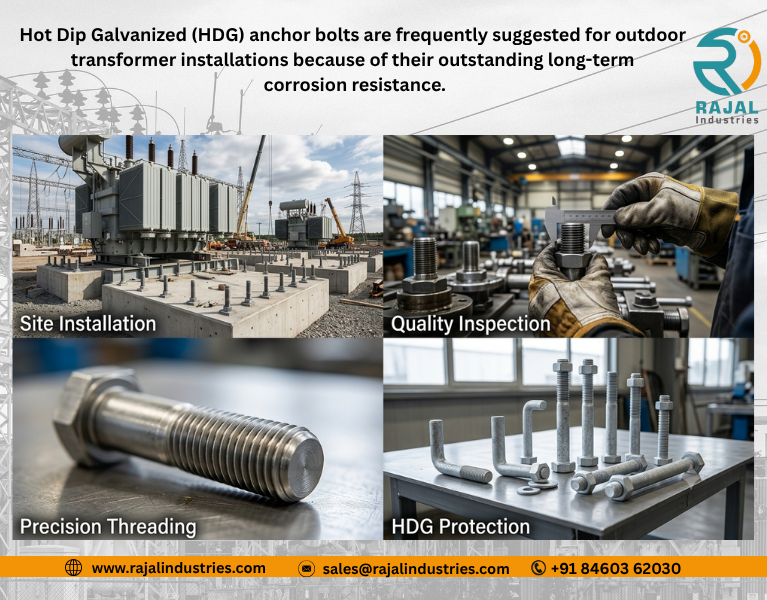
Hot Dip Galvanized (HDG) Anchor Bolts
Hot Dip Galvanized anchor bolts are among the most commonly specified fasteners for outdoor transformer installations.
Typical applications:
- Distribution transformer foundations
- Pole-mounted substations
- Utility substations
- Solar substations
- Outdoor switchyards
- Industrial outdoor equipment
Advantages:
- Excellent corrosion resistance
- Long service life
- Reduced maintenance
- Suitable for harsh weather conditions
Stainless Steel Anchor Bolts
Recommended for:
- Coastal installations
- Marine environments
- Chemical industries
- Water treatment plants
- Food processing facilities
Advantages:
- Excellent corrosion resistance
- Long equipment life
- Low maintenance requirements
Geomet & Dacromet Coatings
Used in:
- Renewable energy projects
- Utility infrastructure
- Telecom installations
- Heavy industrial environments
Advantages:
- High salt spray resistance
- Uniform coating thickness
- Good long-term corrosion protection
Step 7 – Understand Embedment Depth
One of the most critical design parameters for any transformer anchor bolt is embedment depth.
Embedment depth determines how effectively the bolt transfers tensile loads into the concrete foundation.
An incorrect embedment depth may result in:
- Pull-out failure
- Foundation cracking
- Reduced structural safety
- Increased maintenance
- Equipment instability
The required embedment depth depends on:
- Bolt diameter
- Concrete grade
- Applied tensile load
- Foundation dimensions
- Edge distance
- Reinforcement details
The final value should always follow the approved structural drawing and design calculations.
Step 8 – Check Edge Distance & Bolt Spacing
Proper anchor bolt layout is equally important.
Edge Distance
Installing anchor bolts too close to the edge of concrete can reduce the load-carrying capacity of the foundation and increase the risk of cracking.
Bolt Spacing
Adequate spacing between anchor bolts helps distribute loads more evenly throughout the foundation and simplifies installation.
Engineering drawings should always specify the correct spacing and layout.
Installation Best Practices
Even the highest-quality anchor bolt will not perform correctly if it is installed improperly.
During transformer installation, contractors should ensure:
- Foundation dimensions are verified before installation.
- Anchor bolt positions match the approved drawing.
- Bolt threads are protected during concreting.
- Vertical alignment is checked before concrete placement.
- Concrete is properly cured before tightening.
- Nuts are tightened using the specified torque values.
- Final alignment is verified before commissioning.
Following these practices reduces installation errors and improves long-term performance.
Common Transformer Foundation Failures
Many transformer foundation problems are caused by incorrect anchor bolt selection or installation.
Incorrect Anchor Bolt Layout
Improper bolt spacing or incorrect bolt positions can make transformer installation difficult and may require costly modifications.
Wrong Embedment Depth
Insufficient embedment reduces pull-out resistance and may compromise structural stability.
Poor Corrosion Protection
Outdoor transformers installed with unsuitable coatings often experience premature corrosion.
Incorrect Bolt Grade
Selecting a lower property class than specified can reduce the foundation’s load-carrying capacity.
Improper Tightening
Under-tightening may allow movement, while excessive tightening can damage threads or overstress the bolt.
Purchasing Without Reviewing Drawings
Anchor bolts should never be ordered based only on size. Always verify:
- Drawing revision
- Bolt type
- Material
- Property class
- Coating
- Embedment requirements
before releasing production.
Quality Inspection Checklist
Before dispatching anchor bolts, quality teams should verify:
| Inspection Item | Verify |
| Drawing Compliance | ✔ |
| Thread Diameter | ✔ |
| Overall Length | ✔ |
| Bend Dimensions (L/J Type) | ✔ |
| Material Grade | ✔ |
| Property Class | ✔ |
| Surface Coating | ✔ |
| Thread Quality | ✔ |
| Straightness | ✔ |
| Weld Quality (Plate Type) | ✔ |
| Visual Inspection | ✔ |
| Batch Traceability | ✔ |
| Material Test Certificate (If Required) | ✔ |
A systematic inspection process helps ensure smooth installation at site and reduces the risk of project delays.
Why Transformer Manufacturers & EPC Contractors Choose Rajal Industries
Rajal Industries manufactures Transformer Anchor Bolts for OEM manufacturers, electrical utilities and EPC contractors requiring dependable, large-scale production.
Our manufacturing capabilities include:
- MOQ from 50,000+ pieces
- L-Type Anchor Bolts
- J-Type Anchor Bolts
- Straight Anchor Bolts
- Plate Anchor Bolts
- Custom Drawing-Based Anchor Bolts
- Carbon Steel, High Tensile Steel, Alloy Steel, SS304 & SS316
- Property Classes 4.6, 5.6, 8.8 & 10.9
- Hot Dip Galvanized, Zinc Plated, Geomet & Dacromet Coatings
- CNC Thread Rolling
- Consistent Dimensional Accuracy
- Batch Traceability
- OEM Packaging
- Long-Term Supply Agreements
- Export Manufacturing Support
We primarily supply:
- Transformer Manufacturers
- EPC Contractors
- Electrical Utilities
- Renewable Energy Developers
- Steel Structure Companies
- Industrial Machinery Manufacturers
- Infrastructure Projects
- Heavy Engineering Companies
OEM & EPC RFQ Checklist
Before sending an enquiry, include:
☐ Anchor bolt type
☐ Thread size
☐ Overall length
☐ Embedment length
☐ Material
☐ Property class
☐ Surface coating
☐ Quantity
☐ Annual consumption
☐ Engineering drawing
☐ Inspection requirements
☐ Packaging specification
☐ Delivery schedule
Providing complete engineering information helps suppliers prepare accurate quotations, reduce manufacturing errors and shorten project lead times.
Key Takeaways
- Transformer anchor bolts are critical structural components that transfer equipment loads safely into concrete foundations.
- Correct anchor bolt selection depends on foundation design, embedment depth, material, property class and corrosion protection.
- Hot Dip Galvanized anchor bolts are widely used for outdoor transformer installations.
- Proper installation and inspection are just as important as selecting the correct bolt.
- Working with an experienced anchor bolt manufacturer improves project quality, consistency and long-term reliability.
Frequently Asked Questions
What is a transformer anchor bolt?
A transformer anchor bolt is a foundation fastener used to secure a transformer base frame to a reinforced concrete foundation.
Which anchor bolt is commonly used for distribution transformers?
L-type anchor bolts are widely used, while J-type and plate anchor bolts are selected depending on structural requirements.
Which property class is recommended?
Grade 8.8 is commonly specified for distribution transformer foundations. Higher grades should only be used where required by engineering calculations.
Which coating is best for outdoor transformer installations?
Hot Dip Galvanized (HDG) is one of the most commonly specified coatings because it provides excellent long-term corrosion protection.
Why is embedment depth important?
Proper embedment depth allows the anchor bolt to safely transfer tensile forces into the concrete foundation and helps prevent pull-out failure.
Can transformer anchor bolts be manufactured according to customer drawings?
Yes. Rajal Industries manufactures both standard and custom anchor bolts according to engineering drawings and project specifications.
Which industries use transformer anchor bolts?
Transformer manufacturers, EPC contractors, electrical utilities, renewable energy developers, industrial plants, substations and infrastructure projects.
What is your minimum production quantity?
Rajal Industries primarily supports bulk OEM and EPC production from 50,000+ pieces, depending on the product and manufacturing process.
Conclusion
Selecting the correct Transformer Anchor Bolt is a critical part of every distribution transformer installation. The correct anchor bolt type, diameter, embedment depth, material, property class and corrosion protection all contribute to the long-term safety and stability of the transformer foundation.
For transformer manufacturers, EPC contractors, electrical utilities and industrial OEMs, partnering with an experienced Anchor Bolt Manufacturer helps ensure reliable installation, consistent quality and dependable long-term supply.
If your company requires standard or custom transformer anchor bolts with bulk production from 50,000+ pieces, Rajal Industries can provide engineering-focused fastening solutions designed for demanding utility and industrial applications.
Related Keywords
Transformer Anchor Bolt, Distribution Transformer Anchor Bolt, Anchor Bolt Manufacturer, Foundation Anchor Bolt, L Type Anchor Bolt, J Type Anchor Bolt, Transformer Foundation Bolt, Utility Anchor Bolt, Heavy Duty Anchor Bolt, High Tensile Anchor Bolt, Hot Dip Galvanized Anchor Bolt, Stainless Steel Anchor Bolt, Industrial Anchor Bolt, Electrical Equipment Foundation Bolt, OEM Anchor Bolt Manufacturer, EPC Fasteners, Bulk Anchor Bolt Supplier, Drawing-Based Anchor Bolt Manufacturer, Foundation Fasteners, Industrial Fasteners.