

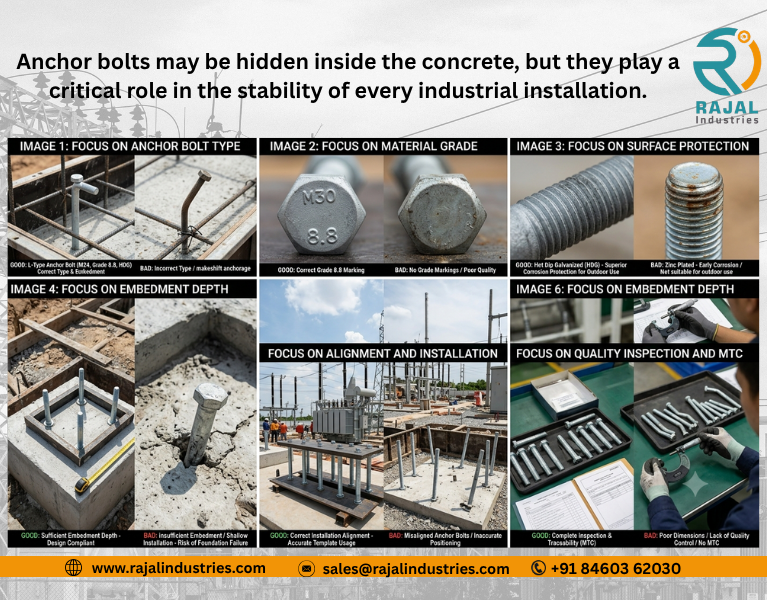
When heavy industrial equipment is installed, the strength of the complete structure depends not only on the equipment itself but also on the foundation fastening system. Whether it is a power transformer, switchyard equipment, electrical panel support structure, industrial machine, steel column, telecom tower or solar mounting system, the anchor bolt transfers loads from the equipment into the concrete foundation.
Selecting the wrong Anchor Bolt can lead to vibration, foundation movement, equipment misalignment, structural instability and expensive maintenance. For this reason, EPC contractors, transformer manufacturers, structural fabricators and industrial OEMs carefully specify anchor bolt type, diameter, embedment depth, material grade and surface protection before construction begins.
At Rajal Industries, we manufacture Anchor Bolts for OEM manufacturers, EPC contractors and infrastructure projects requiring bulk production from 50,000+ pieces. We manufacture standard and drawing-based anchor bolts for transformer foundations, industrial equipment, steel structures and heavy engineering applications.
Quick Answer
An Anchor Bolt is a fastening component designed to secure equipment, steel structures or machinery to concrete foundations.
Anchor bolts are commonly used for:
- Power Transformers
- Distribution Transformers
- Switchyard Equipment
- Electrical Panel Structures
- Industrial Machinery
- Steel Columns
- Solar Structures
- Telecom Towers
- Conveyor Systems
- Heavy Fabrication
Selecting the correct anchor bolt depends on:
- Load calculations
- Concrete strength
- Bolt diameter
- Embedment depth
- Material
- Surface coating
- Environmental conditions
- Applicable engineering standards
What is an Anchor Bolt?
An Anchor Bolt is a threaded fastening system installed into concrete foundations to securely hold equipment or structural members.
Unlike standard bolts, anchor bolts are designed to resist:
- Tensile loads
- Shear loads
- Uplift forces
- Dynamic vibration
- Seismic movement (where applicable)
- Wind loading
- Equipment movement
Anchor bolts become a permanent part of the concrete foundation and provide the critical connection between the structure and its supporting base.
Why Transformer Manufacturers Need Anchor Bolts
Power transformers often weigh several tonnes and operate continuously for decades. During transportation, installation and service, they are subjected to:
- Equipment weight
- Oil weight
- Wind forces
- Short-circuit forces
- Thermal expansion
- Earthquake loading (in applicable zones)
- Transportation stresses
- Maintenance activities
A properly designed anchor bolt system helps maintain equipment alignment and structural stability throughout the transformer’s service life.
Typical transformer applications include:
- Transformer foundation
- Base frame anchoring
- Radiator support structures
- Fire wall supports
- Cable trench structures
- Conservator support frames
- Outdoor switchyard equipment
Industries That Buy Anchor Bolts in Bulk
Anchor bolts are widely used across heavy engineering industries.
Transformer Manufacturers
Applications include:
- Power transformers
- Distribution transformers
- Dry type transformers
- Instrument transformers
- Package substations
EPC Contractors
Used in:
- Substations
- Power plants
- Industrial projects
- Infrastructure projects
- Utility installations
Steel Structure Manufacturers
Applications include:
- Industrial buildings
- PEB structures
- Pipe racks
- Steel columns
- Mezzanine floors
- Heavy fabrication
Industrial Machinery Manufacturers
Used for:
- CNC machines
- Press machines
- Compressors
- Pumps
- Generators
- Material handling systems
- Conveyor equipment
Renewable Energy Projects
Anchor bolts are widely used in:
- Solar module structures
- Wind turbine foundations
- Battery Energy Storage Systems (BESS)
- EV charging stations
- Inverter foundations
Other Industrial Applications
Additional industries include:
- Telecom towers
- Railway infrastructure
- Cement plants
- Chemical plants
- Food processing plants
- Pharmaceutical facilities
- Mining equipment
- Water treatment plants
Types of Anchor Bolts Used by Industrial OEMs
Different projects require different anchor bolt designs.
The most common types include:
L-Type Anchor Bolts
One of the most widely used anchor bolts for transformer foundations and general industrial construction.
Advantages:
- Simple manufacturing
- Good pull-out resistance
- Economical
- Easy installation
Typical applications:
- Transformer foundations
- Steel columns
- Equipment foundations
J-Type Anchor Bolts
Designed with a hooked end that provides improved anchorage in concrete.
Commonly used in:
- Industrial machinery
- Structural foundations
- Utility projects
Straight Anchor Bolts
Usually installed with mechanical anchoring systems or anchor plates.
Applications include:
- Heavy machinery
- Industrial equipment
- Retrofit projects
Anchor Bolts with Anchor Plates
Suitable for:
- Heavy structural loads
- High tensile applications
- Large industrial foundations
- Heavy equipment installation
These are commonly specified where greater pull-out resistance is required.
Step 1 – Select the Correct Anchor Bolt Type
Before selecting an anchor bolt, engineering teams should evaluate:
- Static load
- Dynamic load
- Concrete strength
- Equipment weight
- Installation method
- Foundation thickness
- Seismic requirements
- Wind loading
- Maintenance access
Selecting the correct anchor bolt type during the design stage reduces installation issues and improves long-term structural reliability.
Step 2 – Choose the Correct Bolt Diameter
Anchor bolt diameter depends on engineering calculations rather than equipment size alone.
Common industrial sizes include:
| Thread Size | Typical Applications |
| M12 | Small equipment |
| M16 | Electrical structures |
| M20 | Transformer foundations |
| M24 | Steel structures |
| M30 | Heavy machinery |
| M36 | Industrial foundations |
| M42 | Heavy engineering |
| M48 | Large infrastructure projects |
The selected diameter should safely resist the applied tensile and shear loads with the required safety factor.
Step 3 – Select the Correct Material
Material selection directly affects strength, durability and corrosion resistance.
Common materials include:
| Material | Typical Applications |
| Mild Steel | General Industrial Foundations |
| High Tensile Steel | Heavy Equipment |
| Alloy Steel | High Load Structures |
| SS304 | Chemical & Food Industries |
| SS316 | Marine & Coastal Installations |
Material selection should always consider:
- Structural loading
- Corrosion exposure
- Service life
- Maintenance strategy
- Project specifications
Step 4 – Select the Correct Property Class
The mechanical strength of an Anchor Bolt plays a major role in the long-term stability of the equipment foundation. The property class should always be selected based on structural calculations, foundation design and loading conditions.
Common property classes include:
- Property Class 4.6
- Property Class 5.6
- Property Class 8.8
- Property Class 10.9
- Property Class 12.9 (special engineering applications)
For most transformer foundations, electrical equipment, steel structures and industrial machinery, Grade 8.8 Anchor Bolts provide an excellent balance of strength, availability and cost.
Higher property classes should only be selected where structural calculations require additional tensile capacity.
Grade 4.6 vs 5.6 vs 8.8 vs 10.9 Anchor Bolts
| Property Class | Typical Applications | Advantages |
| 4.6 | Light Structures | Economical |
| 5.6 | General Industrial Equipment | Improved Strength |
| 8.8 | Transformers, Steel Structures, Machinery | Most Common Industrial Grade |
| 10.9 | Heavy Equipment, Dynamic Loads | Very High Strength |
Using a stronger anchor bolt than necessary may increase project cost without improving foundation performance.
Step 5 – Select the Correct Surface Protection
Most anchor bolts remain exposed to weather for many years.
Choosing the correct surface protection significantly affects service life.
Before selecting a coating, engineering teams should consider:
- Indoor or outdoor installation
- Coastal environment
- Chemical exposure
- Rainfall
- Humidity
- Soil conditions
- Expected equipment life
Zinc Plated Anchor Bolts
Typical applications:
- Indoor machinery
- Electrical rooms
- Factory equipment
Advantages:
- Economical
- Good appearance
- Suitable for dry environments
Hot Dip Galvanized (HDG) Anchor Bolts
Commonly used for:
- Outdoor transformers
- Substations
- Steel structures
- Solar projects
- Telecom towers
Advantages:
- Excellent corrosion resistance
- Long outdoor service life
- Lower maintenance
Stainless Steel Anchor Bolts
Recommended for:
- Coastal installations
- Chemical plants
- Water treatment facilities
- Marine applications
Advantages:
- Outstanding corrosion resistance
- Long service life
- Reduced maintenance
Geomet & Dacromet Coatings
Suitable for:
- Utility infrastructure
- Renewable energy
- Heavy industrial environments
Advantages:
- High corrosion resistance
- Uniform coating
- Good performance in aggressive environments
Engineering Considerations Before Selecting Anchor Bolts
Selecting an anchor bolt involves much more than choosing the diameter.
Engineering teams normally evaluate:
Foundation Design
Concrete grade and foundation dimensions directly affect anchor bolt performance.
Embedment Depth
Insufficient embedment may reduce pull-out resistance.
The required embedment should always follow structural calculations and project drawings.
Edge Distance
Anchor bolts installed too close to the concrete edge may increase the risk of concrete cracking.
Bolt Spacing
Proper spacing helps distribute loads and prevents concrete failure.
Tensile Load
Anchor bolts must safely resist uplift forces generated by equipment operation and environmental loads.
Shear Load
Horizontal forces caused by vibration, wind or equipment movement should also be considered.
Dynamic Loading
Transformers, generators, compressors and rotating machinery create cyclic loads that influence anchor bolt selection.
Installation Accuracy
Correct positioning ensures:
- Easier equipment installation
- Proper alignment
- Reduced rework
- Lower installation time
Common Anchor Bolt Failures
Many foundation failures occur because of incorrect bolt selection rather than poor manufacturing.
Common issues include:
Incorrect Embedment Depth
Shallow installation reduces pull-out strength.
Wrong Bolt Grade
Using a lower property class than specified may reduce structural safety.
Poor Corrosion Protection
Outdoor anchor bolts without suitable coating may corrode prematurely.
Incorrect Installation Alignment
Misaligned anchor bolts create installation difficulties and may require expensive foundation repairs.
Inadequate Tightening
Improper tightening affects preload and long-term joint stability.
Purchasing Only on Price
The lowest-cost anchor bolt is rarely the most economical over the life of the equipment.
Quality Inspection Checklist
Before approving production, OEM quality teams should verify:
| Inspection Item | Verify |
| Drawing Compliance | ✔ |
| Thread Diameter | ✔ |
| Bolt Length | ✔ |
| Bend Dimensions (L/J Type) | ✔ |
| Material Grade | ✔ |
| Property Class | ✔ |
| Surface Coating | ✔ |
| Thread Quality | ✔ |
| Straightness | ✔ |
| Weld Quality (Plate Type) | ✔ |
| Visual Inspection | ✔ |
| Batch Traceability | ✔ |
| Material Test Certificate (If Required) | ✔ |
Proper inspection ensures reliable installation and long-term structural performance.
Why EPC Contractors & OEMs Choose Rajal Industries
Rajal Industries manufactures Anchor Bolts for infrastructure, power and industrial projects requiring dependable, large-volume production.
Our manufacturing capabilities include:
- MOQ from 50,000+ pieces
- L-Type Anchor Bolts
- J-Type Anchor Bolts
- Foundation Anchor Bolts
- Plate Anchor Bolts
- Custom Drawing-Based Anchor Bolts
- Carbon Steel, Alloy Steel, SS304 & SS316
- Grade 4.6, 5.6, 8.8 & 10.9
- Hot Dip Galvanized, Zinc Plated, Geomet & Dacromet
- Cold Forging & Hot Forging Support
- CNC Thread Rolling
- Batch Traceability
- OEM Packaging
- Long-Term Supply Programs
- Export Manufacturing Support
We supply OEM manufacturers, EPC contractors and infrastructure companies across India and international markets.
OEM & EPC RFQ Checklist
Before requesting a quotation, include:
☐ Anchor bolt type (L, J, Straight or Plate Type)
☐ Thread size
☐ Bolt length
☐ Embedment length
☐ Material
☐ Property class
☐ Surface coating
☐ Quantity
☐ Annual requirement
☐ Engineering drawing
☐ Inspection requirements
☐ Packaging specification
☐ Delivery schedule
Providing complete technical information improves quotation accuracy and reduces manufacturing lead time.
Key Takeaways
- Anchor bolts transfer structural loads safely into concrete foundations.
- Grade 8.8 anchor bolts are widely used for transformer and industrial foundations.
- Proper embedment depth, spacing and edge distance are essential for foundation performance.
- Surface coating should be selected according to environmental conditions.
- Standard and drawing-based anchor bolts are both widely used by industrial OEMs.
- Working with an experienced anchor bolt manufacturer improves project reliability and long-term supply.
Frequently Asked Questions
What is an anchor bolt?
An anchor bolt is a fastening component used to secure equipment or steel structures to concrete foundations.
Which anchor bolt is commonly used for transformer foundations?
L-type and J-type anchor bolts are among the most commonly specified designs, depending on the engineering requirements.
Which property class is commonly used?
Grade 8.8 is widely used for transformer foundations, industrial machinery and steel structures.
Which coating is best for outdoor transformer foundations?
Hot Dip Galvanized (HDG) is commonly selected because it provides excellent long-term corrosion resistance.
Can anchor bolts be manufactured according to customer drawings?
Yes. Rajal Industries manufactures custom anchor bolts according to engineering drawings and project specifications.
Which industries use anchor bolts?
Transformer manufacturers, EPC contractors, steel fabricators, renewable energy companies, industrial machinery manufacturers, telecom infrastructure companies, railway contractors and heavy engineering firms.
Why is embedment depth important?
Correct embedment helps the anchor bolt safely resist tensile loads and reduces the risk of pull-out failure.
What is your minimum production quantity?
Rajal Industries primarily manufactures bulk OEM and EPC orders from 50,000+ pieces, depending on the product and manufacturing process.
Conclusion
Anchor Bolts form the foundation of every heavy industrial installation. Whether supporting power transformers, switchyards, industrial machinery, steel structures or renewable energy equipment, selecting the correct anchor bolt type, material, property class and corrosion protection is essential for structural safety and long-term reliability.
For OEM manufacturers, EPC contractors and infrastructure developers, partnering with an experienced Anchor Bolt Manufacturer ensures consistent quality, engineering support and dependable long-term supply.
If your company requires standard or custom anchor bolts with bulk production from 50,000+ pieces, Rajal Industries can support your project with engineering-driven fastening solutions designed for demanding industrial applications.
Related Keywords
Anchor Bolt Manufacturer, Anchor Bolt Supplier, Foundation Anchor Bolt, L Type Anchor Bolt, J Type Anchor Bolt, Plate Anchor Bolt, Heavy Duty Anchor Bolt, Industrial Anchor Bolt, Transformer Foundation Bolt, Switchyard Anchor Bolt, Structural Anchor Bolt, Hot Dip Galvanized Anchor Bolt, High Tensile Anchor Bolt, Stainless Steel Anchor Bolt, OEM Anchor Bolt Manufacturer, EPC Fasteners, Foundation Fasteners, Drawing-Based Anchor Bolt, Industrial Fasteners, Bulk Anchor Bolt Supplier.