

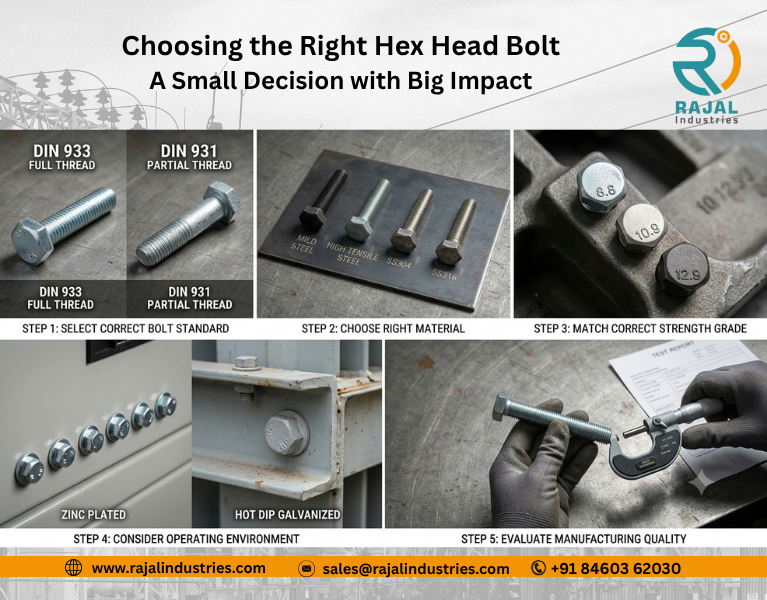
Selecting the right Hex Head Bolt is one of the most important decisions during product design and procurement. A bolt may represent only a small percentage of the total product cost, but choosing the wrong standard, material, grade, or coating can lead to assembly problems, equipment failure, increased maintenance, and warranty claims.
For OEM manufacturers producing power transformers, distribution transformers, dry type transformers, elevators, electrical panels, switchgear, EV chargers, battery energy storage systems (BESS), telecom cabinets, and industrial machinery, the bolt must match both the engineering design and the operating environment.
At Rajal Industries, we manufacture Hex Head Bolts for OEM customers requiring bulk production from 50,000+ pieces. We support standard and drawing-based manufacturing with consistent quality for long-term supply.
Quick Answer
There is no single “best” hex head bolt for every application.
The correct selection depends on:
- Load requirements
- Joint design
- Material
- Strength grade
- Thread type
- Bolt standard
- Surface coating
- Corrosion exposure
- Service temperature
- Maintenance requirements
Selecting the right combination improves joint reliability, extends equipment life, and reduces maintenance costs.
Why Hex Head Bolts Are the Preferred Choice for OEM Manufacturers
Hex head bolts remain one of the most widely used industrial fasteners because they offer:
- High clamping force
- Standardised dimensions
- Easy installation with common tools
- Availability in multiple grades and materials
- Compatibility with automated assembly lines
- Easy replacement during maintenance
- Cost-effective manufacturing
These advantages make them suitable for both structural and mechanical assemblies across a wide range of industries.
Step 1: Select the Correct Bolt Standard
The first step is choosing the appropriate international standard.
| Standard | Thread Type | Typical Applications |
| DIN 933 | Fully Threaded | Panels, Machinery, Equipment |
| DIN 931 | Partially Threaded | Structural Joints |
| ISO 4014 | Partial Thread | Heavy Equipment |
| ISO 4017 | Full Thread | Mechanical Assemblies |
For electrical panels and compact assemblies, fully threaded bolts are commonly selected.
For transformer frames, elevator structures, and heavy fabricated assemblies, partially threaded bolts are often preferred where the engineering design requires an unthreaded shank.
Step 2: Select the Right Material
Material selection directly affects strength, corrosion resistance, and service life.
| Material | Suitable Applications |
| Mild Steel | Indoor industrial equipment |
| High Tensile Steel | Heavy mechanical loads |
| SS304 | Electrical panels and indoor applications |
| SS316 | Marine and chemical environments |
| Alloy Steel | Heavy engineering and structural equipment |
For outdoor transformer installations, stainless steel or coated carbon steel may provide better corrosion resistance depending on the environment.
Step 3: Choose the Correct Strength Grade
One of the most common procurement mistakes is selecting a bolt grade based only on availability or cost.
| Grade | Typical Use |
| 4.6 | Light-duty applications |
| 5.6 | General engineering |
| 8.8 | Industrial machinery, transformers, electrical equipment |
| 10.9 | High-load assemblies, elevators, heavy machinery |
| 12.9 | Special high-strength applications |
Higher strength is not always better. The bolt grade should match the design calculations and joint requirements.
Step 4: Consider the Operating Environment
The working environment plays an important role in fastener selection.
Outdoor Transformer Installations
Factors to consider:
- Rain
- Humidity
- UV exposure
- Dust
- Temperature variation
- Corrosion
Recommended coatings may include:
- Hot Dip Galvanized (HDG)
- Geomet
- Dacromet
Indoor Electrical Panels
Typical considerations include:
- Dimensional consistency
- Ease of assembly
- Corrosion protection for indoor environments
Zinc-plated fasteners are commonly used for indoor applications.
Elevator Systems
Elevator assemblies experience:
- Repeated vibration
- Dynamic loading
- Frequent inspection
- Long service life
The selected bolt must maintain clamp load and dimensional stability throughout the operating life of the equipment.
Step 5: Check Thread Requirements
OEM drawings generally specify:
- Metric thread
- Thread pitch
- Thread tolerance
- Thread length
- Full thread or partial thread
Incorrect thread specifications can delay assembly and increase rejection rates during production.
Step 6: Evaluate Manufacturing Quality
A reliable Hex Head Bolt Manufacturer should provide:
- Accurate dimensions
- Consistent thread quality
- Proper heat treatment (where applicable)
- Uniform coating thickness
- Batch traceability
- Stable production quality
- Reliable delivery schedules
Consistency is especially important for companies producing thousands of units every month.
Industries That Use Hex Head Bolts
Hex head bolts are widely used in:
- Power Transformer Manufacturing
- Distribution Transformer Manufacturing
- Dry Type Transformer Manufacturing
- Elevator Manufacturing
- Passenger Lift Manufacturing
- Freight Lift Manufacturing
- Electrical Panel Manufacturing
- Switchgear Manufacturing
- Control Panel Manufacturing
- Telecom Cabinet Manufacturing
- EV Charger Manufacturing
- Battery Energy Storage Systems (BESS)
- Industrial Machinery
- Renewable Energy Equipment
- Material Handling Equipment
Common Selection Mistakes
Avoid these common issues:
- Selecting the wrong standard
- Ignoring material compatibility
- Using the wrong strength grade
- Choosing incorrect coating
- Ordering inconsistent dimensions
- Buying from suppliers without quality controls
- Selecting based only on price
Each of these mistakes can increase production costs over time.
OEM Procurement Checklist
Before releasing an RFQ, verify:
✔ Bolt standard
✔ Material
✔ Strength grade
✔ Thread type
✔ Thread length
✔ Surface coating
✔ Quantity
✔ Drawing revision
✔ Inspection requirements
✔ Packaging
✔ Delivery schedule
✔ Long-term supply capability
Why OEM Buyers Choose Rajal Industries
Rajal Industries supports OEM manufacturers with:
- MOQ from 50,000+ pieces
- Standard DIN, ISO, ASTM and IS fasteners
- Custom manufacturing as per drawings
- Carbon steel, alloy steel, SS304 and SS316
- Multiple coating options
- Bulk production planning
- Consistent manufacturing quality
- Long-term supply partnerships
We primarily serve transformer manufacturers, elevator OEMs, electrical panel manufacturers, switchgear companies, and industrial equipment manufacturers.
Key Takeaways
- Hex head bolt selection should be based on engineering requirements, not price alone.
- Standard, material, grade, coating, and operating environment all influence long-term performance.
- DIN 933 and DIN 931 remain the most commonly specified standards for industrial applications.
- Working with an experienced OEM fastener manufacturer helps improve production consistency and reduce maintenance issues.
Frequently Asked Questions
Which hex head bolt is best for transformer manufacturing?
The correct bolt depends on the design. Many transformer manufacturers use DIN 931 for structural joints and DIN 933 for equipment assemblies.
Is Grade 10.9 always better than Grade 8.8?
No. The required grade should match the engineering design and loading conditions.
Which coating is suitable for outdoor transformer installations?
Hot Dip Galvanized (HDG), Geomet, or Dacromet coatings are commonly selected where corrosion protection is required.
Can hex head bolts be manufactured according to customer drawings?
Yes. Rajal Industries manufactures standard and custom hex head bolts based on customer drawings and specifications.
What is your production quantity?
Our focus is on OEM manufacturing with bulk production starting from 50,000+ pieces, depending on the product and manufacturing process.
Conclusion
Selecting the correct Hex Head Bolt is an important engineering and procurement decision that directly affects assembly quality, product reliability, and long-term maintenance.
Whether you manufacture power transformers, elevators, electrical panels, switchgear, telecom cabinets, EV chargers, or industrial machinery, choosing the correct standard, material, grade, and coating helps improve production efficiency and equipment performance.
If your company is looking for an OEM Hex Head Bolt Manufacturer capable of supporting bulk orders, drawing-based manufacturing, and long-term supply, Rajal Industries is ready to support your production requirements.
Related Keywords
Hex Head Bolt, Hex Head Bolt Manufacturer, Hex Head Bolt Supplier, Hex Bolt Manufacturer India, Industrial Hex Bolt, OEM Bolt Manufacturer, DIN 933 Hex Bolt, DIN 931 Hex Bolt, ISO 4014 Bolt, ISO 4017 Bolt, Grade 8.8 Bolt, Grade 10.9 Bolt, High Tensile Hex Bolt, Transformer Fasteners, Elevator Fasteners, Electrical Panel Fasteners, Switchgear Fasteners, Industrial Fasteners, Bulk Bolt Supplier, Custom Fastener Manufacturer.