
Selecting DIN For Hex Head Bolt
Selecting between DIN 933 and DIN 931 Hex Head Bolts is a common engineering and procurement decision for OEM manufacturers. Although both are hex head bolts, they are designed for different applications and should not be used interchangeably without understanding their purpose.
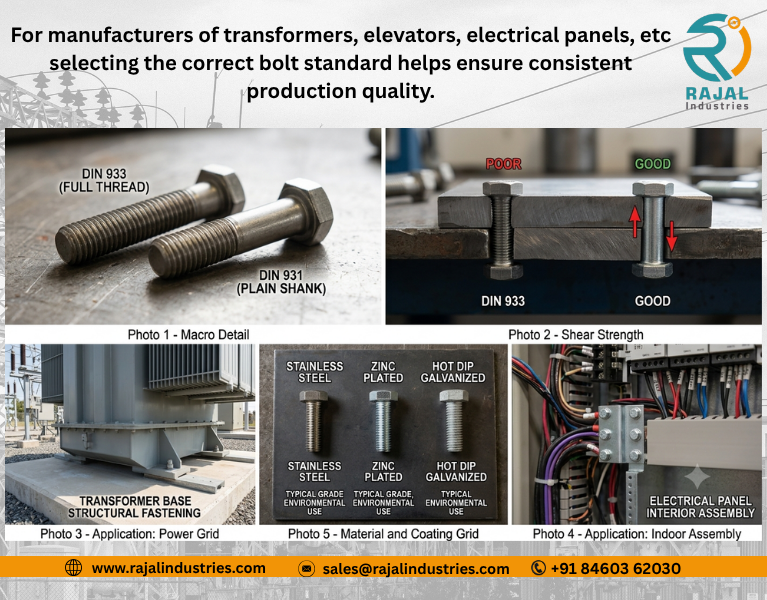
Choosing the wrong bolt can affect joint strength, assembly performance, maintenance, and long-term reliability. For manufacturers of transformers, elevators, electrical panels, switchgear, industrial machinery, EV chargers, and telecom cabinets, selecting the correct bolt standard helps ensure consistent production quality.
At Rajal Industries, we manufacture DIN 933 and DIN 931 Hex Head Bolts for OEM customers requiring bulk production from 50,000+ pieces. We also support drawing-based manufacturing, custom materials, and long-term supply programs.
Quick Answer
The main difference is the thread length.
- DIN 933 is a fully threaded hex head bolt.
- DIN 931 is a partially threaded hex head bolt with an unthreaded shank.
DIN 933 is generally selected when full thread engagement is required, while DIN 931 is preferred when higher shear strength or better alignment is needed in structural joints.
DIN 933 vs DIN 931 Comparison
| Feature | DIN 933 | DIN 931 |
| Thread | Fully Threaded | Partially Threaded |
| Shank | No Plain Shank | Plain Shank Available |
| Best For | General Assemblies | Structural & Heavy Duty Assemblies |
| Load Distribution | Threaded Along Full Length | Better Shear Load Distribution |
| Maintenance | Easy Replacement | Better Joint Alignment |
| Common Industries | Panels, Machinery, Equipment | Transformers, Elevators, Heavy Equipment |
When Should OEM Buyers Select DIN 933?
DIN 933 Hex Head Bolts are commonly used where complete thread engagement is required.
Typical applications include:
- Electrical panels
- Switchgear
- Control panels
- Industrial machinery
- Telecom cabinets
- EV chargers
- Battery enclosures
- General fabricated assemblies
Because the bolt is threaded along its full length, it is suitable for thinner assemblies or where the grip length changes between products.
When Should OEM Buyers Select DIN 931?
DIN 931 Hex Head Bolts are generally preferred where the joint experiences higher mechanical loads.
Common applications include:
- Transformer base frames
- Transformer support structures
- Elevator machine frames
- Guide rail brackets
- Heavy fabricated structures
- Industrial equipment
- Steel assemblies
- Mechanical support systems
The unthreaded shank improves alignment and can reduce stress concentration in shear-loaded joints.
Material Options
Both DIN 933 and DIN 931 are available in:
- Mild Steel
- High Tensile Steel
- Alloy Steel
- Stainless Steel 304
- Stainless Steel 316
The material should be selected according to load, corrosion resistance, operating temperature, and service environment.
Common Strength Grades
Industrial OEMs typically specify:
- Grade 4.6
- Grade 5.6
- Grade 8.8
- Grade 10.9
- Grade 12.9
Higher grades provide greater strength but should only be selected when required by the engineering design.
Surface Coatings
Depending on the application, common finishes include:
- Zinc Plated
- Hot Dip Galvanized (HDG)
- Geomet
- Dacromet
- Black Oxide
- Phosphate
Outdoor transformer installations generally require better corrosion protection than indoor equipment.
How Procurement Teams Choose Between DIN 933 and DIN 931
Instead of selecting only by price, OEM buyers usually compare:
- Engineering drawing requirements
- Grip length
- Thread engagement
- Joint loading
- Shear requirements
- Material grade
- Surface coating
- Assembly method
- Maintenance requirements
- Production consistency
Working closely with the design team before purchasing helps prevent assembly issues and unnecessary inventory.
Common Mistakes
Avoid these common errors:
- Using DIN 933 where a plain shank is required.
- Selecting DIN 931 without checking grip length.
- Choosing the wrong strength grade.
- Ignoring coating requirements for outdoor equipment.
- Purchasing from suppliers with inconsistent dimensional control.
Why Rajal Industries?
Rajal Industries manufactures DIN 933 and DIN 931 Hex Head Bolts for OEM production.
We support:
- MOQ from 50,000+ pieces
- DIN, ISO, ASTM, and IS standards
- Custom manufacturing as per drawings
- Carbon steel, alloy steel, SS304, and SS316
- Bulk production
- Long-term supply agreements
- OEM manufacturers in India and export markets
Key Takeaways
- DIN 933 is fully threaded.
- DIN 931 has a partially threaded shank.
- The correct selection depends on joint design, not just price.
- Material, grade, and coating should match the application.
- OEM buyers should evaluate the complete fastening requirement before placing bulk orders.
Frequently Asked Questions
Is DIN 933 stronger than DIN 931?
Not necessarily. Strength depends mainly on the material grade, while the thread design influences how the load is distributed.
Which bolt is better for transformers?
It depends on the joint design. Structural joints often use DIN 931, while many equipment assemblies use DIN 933.
Can both standards be manufactured in stainless steel?
Yes. Both are available in SS304 and SS316, depending on application requirements.
Do you manufacture custom DIN bolts?
Yes. Rajal Industries manufactures standard and drawing-based hex head bolts for OEM customers with bulk production requirements.
Conclusion
Both DIN 933 and DIN 931 Hex Head Bolts play important roles in industrial manufacturing. The correct choice depends on engineering requirements, load conditions, and assembly design rather than simply selecting one standard over the other.
For transformer manufacturers, elevator OEMs, electrical panel builders, switchgear companies, and industrial equipment manufacturers, understanding this difference helps improve product reliability, simplify maintenance, and support efficient production.
If your company requires bulk quantities (50,000+ pieces), custom manufacturing, or long-term supply, Rajal Industries can support your OEM fastening requirements.
Related Keywords: DIN 933 Hex Bolt, DIN 931 Hex Bolt, Hex Head Bolt Manufacturer, Hex Head Bolt Supplier, Fully Threaded Hex Bolt, Partially Threaded Hex Bolt, Industrial Fasteners, OEM Bolt Manufacturer, Transformer Fasteners, Elevator Fasteners, Electrical Panel Fasteners, Switchgear Fasteners, Grade 8.8 Hex Bolt, Grade 10.9 Hex Bolt, Bulk Fastener Manufacturer.