

Introduction – The Battery Cells Were Healthy, But the Temperature Was Rising
A lithium battery pack manufacturer received an unusual service report.
The battery pack was operating normally.
The cells passed diagnostics.
The Battery Management System (BMS) reported no alarms.
State of Charge (SOC) was normal.
State of Health (SOH) was acceptable.
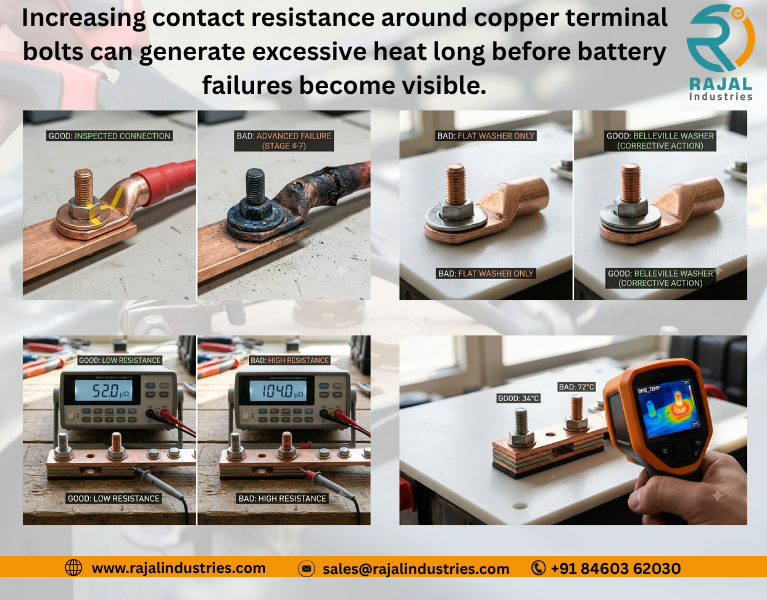
Yet thermal imaging revealed something concerning.
One battery terminal was operating at:
72°C
Nearby terminals were operating at:
34°C
No cell failure had occurred.
No short circuit existed.
No battery module was damaged.
The problem was concentrated around a single M8 copper terminal bolt.
Within weeks, the temperature increased further.
Eventually:
- Terminal discoloration appeared
- Insulation degradation started
- Voltage drop increased
- Power loss became noticeable
The battery did not fail first.
The terminal connection failed first.
This is one of the most common hidden problems found in:
- Lithium Battery Packs
- EV Battery Systems
- Battery Modules
- Battery Cabinets
- Battery Racks
- Telecom Battery Systems
- UPS Systems
- BESS Containers
Quick Answer
Why do copper terminal bolts overheat?
Copper terminal bolts usually overheat because of increased contact resistance caused by preload loss, insufficient torque, oxidation, vibration, thermal cycling, poor surface contact, corrosion, or improper fastener selection.
What Is a Copper Terminal Bolt?
A copper terminal bolt is a fastener used to connect electrical conductors, busbars, battery terminals, and current-carrying components.
Common hardware used in battery terminals includes:
Battery Bolts
- M4 Battery Bolts
- M5 Battery Bolts
- M6 Battery Bolts
- M8 Copper Bolts
- M10 Copper Bolts
Terminal Hardware
- Copper Terminal Bolts
- Copper Busbar Bolts
- Tin-Plated Copper Bolts
- Brass Terminal Bolts
Locking Hardware
- Flange Nuts
- Lock Nuts
- Nylock Nuts
- Prevailing Torque Nuts
Washers
- Belleville Washers
- Spring Washers
- Flat Washers
- Serrated Washers
The M8 copper terminal bolt is among the most common fasteners used in lithium battery pack manufacturing.
Why Battery Terminal Temperature Matters
Battery engineers often focus on:
- Cell Temperature
- Cooling System Performance
- Thermal Runaway Prevention
However, terminal temperature is equally important.
A terminal operating at:
70°C
may indicate a developing connection problem long before the battery itself shows symptoms.
Terminal heating is often an early warning sign.
How a Copper Terminal Connection Generates Heat
Electric current passes through:
- Battery Terminal
- Copper Lug
- Busbar
- Bolt Assembly
If resistance increases:
Heat increases.
The relationship is:
P = I²R
Where:
- P = Heat Generated
- I = Current
- R = Resistance
Even a tiny increase in resistance can create significant heating.
Example: Why a Small Resistance Increase Becomes a Big Problem
Assume:
Current:
400 Amps
Normal Connection Resistance:
50 Micro-ohms
Power Loss:
P = 400² × 0.00005
= 8 Watts
Now assume preload decreases and resistance doubles:
100 Micro-ohms
Power Loss:
P = 400² × 0.0001
= 16 Watts
Heat generation doubles.
Nothing else changed.
The battery is still healthy.
The connection is not.
The 5 Most Common Reasons Copper Terminal Bolts Overheat
1. Preload Loss
This is the number one cause.
Many engineers believe:
Torque = Reliable Connection
However:
Torque only creates preload.
Over time:
- Copper relaxes
- Surfaces settle
- Thermal cycling occurs
Preload decreases.
Contact resistance increases.
Temperature rises.
2. Copper Creep
Copper is softer than steel.
After tightening:
Copper gradually deforms.
This process is known as:
Copper Creep
As creep increases:
- Joint thickness changes
- Clamp force reduces
- Electrical resistance rises
This is extremely common in battery terminals and busbar connections.
3. Thermal Expansion
Battery systems continuously heat and cool.
Every cycle creates:
- Expansion
- Contraction
- Expansion
- Contraction
Thousands of cycles gradually reduce clamp force.
The terminal becomes electrically weaker despite appearing mechanically secure.
4. Oxidation and Surface Contamination
Even highly conductive copper develops surface oxidation.
Other contamination sources include:
- Dust
- Humidity
- Process residues
- Fingerprints
- Cleaning chemicals
These contaminants reduce effective contact area.
Less contact area means:
Higher resistance.
Higher resistance means:
Higher temperature.
5. Improper Fastener Selection
Many manufacturers use:
- Standard Steel Bolts
- Incorrect Washers
- Inadequate Locking Systems
without considering long-term electrical performance.
Battery connections often require:
- Copper Bolts
- Tin-Plated Copper Bolts
- Belleville Washers
- High-Retention Locking Systems
for stable performance.
Why M8 Copper Bolts Are Popular
M8 copper terminal bolts are widely used because they offer:
✔ High conductivity
✔ Excellent current carrying capability
✔ Low electrical resistance
✔ Good compatibility with copper busbars
Applications include:
- EV Battery Packs
- BESS Containers
- Telecom Batteries
- UPS Systems
- Battery Modules
M8 Copper Bolt vs Stainless Steel Bolt
| Parameter | M8 Copper Bolt | M8 SS304 Bolt |
| Electrical Conductivity | Excellent | Poor |
| Contact Resistance | Very Low | Higher |
| Current Carrying Ability | Excellent | Limited |
| Battery Terminal Use | Preferred | Limited |
| Cost | Higher | Lower |
For current-carrying joints, copper hardware is generally preferred.
Real BESS Failure Example
A utility-scale BESS operator identified abnormal heating inside a battery container.
Thermal Camera Results:
Normal Terminals:
31°C–38°C
Problem Terminal:
74°C
Inspection found:
- M8 Copper Terminal Bolt
- Copper Busbar
- Flat Washer Only
Root Cause:
Clamp force relaxation
Corrective Action:
- Replaced hardware
- Added Belleville washers
- Updated torque procedure
After repair:
Terminal temperature dropped below:
35°C
Why Belleville Washers Are Becoming Standard
Battery OEMs increasingly use:
Belleville Washers
because they help compensate for:
- Thermal expansion
- Copper creep
- Surface settlement
Belleville Washer vs Spring Washer
| Parameter | Spring Washer | Belleville Washer |
| Preload Retention | Medium | Excellent |
| Thermal Cycling Resistance | Medium | High |
| Battery Applications | Common | Preferred |
| BESS Systems | Good | Excellent |
| Long-Term Stability | Medium | High |
Many EV and BESS manufacturers now specify Belleville washers for critical terminal joints.
Battery Fasteners Commonly Used in Production
Large battery manufacturers frequently purchase:
Battery Bolts
- M4 Battery Bolts
- M5 Battery Bolts
- M6 Battery Bolts
- M8 Copper Terminal Bolts
- M10 Copper Bolts
Terminal Hardware
- Copper Busbar Bolts
- Tin-Plated Copper Bolts
- Brass Terminal Bolts
Locking Hardware
- Lock Nuts
- Flange Nuts
- Prevailing Torque Nuts
Washers
- Belleville Washers
- Spring Washers
- Flat Washers
- Nord-Lock Washers
These are among the most searched battery fasteners across the EV and energy storage industry.
Why Terminal Heating Happens Before Battery Failure
Most battery failures follow this sequence:
Stage 1
Preload Loss
↓
Stage 2
Increased Resistance
↓
Stage 3
Terminal Heating
↓
Stage 4
Insulation Damage
↓
Stage 5
Voltage Drop
↓
Stage 6
Battery Performance Loss
↓
Stage 7
System Failure
The overheating terminal is often the first visible warning sign.
Industries Most Affected
This issue commonly affects:
- Lithium Battery Pack Manufacturers
- EV Battery Manufacturers
- Battery Module Manufacturers
- Battery Cabinet Manufacturers
- Battery Rack Manufacturers
- BESS Integrators
- Telecom Battery Manufacturers
- UPS Manufacturers
- Energy Storage Equipment OEMs
Inspection Checklist
Before battery pack approval:
✔ Verify terminal torque
✔ Verify preload requirements
✔ Inspect busbar contact surfaces
✔ Review washer selection
✔ Check thermal imaging data
✔ Evaluate copper creep risk
✔ Verify locking system design
✔ Review current carrying requirements
Key Takeaways
- Terminal heating usually starts before battery failure.
- Preload loss is the leading cause of overheating.
- Copper creep gradually reduces clamp force.
- Thermal cycling accelerates resistance growth.
- Belleville washers help maintain preload.
- M8 copper terminal bolts remain one of the most widely used battery fasteners.
- Thermal imaging is one of the best tools for identifying developing failures.
FAQ
Why do battery terminal bolts overheat?
Most overheating is caused by increased contact resistance resulting from preload loss, copper creep, oxidation, or thermal cycling.
What temperature is considered high for a battery terminal?
A terminal operating significantly hotter than neighboring connections often indicates a developing problem that requires investigation.
Why are M8 copper bolts used in battery systems?
M8 copper bolts provide excellent conductivity and low electrical resistance for high-current applications.
What causes contact resistance to increase?
Loose connections, surface contamination, oxidation, vibration, and insufficient clamp force are common causes.
Are Belleville washers better than spring washers?
For battery terminals, Belleville washers often provide superior preload retention and thermal cycling performance.
Can terminal heating occur even when the battery cells are healthy?
Yes. Terminal overheating often develops before any battery cell issues become visible.
Which industries face this problem most often?
EV battery manufacturers, lithium battery pack manufacturers, battery cabinet manufacturers, BESS integrators, and telecom battery OEMs.
How can OEMs reduce battery terminal heating?
By maintaining preload, selecting proper terminal hardware, using Belleville washers, controlling torque, and performing thermal inspections.
Conclusion
A battery terminal operating at 70°C is rarely the real problem.
It is a warning signal.
By the time a copper terminal bolt reaches elevated temperatures, preload loss and resistance growth have often been developing for months.
For lithium battery pack manufacturers, EV battery OEMs, battery cabinet manufacturers, and BESS integrators, battery terminal fasteners deserve the same engineering attention as the cells themselves.
Because in many cases, the first failure is not inside the battery.
It’s at the connection holding the battery together.