

Introduction – Real Site Hook
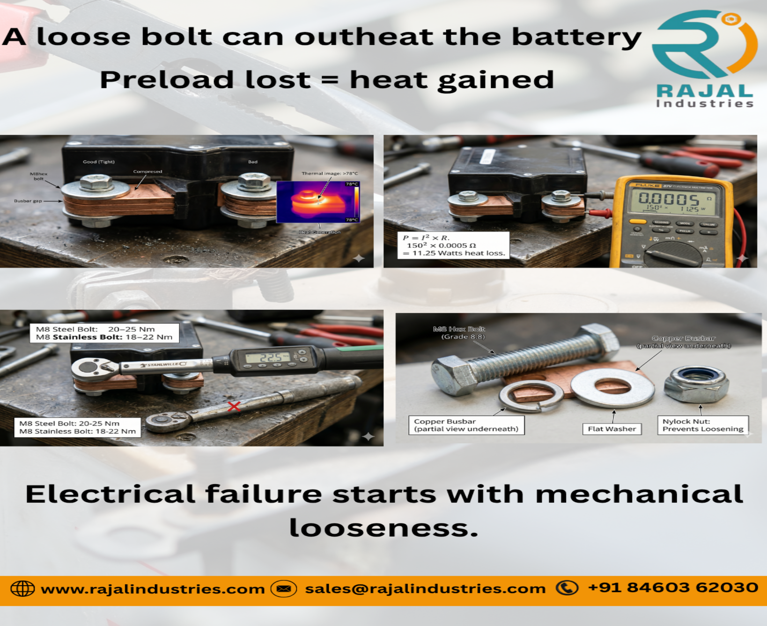
During inspection of an EV battery assembly line, one battery pack showed terminal temperature rising above 78°C under load. Thermal scan revealed heating not in the cable—but at the bolt connection.
The issue was simple:
👉 Loose M8 terminal bolt
👉 Reduced contact pressure
👉 Increased electrical resistance
This is one of the most common and overlooked failures in EV battery systems.
In production EV battery packs, even a small torque loss can lead to heat buildup, voltage drop, and long-term failure.
In OEM manufacturing, these connections are used in 50,000–200,000 pcs production batches, where consistency is critical.
Quick Answer
What causes overheating in EV battery terminal bolts?
Overheating occurs when M8 terminal bolts lose torque, reducing contact pressure between conductive surfaces. This increases electrical resistance, generating heat under current flow.
What is EV Battery Bolt Loosening?
EV battery bolt loosening is the reduction of preload in terminal fasteners due to vibration, thermal expansion, or incorrect torque. This leads to poor electrical contact and increased resistance.
5 Reasons M8 Battery Terminal Bolts Become Loose
- Incorrect torque during assembly
- No locking mechanism (nylock or spring washer)
- Vibration from vehicle movement
- Thermal expansion of copper terminals
- Surface contamination reducing friction
How Loose Bolts Cause Overheating
Battery terminals rely on contact pressure, not just electrical connection.
When M8 bolt preload reduces:
- Contact area decreases
- Micro gaps form
- Resistance increases
Heat generated:
👉 Heat = I² × R
Where:
- I = current
- R = resistance
Even a small increase in resistance causes significant heating under high current loads.
Calculation Example
Assume:
- Current = 150 A
- Resistance increase = 0.0005 ohm
Heat generated:
👉 P = I² × R
👉 P = 150² × 0.0005
👉 P = 11.25 Watts
This heat concentrates at the terminal → causing localized overheating
Correct Torque for M8 Battery Terminal Bolts
| Bolt Type | Torque Range |
| M8 Steel Bolt | 20–25 Nm |
| M8 Stainless Bolt | 18–22 Nm |
⚠️ Important Note
- Over-tightening damages threads
- Under-tightening causes resistance
- Always use calibrated torque tools
Correct Fastener Selection for EV Battery Terminals
Recommended configuration:
- M8 hex bolt (grade 8.8 or SS304 depending on design)
- Spring washer (to maintain preload)
- Nylock nut (to prevent loosening)
- Clean contact surfaces
When to Use Each
✔ Use SS304 bolts → corrosion resistance
✔ Use grade 8.8 → higher mechanical strength
✔ Use nylock → vibration environments
Typical OEM Production Scenario
In EV battery manufacturing:
- Each battery pack uses multiple M8 connections
- Typical requirement: 50,000–200,000 pcs per batch
- Torque variation across batch leads to inconsistent performance
This is why OEMs focus on:
✔ Controlled torque
✔ Standardized fasteners
✔ Reliable suppliers
Common Mistake in Assembly Lines
Many failures occur because:
- Operators tighten “by feel”
- No torque verification
- Reuse of fasteners
👉 This leads to repeat failures in field conditions
Key Takeaways
• Loose M8 bolts increase resistance and heat
• Torque control is critical in EV battery systems
• Locking elements prevent vibration loosening
• Batch consistency is essential for OEM production
FAQ
Q1: What is the correct torque for M8 battery terminal bolts?
Typical torque is 20–25 Nm for steel bolts and slightly lower for stainless steel. Correct torque ensures proper contact pressure and prevents overheating.
Q2: Why do EV battery terminals overheat?
Overheating happens when loose bolts increase resistance at the contact surface. This leads to heat generation under high current flow.
Q3: Should spring washers be used in battery terminals?
Yes. Spring washers help maintain preload and reduce loosening due to vibration in EV systems.
Q4: Can loose bolts damage EV batteries?
Yes. Loose connections can cause heat buildup, voltage drop, and long-term battery damage.
Q5: What type of fastener is best for EV battery terminals?
M8 bolts with proper torque, locking elements, and clean contact surfaces are recommended for stable electrical performance.
Conclusion
Loose M8 terminal bolts are not just a mechanical issue—they directly impact electrical performance and safety in EV battery systems.
In high-volume EV production, even small torque variation can lead to large-scale failures.
👉 We work with OEMs and production-scale orders (MOQ 50,000+ pcs) for EV battery and electrical applications.
Working on EV battery systems or facing terminal overheating issues?
Share your drawing or production requirement (50,000+ pcs), and our engineering team can review the correct fastener solution for your application.
References
- ISO 898-1 (Mechanical properties of fasteners)
- IEC battery connection standards
- Electrical resistance heating formula (I²R)