

Introduction – Real Site Hook
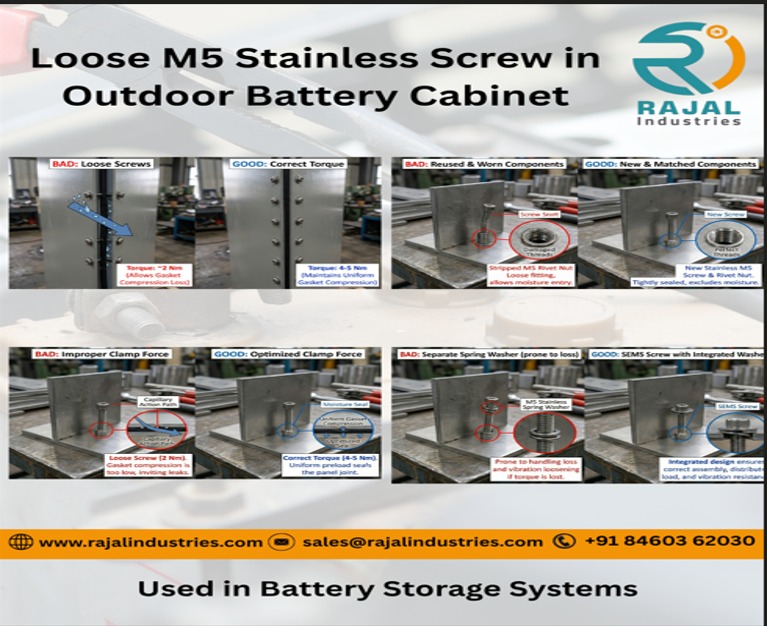
During inspection of an outdoor lithium battery cabinet, moisture droplets were found inside the control compartment. No visible crack in the enclosure. No damaged gasket.
The issue was small.
Three M5 stainless machine screws on the rear panel were loose.
Two rivet nuts had slight thread wear.
Torque measured only 2 Nm instead of the required 4–5 Nm.
This is how battery cabinet fasteners fail.
Moisture does not enter through broken doors.
It enters through loose panel joints.
And once moisture enters:
- • PCB corrosion begins
- • Relay contacts oxidize
- • Battery BMS error alarms increase
The failure starts small.
Why Loose Battery Cabinet Fasteners Cause Moisture Entry
Battery cabinets rely on:
- • Uniform gasket compression
- • Even screw preload
- • Panel flatness
- • Correct torque
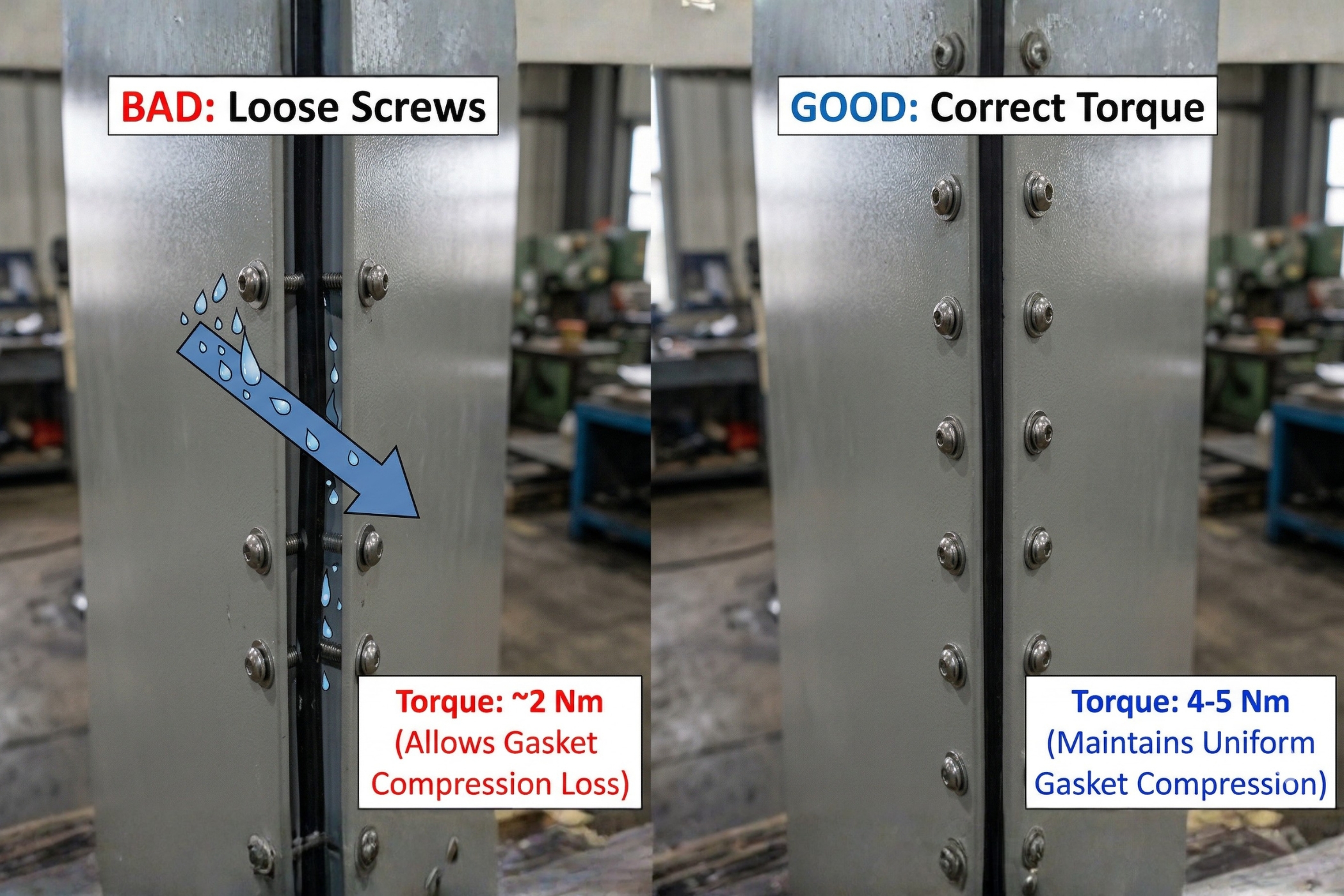
If M5 screws lose preload:
- • Gasket compression reduces
- • Micro gaps appear
- • Capillary action draws moisture inside
Even 0.3–0.5 mm gap is enough for condensation entry.
Over time:
- • Corrosion spreads
- • Internal humidity increases
- • Electrical resistance rises
Loose screws = failed enclosure integrity.
Case Study: Panel Joint Failure in Outdoor Lithium Cabinet
Site conditions:
- • Coastal region
- • High humidity
- • Daily temperature fluctuation
Findings:
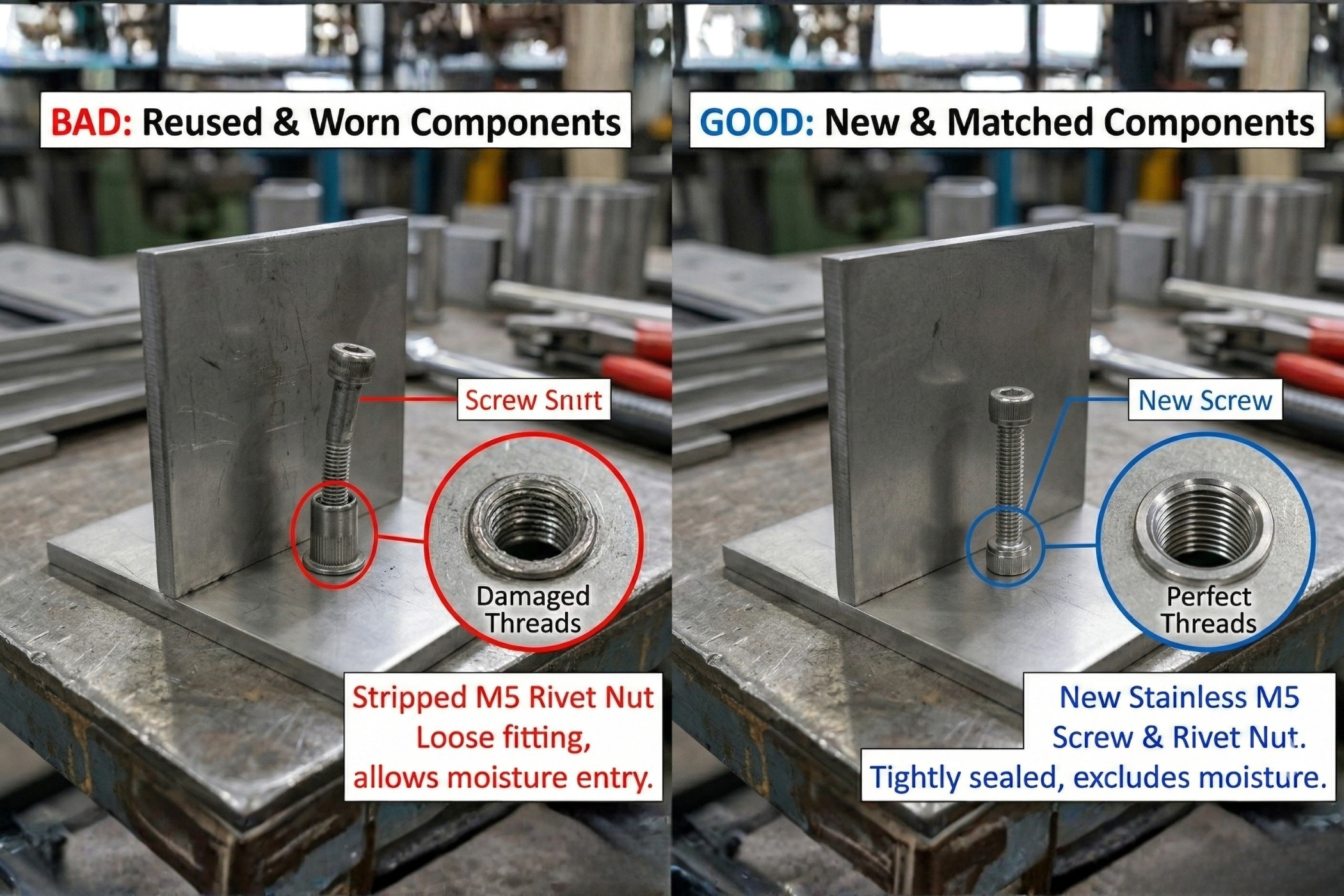
- • M5 stainless screws reused during maintenance
- • Rivet nut threads partially stripped
- • No spring washer used
- • Uneven torque
Result:
Moisture entered rear service panel.
Terminal oxidation observed within 3 months.
Problem was not cabinet design.
Problem was incorrect battery cabinet fasteners selection and torque control.
Correct Fastener Selection for Battery Cabinet Panels
For outdoor battery enclosures, recommended configuration:
- • M5 Stainless Steel 304 Machine Screw
- • Captive panel screw (to prevent loss during maintenance)
- • M5 stainless rivet nut
- • Integrated washer head or SEMS screw
- • Correct torque range
You can review full specifications of our
👉 M5 Stainless Machine Screws for Battery Cabinet Applications
For removable panels, use
👉Captive Panel Screws with Stainless Construction
For sheet metal cabinet walls, use
👉M5 Stainless Rivet Nut Inserts for Secure Thread Holding
These improve thread engagement and long-term panel sealing.
Clamp Force Calculation for M5 Stainless Machine Screw
Material: SS304
Ultimate tensile strength ≈ 700 MPa
Tensile stress area (M5 coarse) ≈ 14.2 mm²
Maximum tensile load:
700 × 14.2 = 9,940 N
≈ 9.9 kN
But in cabinet panels, we do not use full strength.
We aim for proper preload.
Recommended tightening torque:
M5 SS screw → 4–5 Nm
Preload ensures uniform gasket compression without thread stripping.
Torque Recommendation Table
| Fastener Type | Recommended Torque |
| M5 SS304 Machine Screw | 4–5 Nm |
| M5 SEMS Screw | 4–5 Nm |
| M5 with Rivet Nut | 3.5–4.5 Nm |
| M5 Zinc Screw | 4–6 Nm |
Important:
Over-torquing can strip rivet nuts.
Under-torquing allows moisture entry.
Torque must match:
- • Thread type
- • Material
- • Panel thickness
Why Rivet Nut M5 Failure Happens
Common issues :
- • Thin sheet metal
- • Poor installation tool alignment
- • Cross-threading
- • Reused fasteners
If rivet nut spins:
Panel sealing is lost.
Solution:
- • Use stainless rivet nuts
- • Maintain correct hole size
- • Replace damaged inserts immediately
SEMS Screws vs Standard Machine Screws
SEMS screw advantages:
- • Integrated washer
- • Better load distribution
- • Reduced vibration loosening
- • Faster assembly
In vibration-prone battery systems, SEMS screws improve panel reliability.
Comparison: Stainless vs Zinc Screws for Cabinets
| Parameter | Zinc Plated | SS304 |
| Corrosion Resistance | Moderate | High |
| Outdoor Suitability | Limited | Excellent |
| Reuse Durability | Low | Medium |
| Battery Cabinet Use | Indoor only | Recommended |
For telecom and outdoor battery cabinets, stainless fasteners are safer.
Inspection Checklist for Battery Cabinet Fasteners
✔ Check torque annually
✔ Inspect gasket compression
✔ Replace worn rivet nuts
✔ Avoid screw reuse
✔ Inspect corrosion on threads
✔ Check panel alignment
Preventive inspection avoids internal PCB damage
FAQ
Q1: How do loose battery cabinet fasteners affect internal electronics?
Loose screws reduce gasket compression. Moisture enters and increases humidity. High humidity leads to PCB corrosion, short circuits, and BMS faults.
Q2: Which screw is best for battery cabinet panels?
M5 stainless steel 304 machine screws with captive or SEMS design provide corrosion resistance and consistent preload for enclosure sealing.
Q3: Can zinc screws be used in outdoor battery cabinets?
Zinc screws may corrode in humid environments. For outdoor battery cabinet fasteners, stainless steel screws are recommended.
Q4: What torque is safe for M5 SS304 cabinet screws?
Recommended range is 4–5 Nm. Over-tightening may strip rivet nuts. Under-tightening reduces gasket compression.
Q5: Why do rivet nuts fail in battery cabinets?
Failure occurs due to thin sheet metal, incorrect hole size, cross-threading, or repeated reuse of screws.
Q6: Are captive panel screws necessary?
Yes. Captive screws prevent loss during maintenance and reduce the risk of incorrect fastener replacement.
Conclusion
Battery cabinet failure often begins at the smallest point — loose screws.
Battery cabinet fasteners must maintain preload, resist corrosion, and support gasket sealing.
Using:
- • M5 stainless machine screws
- • Stainless rivet nuts
- • Captive or SEMS screw systems
- • Correct torque control
Prevents moisture entry and long-term electronic damage.
Need a fastener audit for your battery cabinets?
Contact our engineering team for enclosure-specific recommendations.
References
ISO 3506 – Stainless steel mechanical properties
IEC 60529 – IP rating enclosure sealing
ASTM A240 – Stainless steel material standard
EN 1993 – Structural steel design considerations