

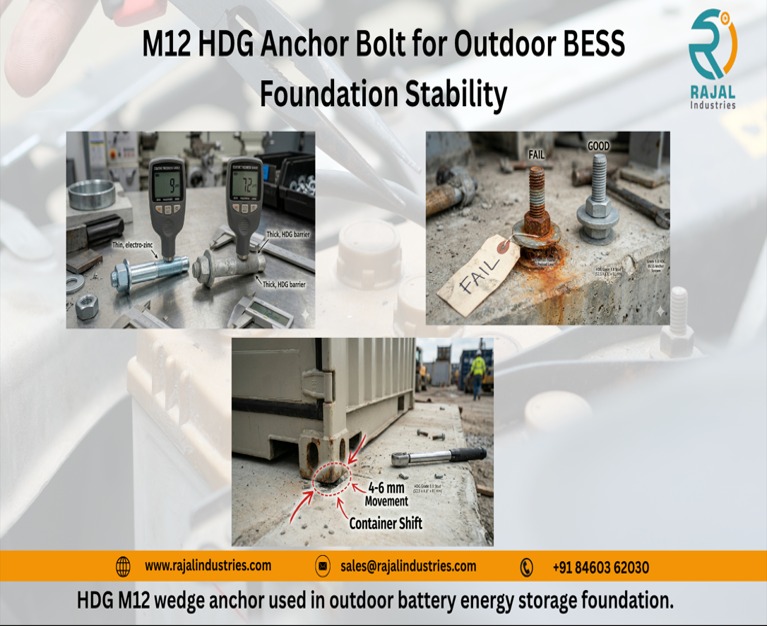
Why Do M12 Zinc Anchor Bolts Fail in BESS Yards? (HDG vs. Zinc Analysis)
Introduction – Real Site Hook
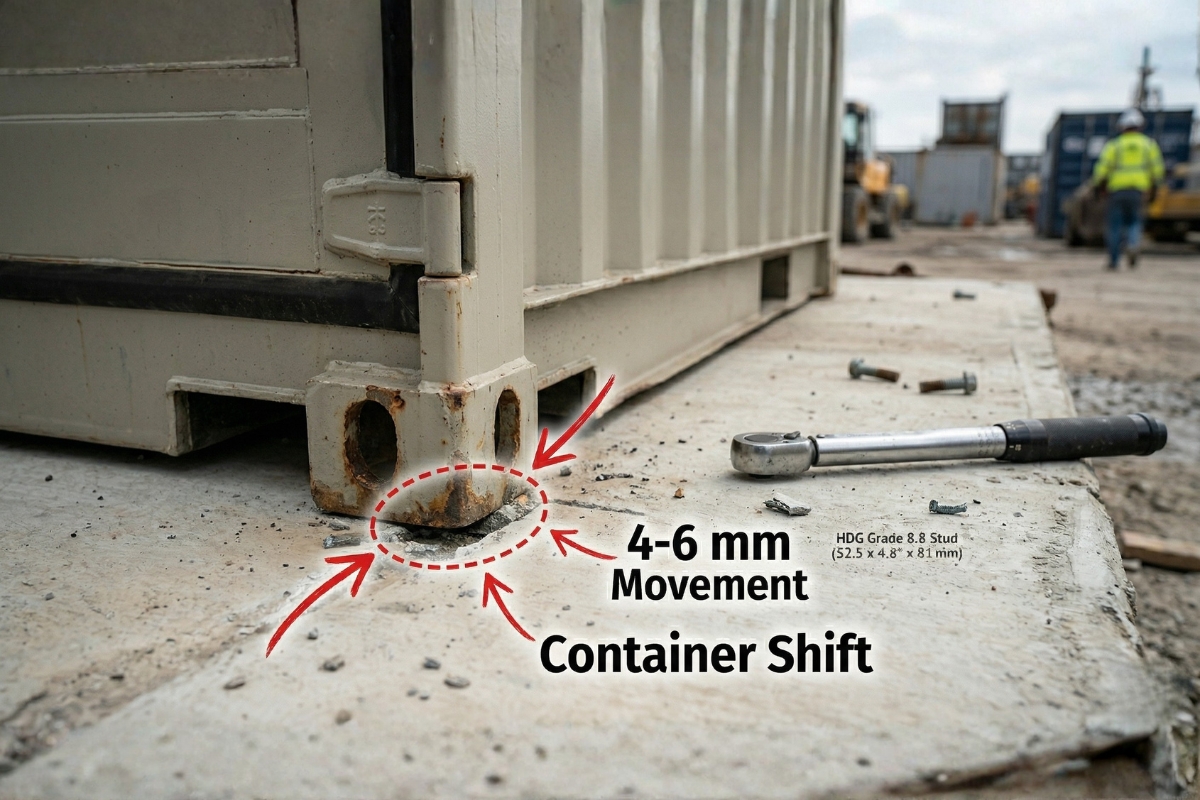
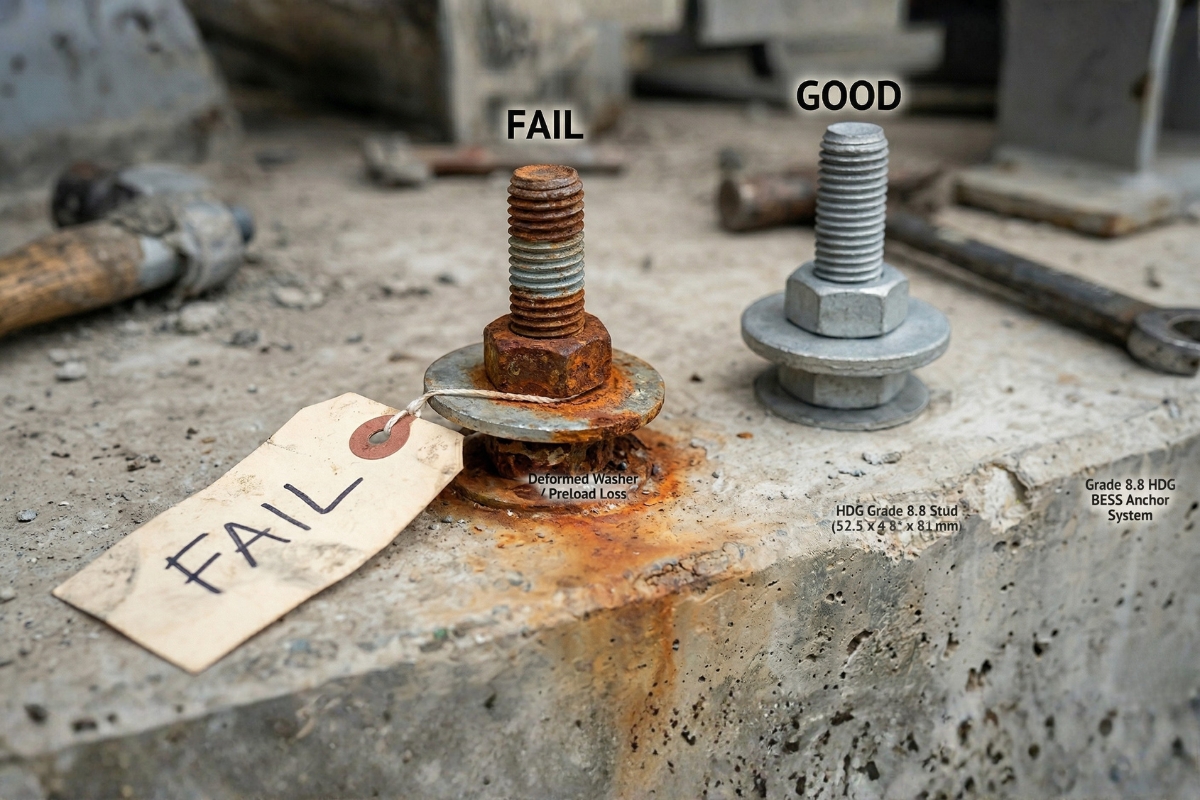
In a recent inspection of a 20 MW outdoor Battery Energy Storage System site, 35% of installed M12 anchor bolts showed corrosion under the structural washer. Rust had expanded at the washer interface. Torque values had dropped below 45 Nm in multiple positions. Two container corners shifted 4–6 mm under wind pressure.
This is how BESS anchor bolt corrosion begins.
It starts under the washer.
It reduces preload.
It weakens foundation stability.
Outdoor BESS systems operate for 15–20 years. Anchor bolts must survive rain, soil moisture, wind vibration, and temperature cycles.
If the wrong coating is used, failure begins early.
How BESS Anchor Bolt Corrosion Reduces Foundation Stability
M12 anchor bolts transfer:
Dead load
Wind load
Seismic force
Vibration
When corrosion reduces bolt diameter:
Tensile strength decreases
Clamp force drops
Structural washer loses preload
Container micro-movement begins
Even small corrosion under the washer affects BESS foundation stability and long-term alignment.
Why Zinc Plated M12 Anchor Bolts Fail Outdoors
Electro zinc coating thickness: 8–12 microns.
Purpose:
Indoor corrosion protection
Shelf-life storage
Low-cost applications
Zinc plating is not designed for long-term outdoor exposure.
HDG coating thickness: 50–85 microns.
HDG creates a metallurgical bond with steel.
This forms a sacrificial protection layer.
Difference:
Zinc plating = surface coating
HDG = bonded corrosion barrier
For outdoor BESS yards, M12 HDG anchor bolts are mandatory.
You can review detailed specifications for our
M12 HDG Grade 8.8 Wedge Anchor for Outdoor BESS Foundations
Case Study: 4–6 mm Container Movement and Wind Risk
At the inspected site:
Rust formed below washer
Lock nut preload reduced
Embedment remained intact
Clamp force dropped
Under high wind:
Container shifted 4–6 mm repeatedly.
Repeated movement leads to:
Base plate hole enlargement
Increased vibration
Cable strain
Structural fatigue
This is how minor corrosion becomes major structural risk.
Tensile Load Calculation for Grade 8.8 M12 Anchor Bolt
Mechanical properties (ISO 898-1):
Ultimate tensile strength = 800 MPa
Yield strength = 640 MPa
Tensile stress area ≈ 84.3 mm²
Calculation:
640 × 84.3 = 53,952 N
≈ 53.9 kN
If corrosion reduces diameter by 10%:
Load capacity may drop below 45 kN.
In high wind zones, that reduction can compromise wind load resistance.
Recommended Torque Chart
| Bolt Type | Torque Range |
| M12 Zinc | 70–85 Nm |
| M12 HDG | 65–75 Nm |
Important:
HDG threads are thicker.
Always use lubricant-corrected torque value to avoid false preload readings.
Incorrect torque = incorrect clamp force.
HDG vs Zinc Comparison
| Parameter | Coating Thickness | Outdoor Durability | Wind Load Stability | BESS Suitable |
| Zinc | 8–12 micron | Low | Decreases | No |
| HDG | 50–85 micron | High | Maintained | Yes |
Importance of Structural Washer M12
Structural washers distribute load and maintain clamp force.
Flat washers are thinner and can embed into base plate.
For BESS outdoor applications, pair anchor bolts with:
Heavy-Duty M12 Structural Washer for Outdoor Battery Installations
This prevents torque loss and improves preload stability.
Complete Outdoor BESS Anchor System Recommendation
Recommended configuration:
- • M12 HDG Grade 8.8 wedge anchor
- • Embedment depth 90–110 mm
- • Structural washer M12
- • Heavy lock nut
- • Proper torque control
For large installations, request a
BESS Foundation Fastener Kit including HDG Anchor Bolts and Structural Washers
Inspection Checklist for Outdoor BESS Yards
✔ Inspect rust below washer
✔ Re-check torque every 6 months
✔ Remove standing water
✔ Check embedment depth
✔ Inspect coating damage
✔ Replace zinc bolts with HDG
Inspection should be done before monsoon season.
FAQ
Q1: How does BESS anchor bolt corrosion affect wind load resistance?
Corrosion reduces bolt cross-section and preload. Reduced preload lowers wind load resistance and foundation stability. M12 HDG anchor bolts maintain structural reliability in outdoor battery yards.
Q2: What is the best anchor bolt for outdoor BESS foundations?
The recommended solution is an M12 HDG Grade 8.8 wedge anchor with structural washer and lock nut. This provides corrosion protection and tensile strength required for outdoor installations.
Q3: What embedment depth is safe for M12 wedge anchors in BESS systems?
Typically 90–110 mm in C25 concrete. Final value depends on wind load and container weight.
Q4: Should HDG anchor bolts be lubricated?
Yes. HDG coating increases friction. Lubrication ensures correct torque and clamp force.
Q5: Can zinc plated anchor bolts be used temporarily in BESS yards?
They may survive short term, but for 15–20 year battery projects, HDG anchor bolts are strongly recommended.
Conclusion
BESS anchor bolt corrosion weakens foundation stability and reduces wind load resistance.
Using M12 HDG Grade 8.8 wedge anchors with structural washers and correct torque ensures long-term outdoor performance.
Need a fastener audit for your BESS yard?
Contact our engineering team for a site-specific recommendation.
References
ISO 898-1 – Mechanical properties of carbon steel fasteners
ASTM A153 – Hot Dip Galvanizing standard
ACI 318 – Concrete anchor design guidelines
EN 1991 – Wind load design principles